Artwork
The Domino Girl
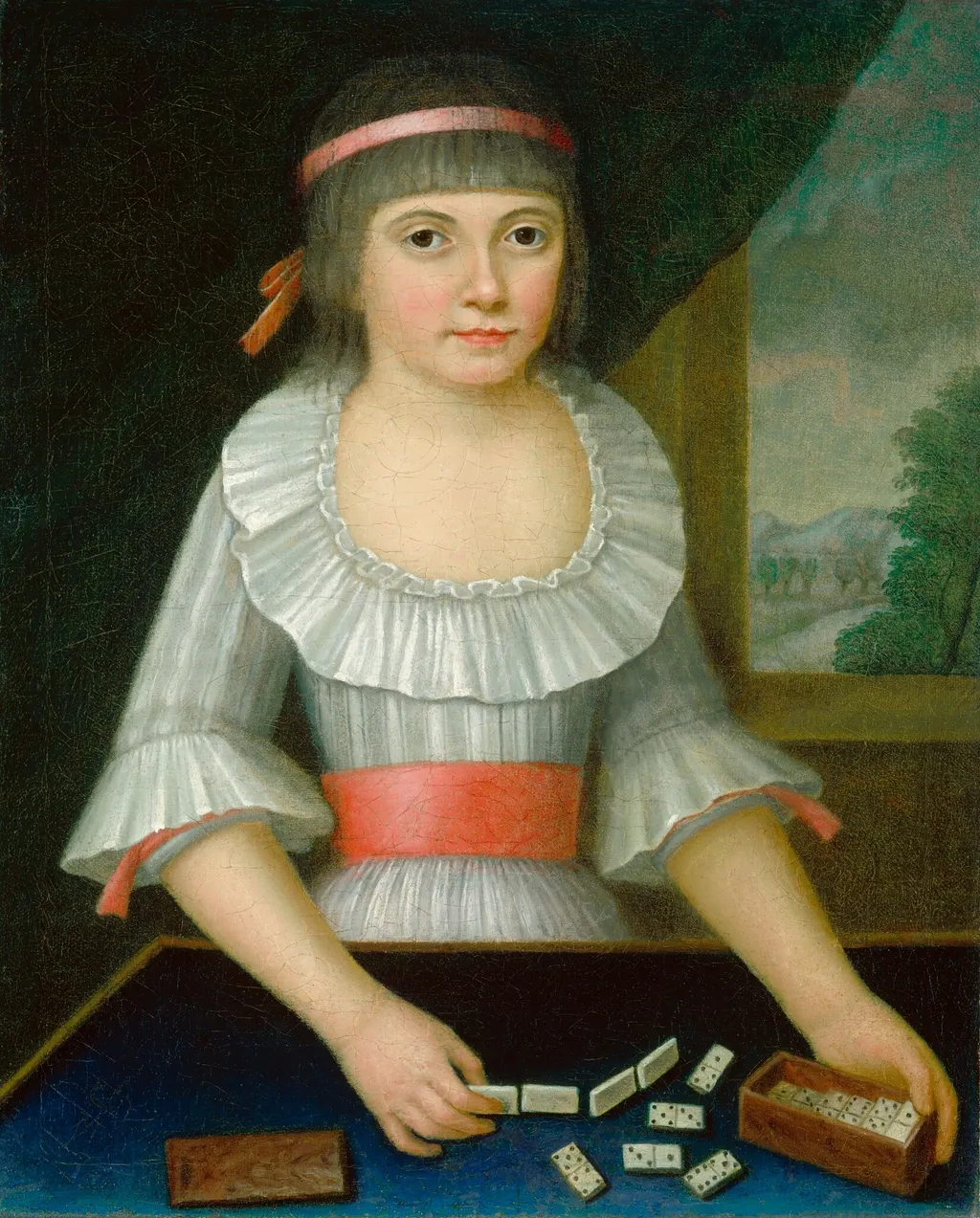
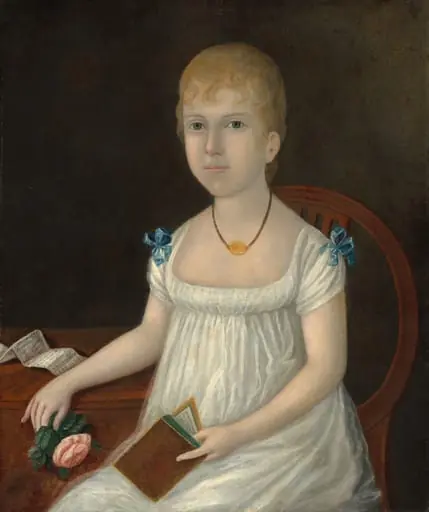
The Domino Girl is an oil painting. It dates from 1790 and is held in the collection of the National Gallery of Art.
About this work
Subject & Meaning
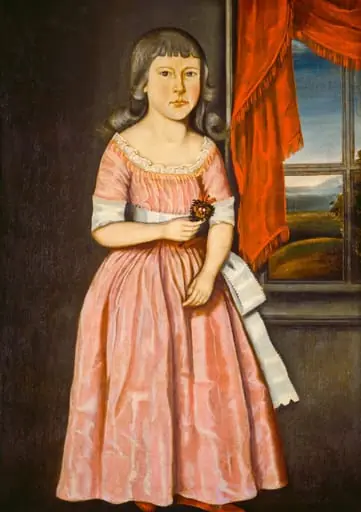
The painting captures the sitter in a half-length format, focusing on the visual impact of the costume rather than a detailed psychological study.
The work depicts a young woman identified by her attire as a participant in the domino mask tradition, a costume element often associated with festive masquerade or carnival celebrations. As an 18th-century American portrait, the subject is presented in a manner that emphasizes the social performative aspects of the era, where such disguises allowed for temporary shifts in identity and status. The painting captures the sitter in a half-length format, focusing on the visual impact of the costume rather than a detailed psychological study.
The title 'The Domino Girl' directly references this specific iconography, suggesting the figure represents the cultural practice of wearing domino masks during social gatherings in the late 1700s.
Technique & Style
The Domino Girl is an oil painting on canvas created in 1790 by an American 18th‑century artist. The work measures roughly 58.1 cm in height by 46.8 cm in width, placing it within the modest scale typical of contemporary portraiture. Executed in oil, the surface exhibits the smooth finish and subtle tonal modeling characteristic of the period’s portrait tradition.
The canvas functions as the support, and the painting’s handling is evident in the delicate brushwork that defines the sitter’s features and attire. As a portrait, the composition emphasizes individual likeness through restrained detail and a muted palette, reflecting the formal conventions of early American portraiture.
History & Provenance
Created in 1790, The Domino Girl is an oil-on-canvas portrait attributed to an American artist of the 18th century. The work's early history is marked by conflicting regional records; while Garbisch family archives note a New Jersey origin, a 1942 illustration caption in Antiques magazine suggests it was discovered in Pennsylvania. By 1942, the painting was in the collection of Mr. and Mrs. Carl Drepperd, who sold it to Edgar William and Bernice Chrysler Garbisch in 1954.
The Garbishes retained the work until their death, at which point it was bequeathed to the National Gallery of Art in Washington, D.C., in 1980.
The painting The Domino Girl is part of the National Gallery of Art’s collection in Washington, D.C., having entered the museum by bequest in 1980. Its accession number is recorded as a bequest from Edgar William and Bernice Chrysler Garbisch, who acquired the work in 1954 from the Harry Stone Gallery in New York. The work’s dimensions are 58.1 cm by 46.8 cm. Provenance traces back to a New Jersey record, later documented in Pennsylvania, before its sale to the Garbisches. Exhibition records are not detailed in the available sources.
Context
The Domino Girl, an oil‑on‑canvas portrait dated 1790, exemplifies early American portraiture through its modest scale (58.1 × 46.8 cm) and restrained composition. The work entered the National Gallery of Art via the bequest of Edgar William and Bernice Chrysler Garbisch, who acquired it in 1954 from the Harry Stone Gallery in New York; earlier it had been found in Pennsylvania, a fact noted in a 1942 Antiques illustration. As a representative piece of 18th‑century American genre painting, it offers scholars insight into contemporary notions of domestic leisure and gender roles, and its provenance illustrates the transatlantic circulation of artworks before the establishment of major public collections.
Legacy
The Domino Girl, painted in 1790 by an American 18th‑century artist, entered the National Gallery of Art in Washington, D.C., through the bequest of Edgar William and Bernice Chrysler Garbisch, who acquired it in 1954 from the Harry Stone Gallery. Its provenance traces earlier ownership to New Jersey and a 1942 discovery in Pennsylvania, as documented in Garbisch records and a 1942 Antiques article. The canvas, measuring 58.1 × 46.8 cm, is catalogued as a portrait and remains a representative example of early American portraiture within the museum’s collection, frequently referenced in scholarship on the period.
Overview
The Domino Girl is an oil on canvas painting depicting a young girl deeply engrossed in a game of dominoes. The composition establishes a serene and contemplative atmosphere, drawing the viewer into a moment of childhood absorption. The work's visual elements coalesce to present an intimate scene, emphasizing the figure against a subtly rendered background.
Artist & collection