Artwork
Little Girl with Slate
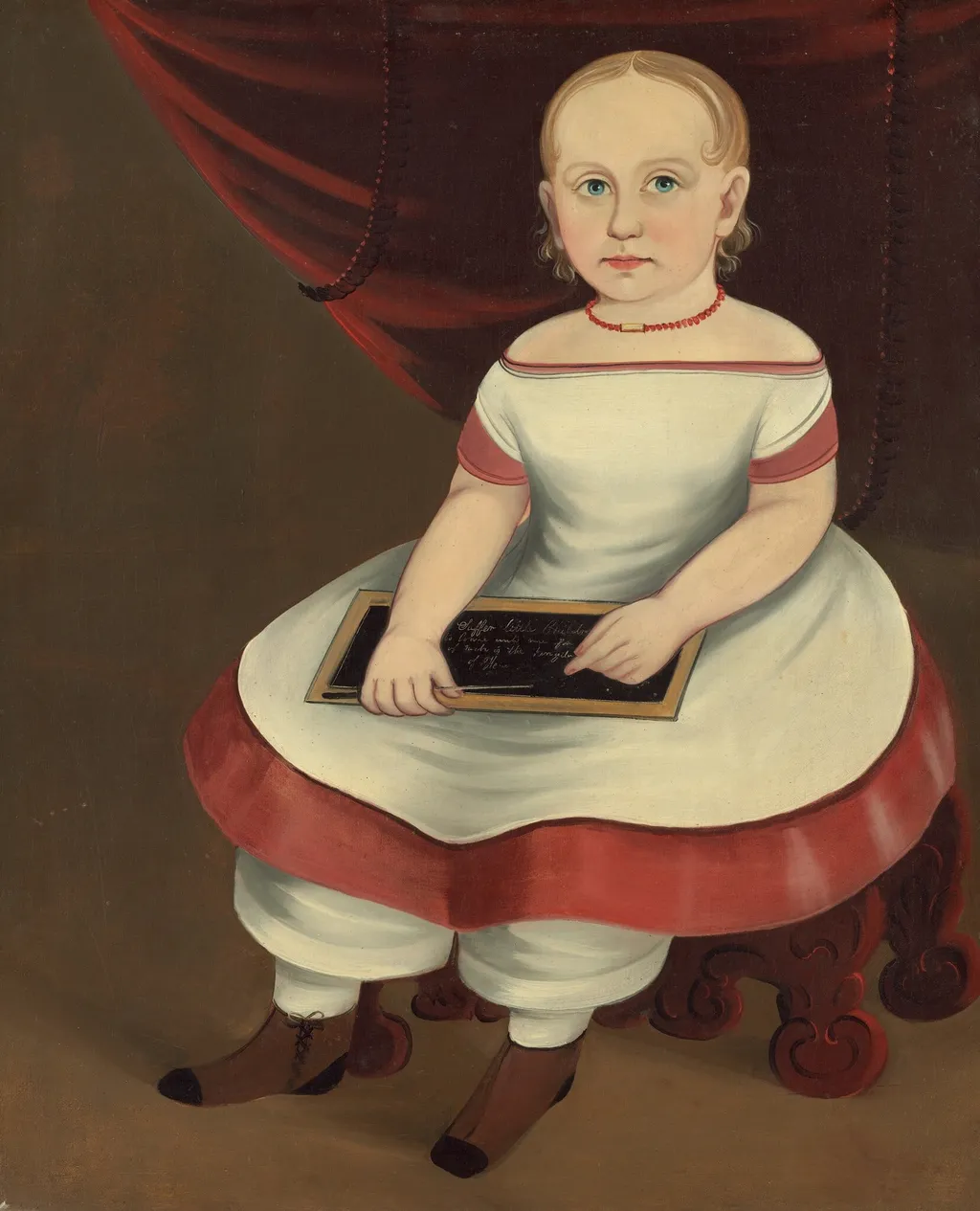
Little Girl with Slate is an oil painting by the Romanticist artist Prior-Hamblin School. It dates from 1845 and is held in the collection of the National Gallery of Art.
- Inscription
- Inscribed:on slate: Suffer Little Children to Come unto me for of such is the kingdom of Heav[en]
About this work
Overview
Little Girl with Slate is an oil on canvas painting by the Prior-Hamblin School, an American artistic collective active in the mid-nineteenth century.
Little Girl with Slate is an oil on canvas painting by the Prior-Hamblin School, an American artistic collective active in the mid-nineteenth century. Dated circa 1845, the work measures 68.8 by 56 centimeters (27 1/16 by 22 1/16 inches) and is held in the collection of the National Gallery of Art in Washington, D.C., under accession number 1953.5.66. The painting is a significant example of American naive portraiture, representing the collaborative and stylistically distinctive output of a family-based workshop that produced portraits in New England during the antebellum period. Its acquisition by the National Gallery of Art in 1953 marked an important moment in the institutional recognition of American folk art.
Subject & Meaning
The painting depicts an unidentified young child seated frontally on a carved wooden stool with scrolled legs, holding a rectangular slate across the lap. The figure wears a white off-shoulder dress with pink trim at the neckline and sleeves, a pinkish-red skirt, white pantaloons, brown lace-up boots with dark toes, and a red beaded necklace. The child's blonde hair is parted and pulled back, and the hands rest on the slate with fingers slightly curled. The slate bears a visible inscription: "Suffer Little Children to Come unto me for of such is the kingdom of Heav[en]," a quotation from the Gospel of Matthew that frames the child within a context of religious innocence and spiritual privilege. Behind the figure, a dark red draped curtain with braided trim hangs against a muted brown background, creating a simple stage-like setting. The iconography of the slate itself, a common educational tool of the period, combined with the biblical inscription, suggests themes of childhood instruction, piety, and the moral expectations placed upon children in nineteenth-century American culture. The portrait thus functions simultaneously as a likeness, a statement of familial values, and a devotional object.
Technique & Style
The work is executed in oil on canvas with a technique characteristic of the Prior-Hamblin School's naive style. The surface shows smooth brushwork with flat, even color application and minimal modeling, creating a two-dimensional quality that eschews academic perspective and volumetric rendering. Light falls evenly on the figure with soft shadows beneath the skirt and stool, suggesting a basic understanding of light source without full commitment to naturalistic shading. The palette is dominated by warm browns, deep reds, and crisp whites, with the pink and red accents of the costume providing chromatic focus against the darker background. The background remains plain and unadorned except for the draped curtain, a compositional convention that isolates the subject and emphasizes the frontal, direct presentation. This handling aligns with the broader tendencies of American limner painting, where self-taught or minimally trained artists produced portraits that prioritized clarity of design and symbolic legibility over illusionistic depth. The framed dimensions of 77.4 by 64.7 by 5.3 centimeters indicate a modest scale appropriate for domestic display.
History & Provenance
The painting's recorded provenance begins in Boston, reflecting the Prior-Hamblin School's base of operations in New England. In 1953, Edgar William and Bernice Chrysler Garbisch purchased the work; the same year, they donated it to the National Gallery of Art, where it entered the collection as a gift. The accession number 1953.5.66 records this transaction. The painting has since appeared in several notable exhibitions. In 1968-1969, it was included in "American Primitive Paintings from the Collection of Edgar William and Bernice Chrysler Garbisch" at the Columbus Museum of Arts and Crafts in Georgia. It served as an extended loan to the Council on Economic Policy in the Office of the Secretary of the Treasury at the White House from 1973 to 1974. The work toured with the Arkansas Artmobile Bicentennial Exhibition, organized by the Arkansas Arts Center, in 1975-1976. From 1985 to 1987, it traveled in "American Naive Paintings from the National Gallery of Art," organized by the International Exhibitions Foundation, with its first venue at the Museum of American Folk Art in New York. In 1988-1989, it appeared in "La Nascita di Una Nazione: Pittori americani dalla National Gallery of Art di Washington 1730-1880," shown at Palazzo Pepoli Campogrande in Bologna and the Galleria Internazionale d'Arte Moderna di Ca'Pesaro in Venice. Most recently, it was featured in "Le Douanier Rousseau: L'innocence archaïque" at Palazzo Ducale in Venice and the Musée d'Orsay in Paris in 2015-2017, though not in Prague.
Context
The Prior-Hamblin School was a family-based collective of portrait painters active in the mid-nineteenth century, centered on the work of William Matthew Prior and his in-laws, the Hamblin family. The school's output represents a significant chapter in American naive painting, bridging the traditions of itinerant limner portraiture and the emerging commercial market for middle-class family likenesses. The group has been the subject of scholarly attention since at least 1948, when Nina Fletcher Little published "William M. Prior, Traveling Artist, and his In-Laws, the Painting Hamblens" in Antiques. Subsequent scholarship by Jean Lipman and Alice Winchester (1950), Robert C. Bishop (1976), and Eleanor Rumford (1981) has expanded understanding of the school's place within American art. Deborah Chotner's 1992 entry in the National Gallery of Art's systematic catalogue of American naive paintings, with contributions by Julie Aronson, Sarah D. Cash, and Laurie Weitzenkorn, provides the authoritative scholarly treatment of Little Girl with Slate. Claire Perry's 2006 study Young America: Childhood in 19th-Century Art and Culture situates the painting within broader cultural discourses of childhood, reproducing it as figure 158. The work's inclusion in the 2015-2017 Rousseau exhibition, which linked American naive painting to European self-taught art, testifies to its continued relevance in comparative studies of artistic innocence and archaism.
Legacy
Little Girl with Slate has maintained a stable position within the canon of American naive painting since its acquisition by the National Gallery of Art. Its reproduction in successive museum catalogues from 1970, 1980, and 1992, as well as its inclusion in scholarly publications and international exhibitions, indicates its function as a representative example of the Prior-Hamblin School's child portraiture. The painting's afterlife has been shaped by its association with the Garbisch collection, one of the most important private assemblies of American folk art, whose dispersal to major institutions significantly influenced public understanding of the genre. The work's appearance in the 2015-2017 Rousseau exhibition at major European venues introduced it to new audiences within the framework of global naive art, suggesting its capacity to transcend national categories. The painting's presence in the National Gallery of Art's permanent collection ensures its continued accessibility for research and public engagement, while its digital availability under Creative Commons CC0 licensing, as implemented by the museum, facilitates broad dissemination. The inscription on the slate, with its partial truncation of "Heaven," remains a poignant material detail that connects viewers to the religious and educational practices of antebellum American childhood.
Artist & collection