Artwork
Girl in Red with Flowers and a Distelfink
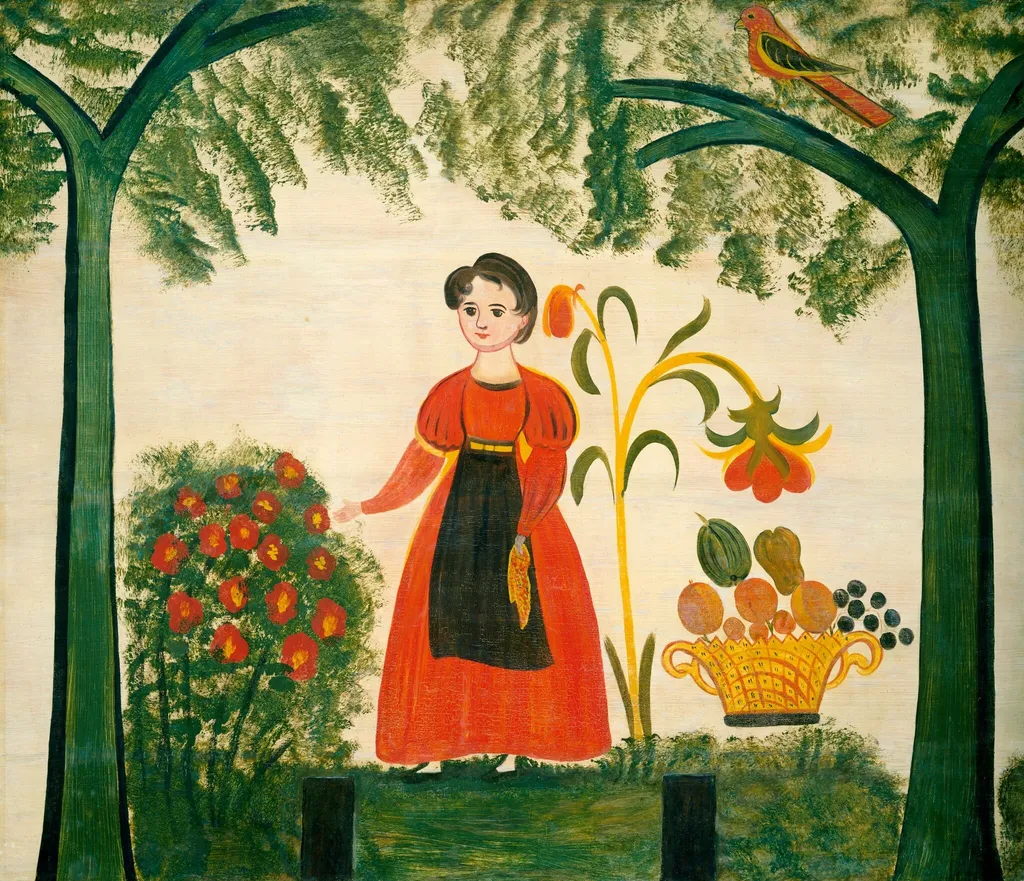
Girl in Red with Flowers and a Distelfink is an oil painting. It dates from 1830 and is held in the collection of the National Gallery of Art.
About this work
Technique & Style
The painting employs oil on wood (fireboard) as its medium and support, a common pairing in early nineteenth-century American folk art for its durability and ready availability. Handling is meticulous yet restrained, with smooth, evenly applied glazes that preserve the crisp outlines of the subject and the Distelfink motif, while the flat, decorative treatment of foliage and drapery reflects folk conventions rather than academic illusionism. The composition's formal qualities emphasize symmetry and clarity, with the child's red dress and the bird's bright plumage serving as focal accents against a muted, planar background.
History & Provenance
Created in 1830 by an American folk artist, the oil-on-wood fireboard known as Girl in Red with Flowers and a Distelfink originated in Pennsylvania.
Created in 1830 by an American folk artist, the oil-on-wood fireboard known as Girl in Red with Flowers and a Distelfink originated in Pennsylvania. Its documented ownership begins with the Silvermine Tavern Antique Shops in Norwalk, Connecticut, which sold the piece in 1947 to the collectors Edgar William and Bernice Chrysler Garbisch. The painting remained in their possession until 1978, when it was gifted to the National Gallery of Art in Washington, D.C., where it remains part of the collection.
The available sources do not list a specific accession number or any public exhibition history for the work.
Overview
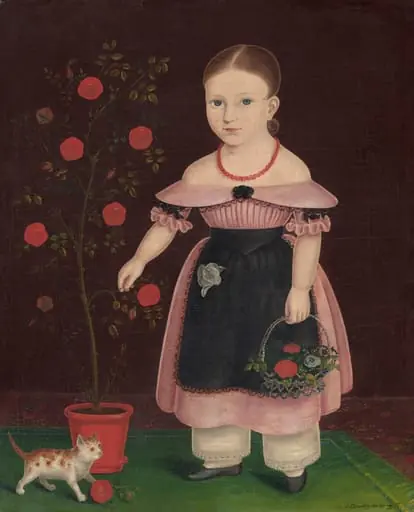
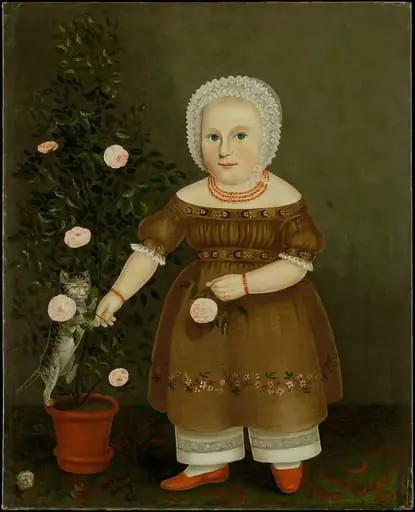
This oil painting, Girl in Red with Flowers and a Distelfink, portrays a young girl holding a bouquet and a finch, set against the backdrop of a tree. The artwork is notable for its use of a fireboard as the painting surface, an unconventional choice for such a piece. It combines elements of portraiture with symbolic imagery, rendered with careful attention to detail.
Subject & Meaning
The painting's central figure is a girl dressed in red, clutching both a cluster of flowers and a distelfink. This specific bird carries cultural weight, recognized as a traditional Pennsylvania Dutch symbol often associated with good fortune. Its presence here introduces a regional cultural context, enriching the portrait beyond a simple depiction.
Artist & collection