Artwork
Holy Women at Christ' s Tomb
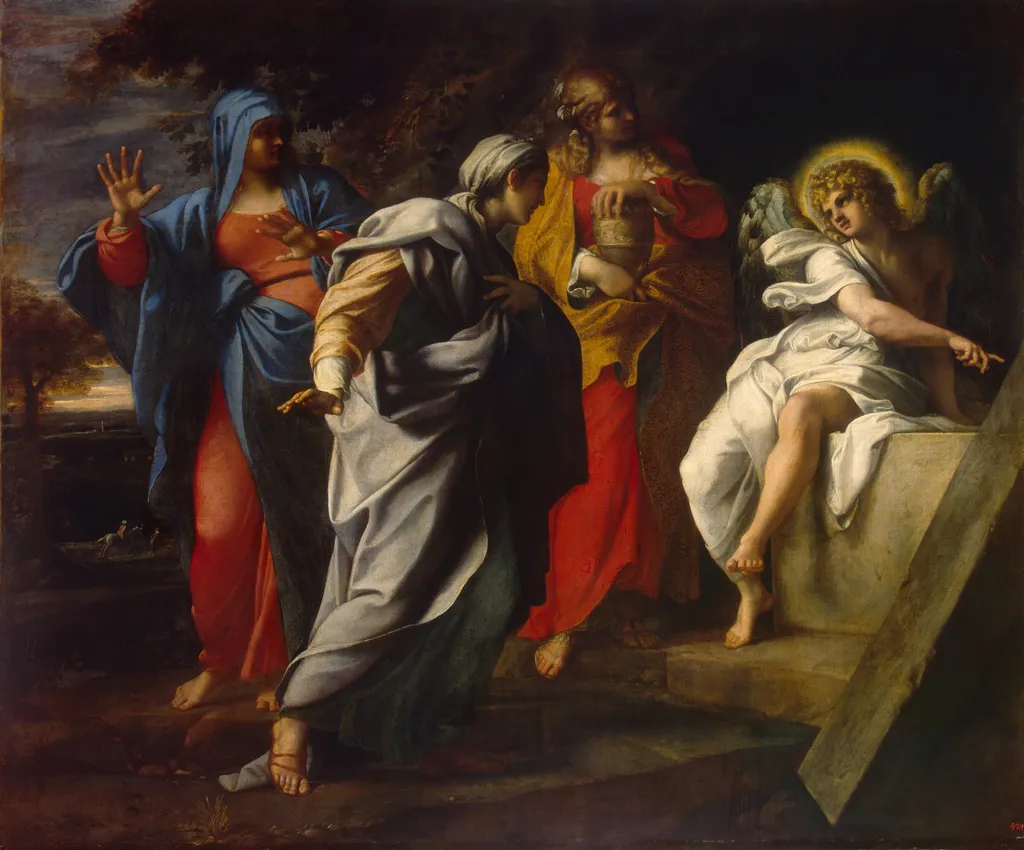
Holy Women at Christ' s Tomb is an oil painting by the Mannerist artist Annibale Carracci. It dates from 1596 and is held in the collection of the Hermitage Museum.
About this work
Overview
It is held in the Hermitage Museum in Saint Petersburg, which acquired the painting in 1836.
Holy Women at Christ's Tomb, also known as The Three Marys or The Pious Women at Christ's Tomb, is an oil on canvas painting by the Italian Baroque artist Annibale Carracci. Created circa 1590, the work measures 121 cm in height and 145.5 cm in width. It is held in the Hermitage Museum in Saint Petersburg, which acquired the painting in 1836. The religious scene depicts the myrrhbearers arriving at Christ's sepulcher, rendered with a dramatic synthesis of classical and Renaissance influences that mark a pivotal moment in Carracci's Roman period.
Subject & Meaning
The painting illustrates the biblical episode of the three Marys, or myrrhbearers, who travel to Christ's tomb at dawn on the third day after the Crucifixion to anoint his body. An angel in white drapery sits on the tomb, announcing the Resurrection. The woman closest to the angel leans forward with her right hand reaching out, while Mary Magdalene, positioned behind in a red and gold dress, holds a small vessel of ointments. The leftmost woman raises her left hand with fingers spread. The reactions of the women to the miracle are conveyed through their coordinated gestures rather than their facial expressions, which are enveloped in the penumbra of dawn. This iconographic choice was notably rare in Italian painting of that era, and its unusual composition may be linked to the antiquarian interests of its patron.
Technique & Style
Carracci employed strong chiaroscuro, illuminating the figures from the upper left to create dramatic contrasts against the dim, atmospheric background of dark foliage and a distant gray sky. The palette is dominated by deep blues, crimson reds, and warm golds set against brown shadows, with the brilliant white of the angel's vestments interrupting the semi-darkness of the scene. Brushwork is smooth and blended in the flesh tones, while more visible texture defines the drapery folds. The figures occupy a shallow, stage-like space, their statuary poses and gestures creating a rhythmic equilibrium of weights and counterweights that suspends the moment of the announcement. The foreshortened tomb and the large stone slab angled in the lower right foreground accentuate spatial depth, while a landscape on the left closes the composition. The overall finish is polished, with careful attention to fabric textures and anatomical detail.
History & Provenance
The painting was commissioned by Lelio Pasqualini, a native of Bologna and a canon at Santa Maria Maggiore in Rome, whose notable antiquarian collection is cited in various seventeenth-century sources. After Pasqualini's death, the work passed by inheritance to Monsignor Agucchi, and subsequently to Cardinal Filomarino, the Archbishop of Naples. Carlo Cesare Malvasia recorded in his 1678 Felsina Pittrice that the painting was then in Naples at the home of the Duke della Torre, the cardinal's nephew, who famously refused an offer from the King of England to trade the painting for three chamber tapestries. The dukes later sold the work, which passed through several collections, including that of Lucien Bonaparte, before the Hermitage Museum acquired it in 1836.
Context
The work is considered one of the highest achievements of Carracci's assimilation of Roman artistic stimuli, reflecting the same development visible in his celebrated frescoes on the vault of the Galleria Farnese. The direct references in this canvas are classical sculpture and the art of Raphael, particularly Raphael's cartoons for the Vatican tapestries. Despite being typical of Carracci's mature Roman style, the painting retains a connection to his early work. The red and gold dress worn by Mary Magdalene is nearly identical to the figure of Good Fortune or Felicitas in his Allegory of Truth and Time at Hampton Court, painted roughly fifteen years earlier.
Legacy
Malvasia's designation of the painting as an unmatched work underscores its early notoriety and high regard. Its subsequent influence is confirmed by numerous engravings, copies, and derivations, including a notable print by the French engraver Jean-Louis Roullet. A painted version by Carracci's pupil Francesco Albani, also held in the Hermitage Museum, further demonstrates the work's immediate impact and the enduring appreciation of its compositional and stylistic innovations within the Baroque tradition.
Own this work as a print
Artist & collection
Artist
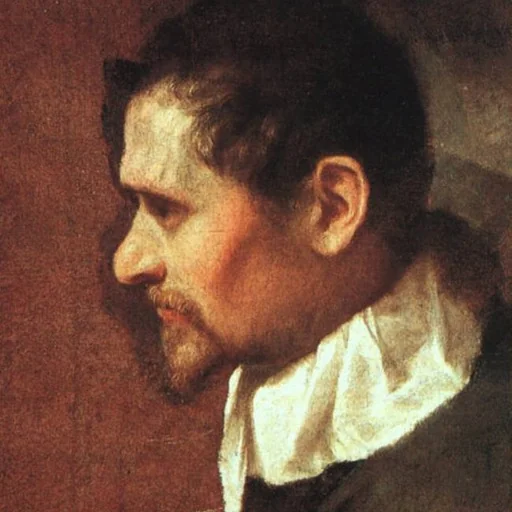
Annibale Carracci ( kə-RAH-chee, UK also kə-RATCH-ee, Italian:; November 3, 1560 – July 15, 1609) was an Italian painter and instructor, active in Bologna and later in Rome.