Artwork
Two children teasing a cat
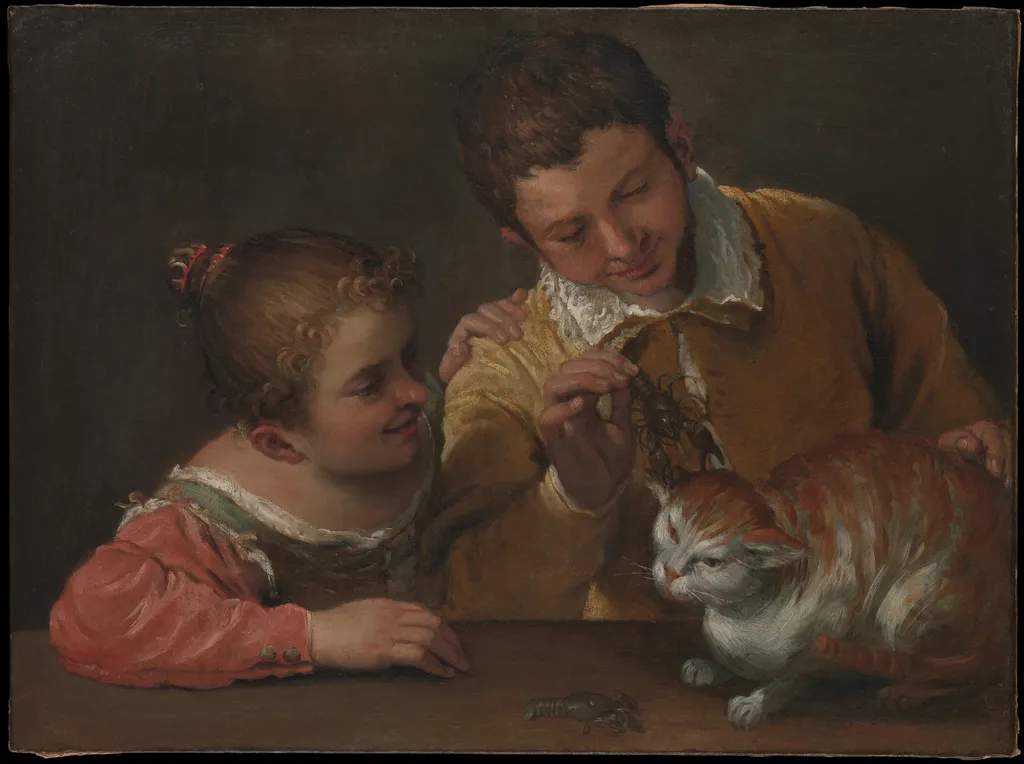
Two children teasing a cat is an oil painting by the Early Baroque Italian artist Annibale Carracci. It dates from 1596 and is held in the collection of the Metropolitan Museum of Art.
About this work
Subject & Meaning
Scholars have noted a possible moral warning embedded in the composition, echoing Flemish proverb-based cautionary themes.
The painting shows a boy and a girl playfully tormenting a cat; the boy grips a shrimp and aims its claw toward the cat's ear while the animal adopts a wary stance, creating a moment of suspense before the anticipated bite. This genre scene, typical of late-16th-century Bolognese art, was likely produced during Annibale Carracci's youthful period and reflects the influence of Venetian masters. Scholars have noted a possible moral warning embedded in the composition, echoing Flemish proverb-based cautionary themes.
The work's iconography links it to lost drawings by Sofonisba Anguissola and to Caravaggio's similar motifs, and its popularity in Bologna is documented by later copies.
Technique & Style
The work is an oil painting on canvas, measuring roughly 66 × 88.9 cm, and belongs to the genre-scene category. Its surface consists of oil paint applied to a canvas support. The composition captures a fleeting, suspended instant: two children poised to tease a cat, the boy holding a shrimp-like crustacean aimed at the animal's ear while the cat adopts a wary stance, creating an anticipatory tension before the impending bite.
Stylistically, the piece reflects Venetian influence, evident in its loose brushwork and tonal modeling, and exemplifies Annibale Carracci's early genre output, characterized by narrative suspense rather than the resolved consequences seen in comparable works.
History & Provenance
Two Children Teasing a Cat is an oil on canvas by Annibale Carracci, dated on stylistic grounds to c. 1587–1588, with no surviving documents concerning its commission or circumstances of execution. The painting is placed in the artist's still-youthful phase, when he was producing genre works, and the perceptible Venetian, particularly Tintoretto-influenced, matrix situates it at the end of the 1580s, a period when Carracci is documented as having stayed in Venice. The work was previously attributed to Agostino Carracci before Roberto Longhi reassigned it to Annibale, an attribution now broadly accepted.
After a complex collecting history, the painting entered the antiquarian market in 1994, when it was acquired by the Metropolitan Museum of Art in New York, where it remains today.
Context
Scholarship attributes this work to Annibale Carracci following Roberto Longhi's reassignment from Agostino Carracci, a view now widely accepted despite the absence of commissioning documents. Stylistic analysis places the painting in the late 1580s during Carracci's youthful phase of genre production and his Venetian sojourn, noting clear Tintoretto influences. Art historically, the composition is linked to a lost Sofonisba Anguissola drawing, which also inspired Caravaggio; however, Carracci uniquely depicts the moment of suspense prior to the cat's reaction rather than the consequence.
Critics hypothesize the scene offers a mild moral warning against recklessness, akin to Flemish proverbial paintings. The image's regional popularity is evidenced by later derivations, including a canvas by Giuseppe Maria Crespi.
Legacy
The painting's legacy is defined by its pivotal role in the development of Italian genre painting and its attribution history. Initially ascribed to Agostino Carracci, the work was reattributed to Annibale by art historian Roberto Longhi, a judgment now widely accepted. Stylistically, it bridges Venetian influences, particularly Tintoretto, with Bolognese traditions.
The composition is historically significant for its relationship to a lost work by Sofonisba Anguissola, which also inspired Caravaggio's Boy Bitten by a Lizard; however, Carracci's version is distinguished by its depiction of the moment of suspense rather than the aftermath. The work achieved considerable popularity in the Bologna region, directly influencing later artists such as Giuseppe Maria Crespi, whose painting Girl Playing with a Cat and a Mouse derives from Carracci's arrangement. Its acquisition by the Metropolitan Museum of Art in 1994 further cemented its status in major public collections.
Overview
Annibale Carracci's Two Children Teasing a Cat, an oil painting on canvas from approximately 1587–1588, depicts a lively domestic moment. This work is now housed at the Metropolitan Museum of Art in New York. It exemplifies the artist's early engagement with genre painting, capturing an everyday interaction with a sense of immediacy uncommon in late 16th-century Italian art. The small scale further emphasizes its intimate subject matter.
Own this work as a print
Artist & collection
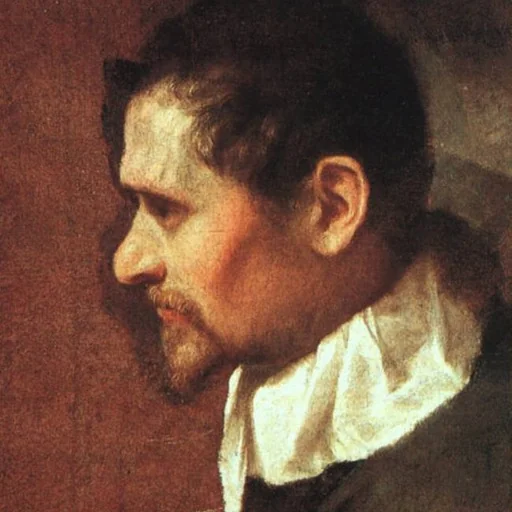
Artist
Annibale Carracci ( kə-RAH-chee, UK also kə-RATCH-ee, Italian:; November 3, 1560 – July 15, 1609) was an Italian painter and instructor, active in Bologna and later in Rome.