Artwork
The Dead Christ Supported by an Angel
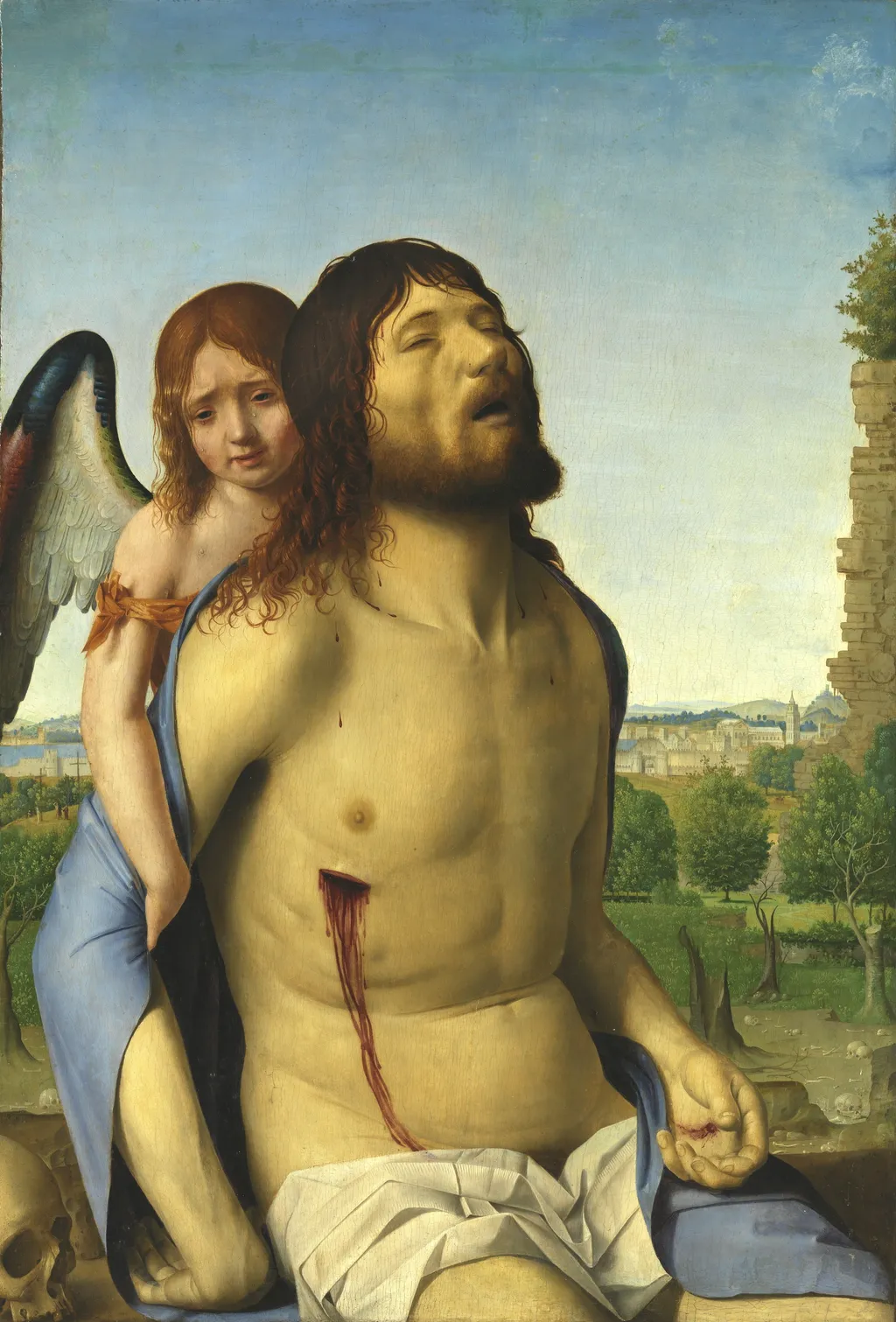
The Dead Christ Supported by an Angel is a mixed painting by the Early Renaissance artist Antonello da Messina. It dates from 1475 and is held in the collection of the Museo del Prado.
About this work
Subject & Meaning
The painting’s mature use of light, color gradation and geometric placement of figures reflects Antonello’s later style, as noted in contemporary scholarship.
The painting shows the dead Christ supported by a weeping angel, a subject drawn from the Passion narrative rather than a Gospel account. The dead Christ is depicted with an open mouth, fallen hands and a side wound from which blood flows, while the angel holds him aloft, its youthful face expressing sorrow. A skull and barren trees in the foreground symbolize mortality, contrasting with a distant city and green landscape that allude to the Resurrection and Jerusalem.
The work combines a northern iconography of a dead Christ embraced by an angel, seen in the output of Carlo Crivelli, with Antonello da Messina’s own naturalistic rendering of the body’s anatomy and the emotional tension between the figures. The composition was intended for private contemplation on the price of salvation, using stark realism and symbolic landscape to evoke the Passion.
The setting includes a recognizable view of Messina with its cathedral and fortifications, linking the sacred scene to the artist’s hometown. The angel’s pink flesh contrasts with Christ’s pallid tones, emphasizing the distinction between divine innocence and human suffering. The painting’s mature use of light, color gradation and geometric placement of figures reflects Antonello’s later style, as noted in contemporary scholarship.
Technique & Style
The Dead Christ Supported by an Angel is executed in oil and tempera on a wooden panel, a mixed technique characteristic of Antonello da Messina's late practice. The panel measures 74 × 51 cm and supports a composition built on geometrically arranged volumes, with figures placed in space according to a Renaissance proportional scheme. Light and color are handled with subtle gradation, more nuanced than in the artist's earlier works, producing a luminous landscape of green meadows and rounded-canopied trees behind the principal group.
Antonello renders Christ's body naturalistically, with detailed attention to the bleeding side wound, the nail wound on the left hand, and a pallid, cadaverous flesh tone set against the rosier, idealized complexion of the weeping angel. The stark foreground, incorporating a meticulously described skull and dry trunks, is balanced against the bright, sunlit city in the distance, creating a symbolic contrast between death and resurrection. The iconography of the dead Christ supported by an angel derives from Northern European sources, though it had already appeared in the work of Carlo Crivelli.
History & Provenance
The painting was created by Antonello da Messina, with dating varying across sources: the Italian Wikipedia entry places it circa 1476–1478, while the Spanish Wikipedia entry gives a range of 1475–1476, and some experts have proposed an earlier date around 1470. According to the Italian source, it was executed on commission from a private patron following Antonello's definitive return to his native Messina in 1476, when he was around 47 years old. The Spanish source suggests that Antonello may have completed the work with assistance from his son Jacobello.
Regarding provenance, the Spanish Wikipedia notes that the painting had been kept until 1881 in Monforte de Lemos in Galicia, where it may have been brought from Italy by a high-ranking ecclesiastic. Around 1965, the work was located in a private collection in Irún, Spain, and its purchase was proposed to the Museo del Prado. Although initially questioned as an unpublished work, subsequent studies confirmed it as a masterwork by the artist. It is now held in the Museo del Prado in Madrid.
The painting is held in the collection of the Museo del Prado in Madrid. Its history prior to entering the museum includes a long period in Monforte de Lemos, Galicia, where it remained until 1881, possibly brought from Italy by a high-ranking clergyman. The work was later located in a private collection in Irún, Spain, around 1965, at which point its acquisition by the Prado was proposed.
Although initially met with some skepticism as an unpublished piece, subsequent studies confirmed its status as a masterpiece by the artist. The museum's official records list the work as part of its holdings, though specific inventory numbers are not detailed in the available sources.
Context
Antonello da Messina painted The Dead Christ Supported by an Angel between 1475 and 1478, likely for a private patron, as indicated by stylistic analysis of its devotional function and historical context of his later Sicilian period. The work depicts Christ dead and cradled by a mourning angel amid symbolic landscape elements, dry trees and skulls representing mortality, with a distant cityscape possibly depicting Messina itself. Art historians note its mature use of light and spatial geometry, reflecting Antonello’s development beyond early techniques toward the nuanced chiaroscuro seen in his final works.
The iconography draws from northern European traditions, particularly Carlo Crivelli, yet Antonello reinterprets it with heightened naturalism in the corpse’s anatomy and contrasting idealized angelic beauty. The painting’s provenance includes a 19th-century presence in Galicia, Spain, before its acquisition by the Museo del Prado, where it remains today.
Overview
Painted in 1475, The Dead Christ Supported by an Angel is a late work by the Sicilian master Antonello da Messina, created shortly before his death. The composition presents a poignant Lamentation scene, focusing on the lifeless body of Christ, whose torso is exposed to reveal the wound in his side. His hands are bound with a white cloth, and his head lolls forward in death.
He is physically supported by a solitary angel with reddish hair and expansive wings, who gazes upward in sorrow. The figures are set against a landscape featuring a distant city, trees, and a stone wall beneath a pale, atmospheric sky. Antonello employs his characteristic mixed technique, likely oil on panel, to achieve a sculptural solidity in the figures and a nuanced, hazy depth in the background.
This work exemplifies the artist's synthesis of Northern European attention to detail and light with Italian Renaissance spatial clarity and emotional restraint. As one of his final productions, it reflects a mature mastery of form and a profound, quiet meditation on mortality, standing as a significant example of 15th-century religious painting in Italy.
Own this work as a print
Artist & collection


![The Crucifixion with the Virgin, Saint John, Saint Jerome, and Saint Mary Magdalene [middle panel], by Pietro Perugino](https://artifactworldgallery.com/img/pietro-perugino--the-crucifixion-with-the-virgin-saint-john-saint-jerome-and--a9b4c312771e3f71-w320.webp)