Artwork
Madonna and Child
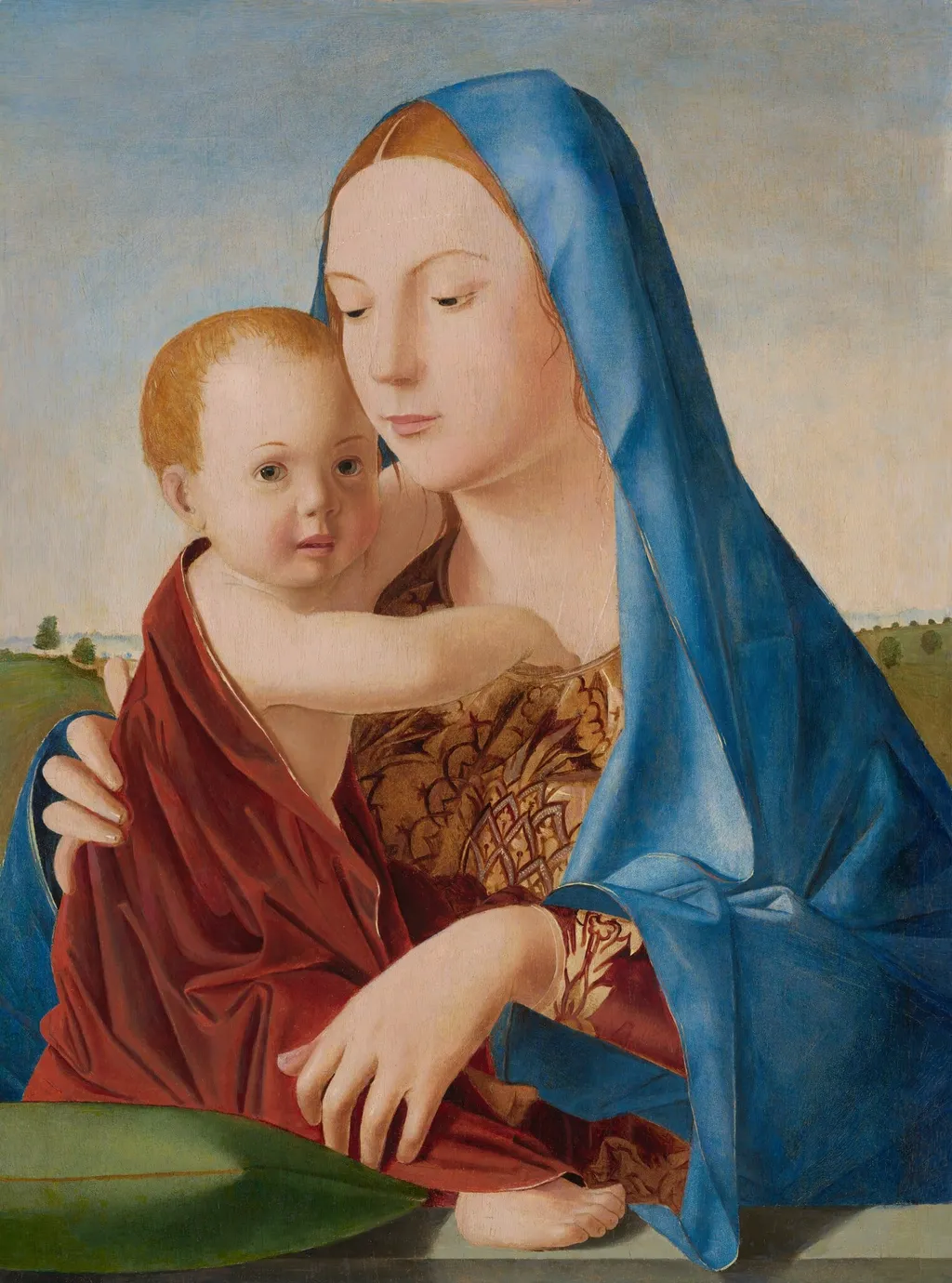
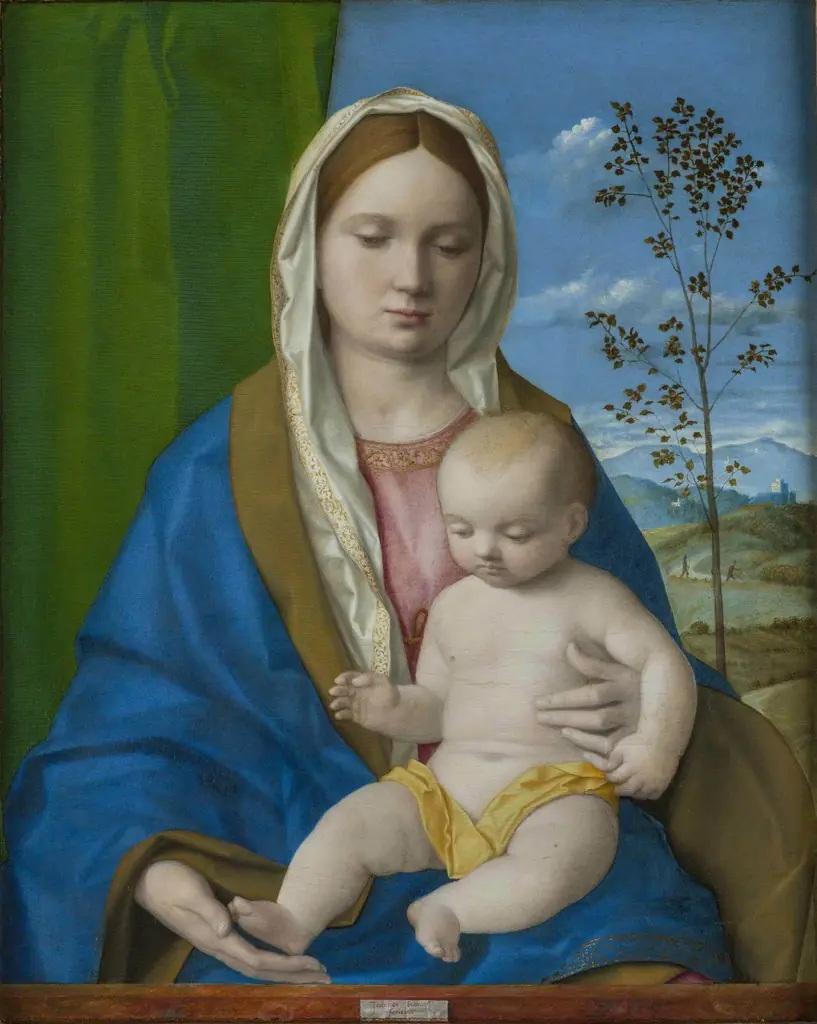
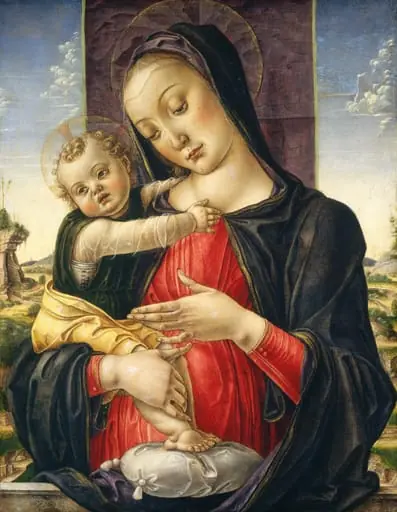
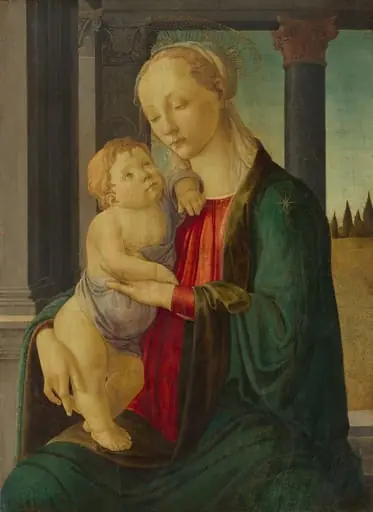
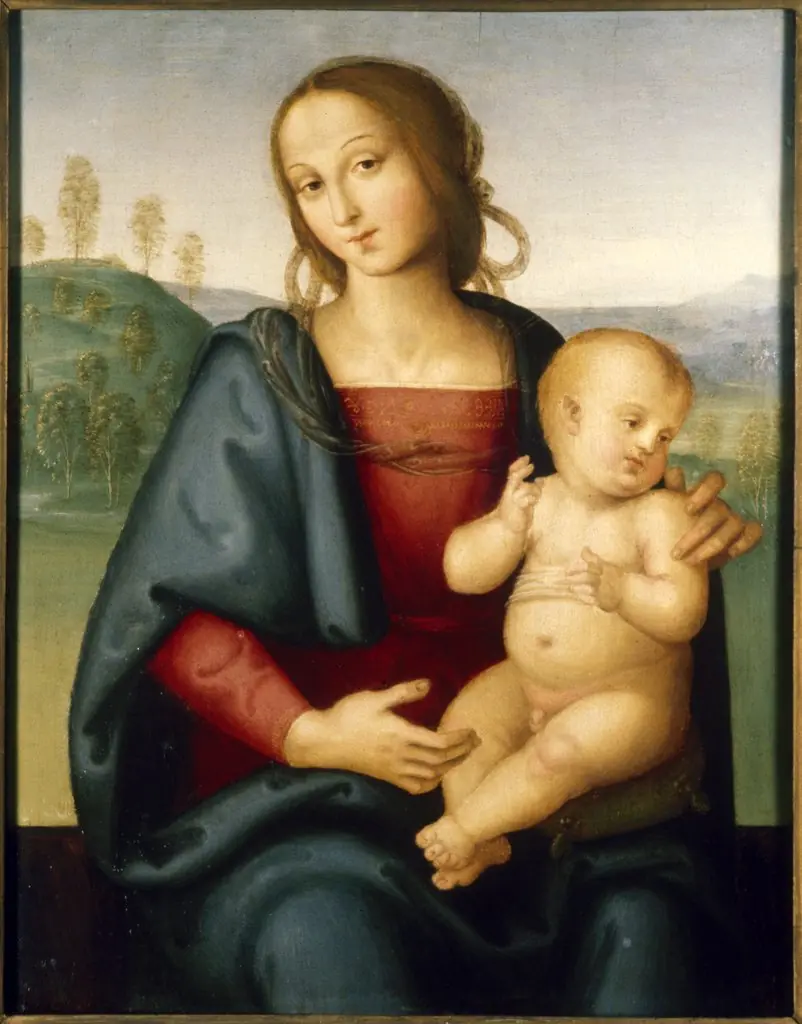
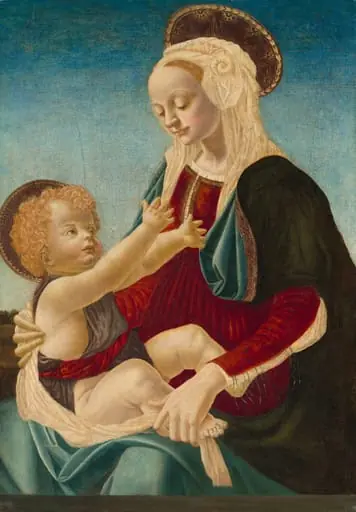
Madonna and Child is an oil painting by the Early Renaissance artist Antonello da Messina. It dates from 1475 and is held in the collection of the National Gallery of Art.
About this work
Subject & Meaning
The composition emphasizes intimate tenderness, with the Child playfully tugging at Mary’s garment, evoking themes of maternal affection and divine humanity.
The subject of Antonello da Messina’s Madonna and Child (c. 1475) is a devotional image of the Virgin Mary holding the Christ Child, a conventional iconography in Christian art. The composition emphasizes intimate tenderness, with the Child playfully tugging at Mary’s garment, evoking themes of maternal affection and divine humanity. The serene outdoor setting and the figures’ sculptural plasticity reflect Antonello’s engagement with Venetian art, particularly Giovanni Bellini’s lyrical approach to religious subjects, which he encountered during his 1474 visit to Venice.
The work’s restrained yet expressive style underscores both the Virgin’s reverence and the Child’s humanity, blending emotional warmth with formal rigor.
Technique & Style
Executed circa 1474–1477, the work is an oil painting on a wooden panel, originally measuring approximately 58.9 by 43.7 centimeters. The medium combines oil and tempera, applied with a technique that emphasizes the volumetric solidity and plasticity of the figures, reminiscent of contemporary sculpture. Stylistically, the handling creates a striking contrast between the tangible, three-dimensional presence of the Christ Child and the ethereal, ivory-like delicacy of the Virgin Mary.
The composition features an airy outdoor setting that reflects Venetian influences, specifically those of Giovanni Bellini, suggesting a date after Antonello's 1474 visit to Venice. The figures engage in an affectionate interaction, with the Child playfully manipulating the Mother's neckline, demonstrating a synthesis of rigorous formal structure and intimate, lyrical expression.
History & Provenance
The Madonna and Child is dated to approximately 1474–1477, a timeframe linked to Antonello da Messina's 1474 visit to Venice which influenced the work's style. Initially attributed to various artists such as Marcello Fogolino or Iacobello De Antonio, the painting received unanimous attribution to Antonello following Bernard Berenson's 1913 study. The provenance begins with the London collection of William Graham, from which it likely entered the collection of Robert Henry Benson by 1901.
In 1927, the work was sold to Duveen Brothers and subsequently acquired by Clarence H. Mackay of Roslyn, New York, in October 1928. Duveen Brothers repurchased the painting, selling it to the A.W. Mellon Educational and Charitable Trust in Pittsburgh on December 15, 1936. Andrew W. Mellon donated the artwork to the National Gallery of Art in Washington, D.C., in 1937.
The work is held by the National Gallery of Art in Washington, D.C., where it entered the collection as part of the Andrew W. Mellon Educational and Charitable Trust acquisition in 1936 and was gifted to the museum the following year; its accession is recorded under the Trust’s 1936 purchase and 1937 donation. Provenance traces from William Graham, through Robert Henry Benson, to Duveen Brothers, and finally to the Trust, as documented in the NGA curatorial files. The painting’s presence in the National Gallery’s collection is noted in the museum’s catalog and on its Wikidata entry‑3). No exhibition history is mentioned in the available provenance records.
Context
The work, an oil‑tempera panel depicting the Virgin and Child, is generally dated to around 1475 and attributed to Antonello da Messina; this attribution was first advanced by Bernard Berenson in 1913 and later accepted without dispute, although earlier catalogues had linked it to a Venetian school hand, Marcello Fogolino, or Iacobello De Antonio. Its early ownership passed from the English collector William Graham to Robert Henry Benson, then through Duveen Brothers to Clarence H. Mackay and finally to the A.W. Mellon Educational and Charitable Trust, which gifted it to the National Gallery of Art. Stylistically the piece combines sculptural modeling with a delicate, intimate interaction between mother and child, reflecting Antonello’s Venetian phase and his dialogue with Giovanni Bellini.
Overview
Painted in 1475, Antonello da Messina's Madonna and Child exemplifies the artist's pivotal role in introducing oil painting techniques to Italian art. The composition features the Virgin Mary holding the Christ Child within a shallow, intimate interior space, rendered with a geometric clarity characteristic of Antonello's style. Unlike the flat, linear quality of traditional tempera, the artist utilizes oil and tempera to achieve subtle gradations of light and shadow, creating a convincing sense of three-dimensional volume and tactile realism.
The figures are depicted with sharp, lifelike facial features that contrast with the soft, muted tones of the surrounding drapery and background. Light falls gently across their skin, modeling their forms with a precision that reflects Antonello's mastery of Northern European oil methods combined with Italian compositional balance. This work marks a significant departure from earlier Quattrocento styles, demonstrating how the medium allowed for greater atmospheric depth and psychological presence.
The painting stands as a testament to Antonello's unique synthesis of Flemish technique and Italian humanism, influencing contemporaries and successors in the Venetian school.
Own this work as a print
Artist & collection