Artwork
Peppina
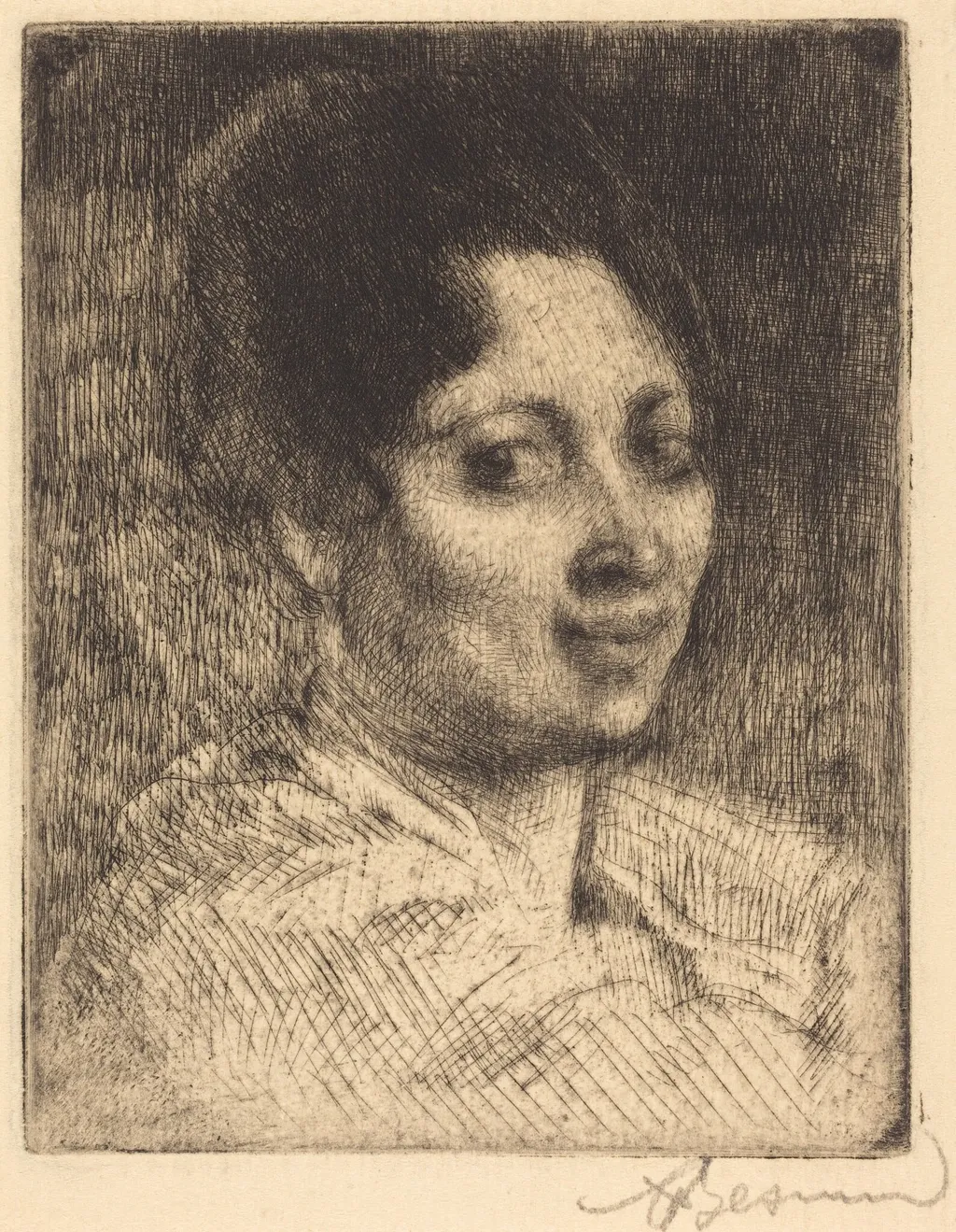
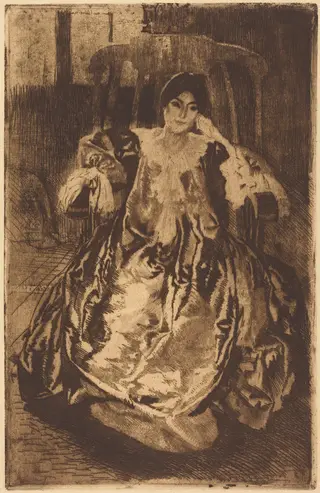
Peppina is an ink print by Albert Besnard. It dates from 1919 and is held in the collection of the National Gallery of Art.
- Inscription
- Inscribed:lower right below plate mark in graphite: ABesnard; by later hand, lower left verso in graphite: 18912; by later hand, lower right verso in graphite: K 1381/3
- Markings
- Marked:None.
About this work
Overview
The work captures a woman’s face and upper torso with minimal background, emphasizing the subject’s presence through direct gaze and textured rendering.
Created in 1919, Peppina is a black-and-white portrait rendered in etching and drypoint on laid paper. The work captures a woman’s face and upper torso with minimal background, emphasizing the subject’s presence through direct gaze and textured rendering. The medium’s inherent line quality lends a sense of immediacy, as if the image were drawn directly from life rather than composed in the studio.
Subject & Meaning
The subject, identified as Peppina, is portrayed with quiet intimacy. Her expression is neutral, neither posed nor performative, suggesting a moment of stillness rather than formal portraiture. The focus on her hair and collar, rendered with tactile detail, draws attention to personal, everyday elements, implying a connection between the sitter and the artist beyond mere representation.
Technique & Style
Besnard employed drypoint to carve fine, scratchy lines directly into the plate, creating rich, velvety blacks and uneven edges. Etching provided finer contours, particularly around the face. The crisscrossed marks in the collar and the loose, irregular strokes in the hair exploit the medium’s capacity for texture, rejecting smoothness in favor of a hand-wrought, almost spontaneous appearance.
History & Provenance
The print was made in 1919, near the end of Besnard’s career, during a period when he increasingly favored intimate, experimental prints over large-scale paintings. Peppina likely stems from private sessions, possibly with a model or acquaintance. Its survival in museum collections suggests early recognition of its technical nuance, though it never entered mainstream public discourse.
Context
In the postwar years, many European artists turned toward introspective, smaller-scale works. Besnard’s shift from grand historical compositions to quiet portraits like Peppina reflects this broader trend. The print aligns with contemporary interest in the expressive potential of printmaking, particularly its capacity to convey psychological depth through line and texture rather than color or detail.
Legacy
Peppina remains a quiet example of Besnard’s late graphic work, valued for its restraint and technical honesty. It is studied for its use of drypoint’s tactile qualities and its departure from academic portraiture. While not widely reproduced, it continues to inform discussions on early 20th-century printmaking as a vehicle for personal expression.
Own this work as a print
Artist & collection

 Interieur mit Frau (Interior with Woman)
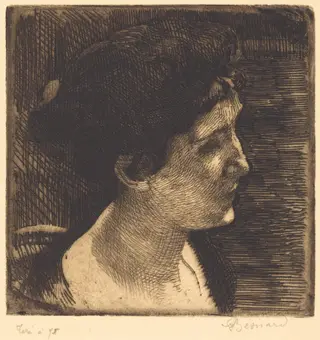 Woman in Full Profile (Grand profil de femme)
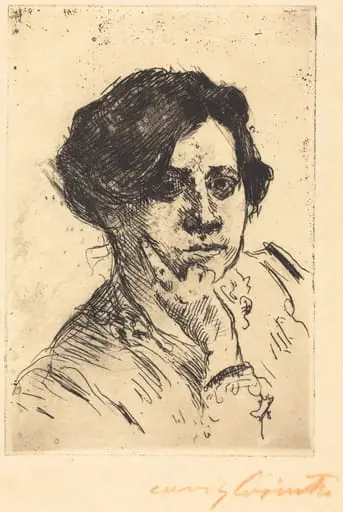 Frauenkopf (Head of Woman)
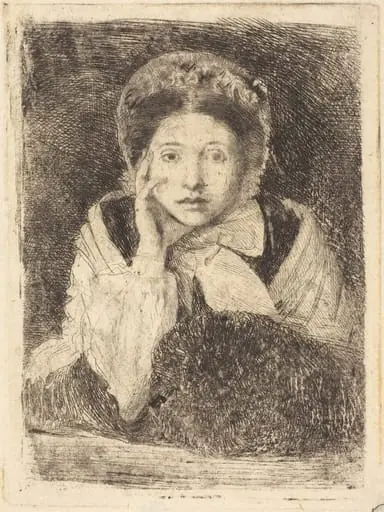 Marguerite De Gas, the Artist's Sister (Marguerite De Gas, soeur de l'artiste)
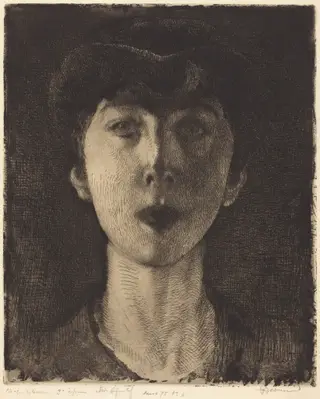 Queen Elisabeth of Belgium (La Reine Élisabeth de Belgique)
 Ada
Ada Head of a Woman: Madeleine
 Mrs. Granberg
 Jeanne Hading
 The Silk Gown (La Robe de Soie)