Artwork
Restrike from fragment of cancelled plate for "A Prophecy"
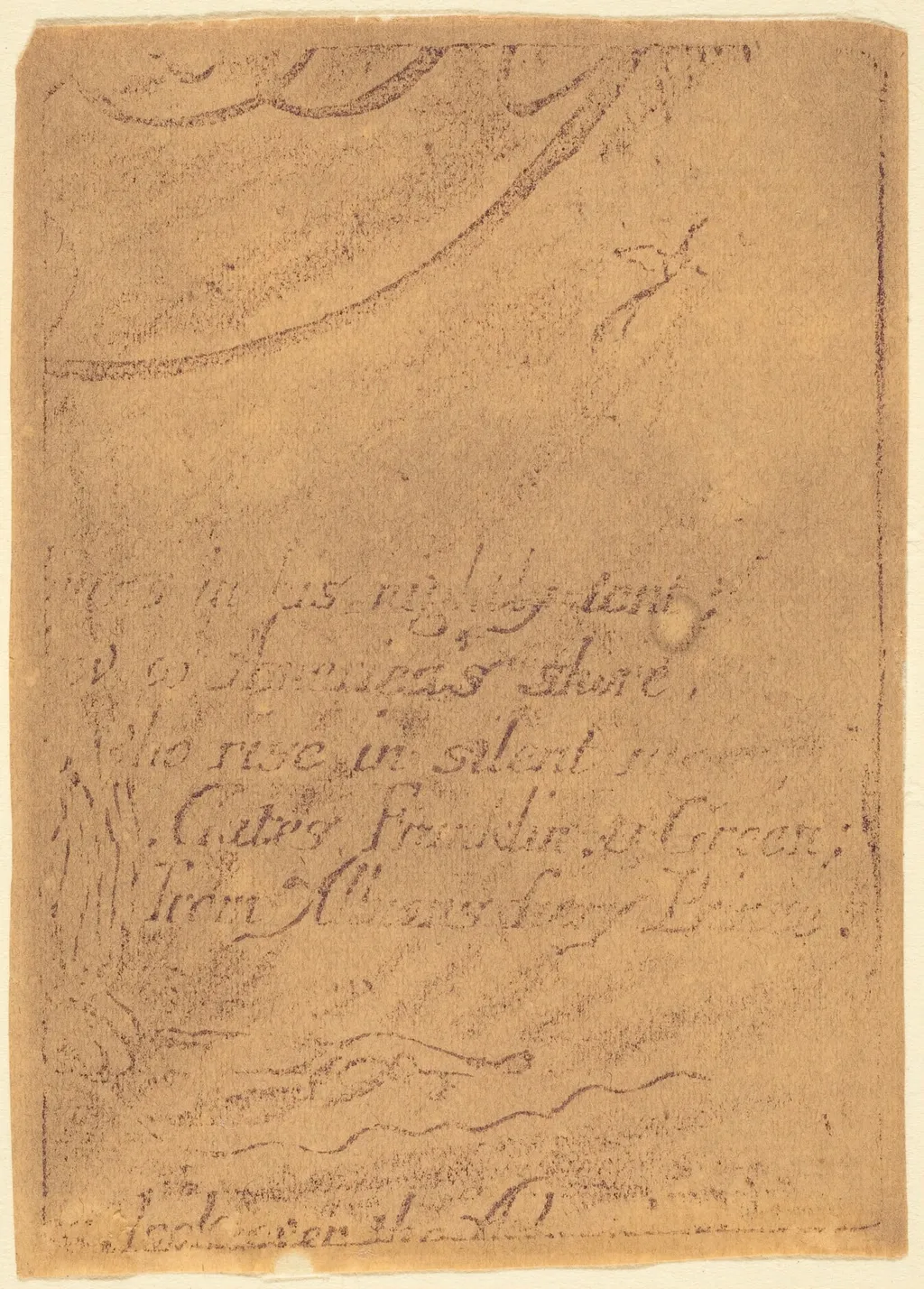
Restrike from fragment of cancelled plate for "A Prophecy" is an ink print by the Romanticist artist William Blake. It dates from 1793 and is held in the collection of the National Gallery of Art.
About this work
Overview
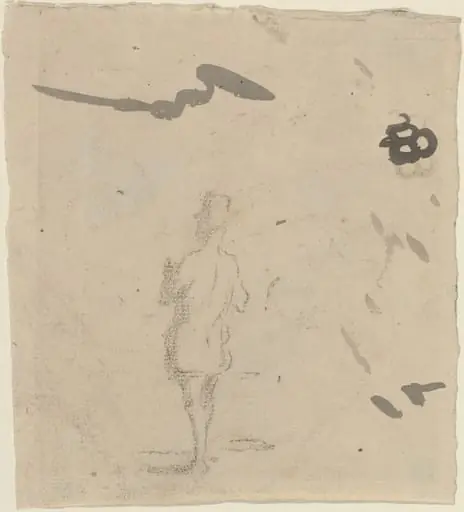
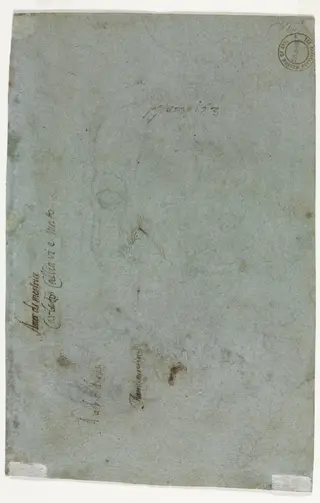
” The image appears as a faded, uneven impression on light‑brown paper, with dark, incised lines that suggest both textual fragments and abstract marks.
In 1793 William Blake produced a relief-etched print that is a restrike taken from a surviving fragment of a plate he had previously cancelled for his work titled “A Prophecy.” The image appears as a faded, uneven impression on light‑brown paper, with dark, incised lines that suggest both textual fragments and abstract marks. The piece reflects Blake’s practice of revisiting and reworking his own plates.
Subject & Meaning
The surviving marks consist of partially legible words and geometric strokes that hint at a larger, now‑lost composition. The fragmented text and a stark diagonal line across the centre evoke a sense of rupture, consistent with the prophetic themes Blake explored, where symbolic language often intertwines with visionary disruption.
Technique & Style
Blake employed relief etching, a process in which the design is cut into a metal plate and the raised surfaces receive ink. This particular print is a restrike, meaning it was pulled from a later impression of a damaged or cancelled plate, resulting in a softer, more worn appearance than an original impression.
History & Provenance
The plate for “A Prophecy” was originally abandoned by Blake, and only a fragment survived. The 1793 restrike was produced from that fragment, likely for personal use or limited distribution. The work remained relatively obscure during Blake’s lifetime, gaining scholarly attention only after his prophetic series were reassessed in the nineteenth century.
Context
Created during a period when Blake was based in London, the print belongs to his broader corpus of “prophetic works,” a series that combined poetic narrative with intricate visual symbolism. Though these pieces were not widely recognized in his day, they later became central to understanding his contribution to Romantic visual art and his unique synthesis of text and image.
Own this work as a print
Artist & collection
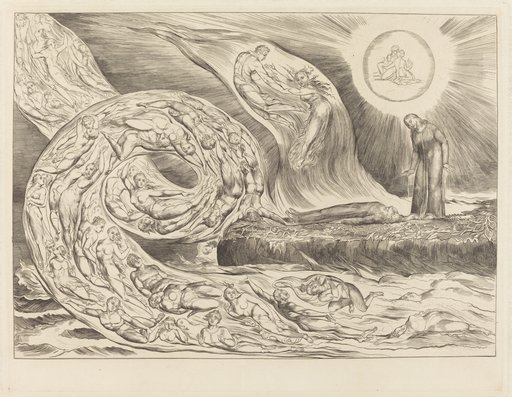
Artist
William Blake (28 November 1757 – 12 August 1827) was an English poet, painter and printmaker.

![An Armed Man Spurning a Woman [recto], by William Blake](https://artifactworldgallery.com/img/william-blake--an-armed-man-spurning-a-woman-recto--1c6f4d8e0f65d2b6-w320.webp)