Artwork
The Canterbury Pilgrims
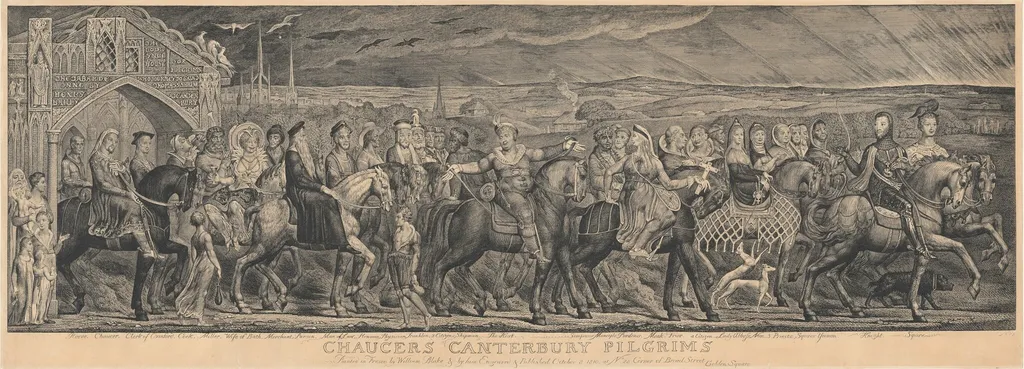
The Canterbury Pilgrims is an ink print by the Romanticist artist William Blake. It dates from 1810 and is held in the collection of the National Gallery of Art.
About this work
Overview
The Canterbury Pilgrims is an 1810 engraving by William Blake, exemplifying his fusion of literary and visual art through imaginative storytelling.
Subject & Meaning
The engraving depicts a diverse procession of pilgrims on horseback and on foot, reflecting various social classes, likely emphasizing unity and diversity inspired by medieval tradition, possibly referencing Geoffrey Chaucer's Canterbury Tales.
Technique & Style
Executed in Blake's characteristic Romantic period style, the work features intricate details, expressive figures, and a dreamy landscape backdrop, blending symbolic and realistic elements.
History & Provenance
Created in 1810 by the underrecognized yet prolific English artist William Blake, the engraving is part of his broader oeuvre that combined poetic and artistic vision.
Context
Rooted in the Romantic era, the piece draws on medieval and religious themes, characteristic of Blake's work, which often explored visionary and creative expression.
Artist & collection
Artist
William Blake (28 November 1757 – 12 August 1827) was an English poet, painter and printmaker.

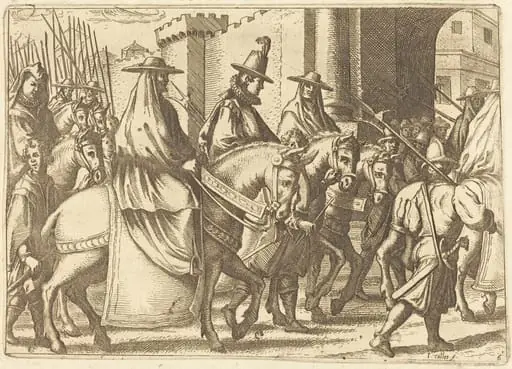
![Entry of Marie de Medici into Amsterdam [plate 6 of 6], by Pieter Nolpe](https://artifactworldgallery.com/img/pieter-nolpe--entry-of-marie-de-medici-into-amsterdam-plate-6-of-6--1180e5a1b81c4aa0-w320.webp)