Artwork
Mary Magdalen
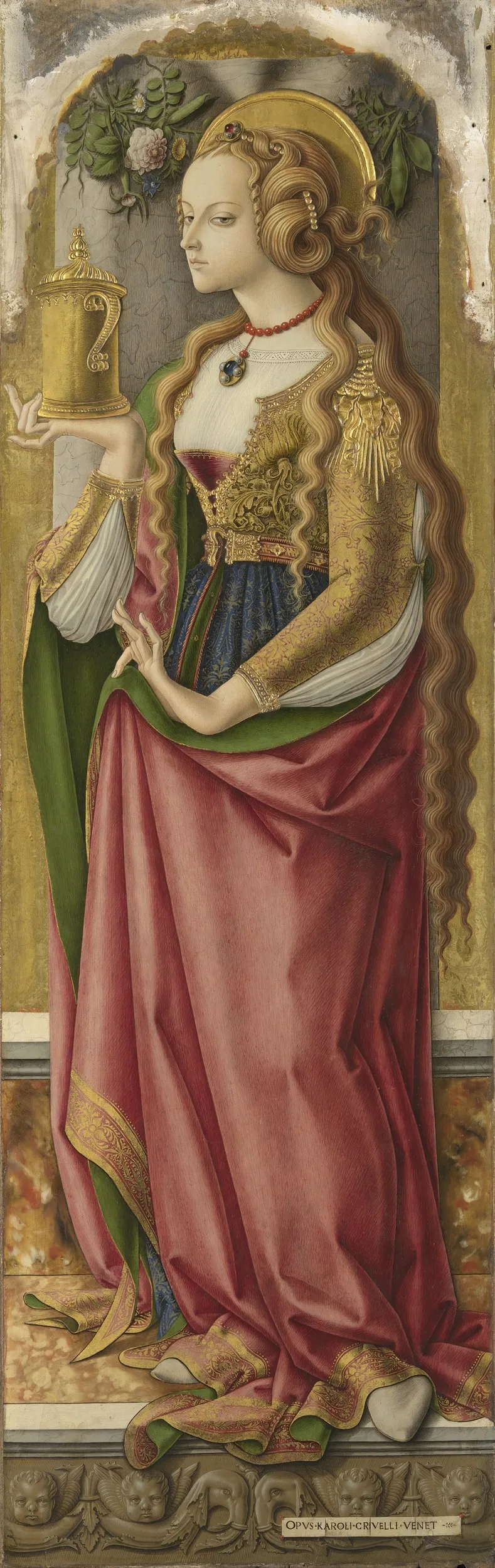
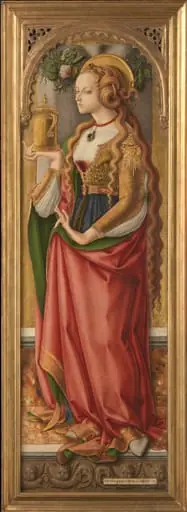
Mary Magdalen is a tempera painting by the Venetian Renaissance artist Carlo Crivelli. It dates from 1490 and is held in the collection of the Solly Collection.
About this work
Subject & Meaning
The painting is signed on a cartellino in the lower right corner with 'OPVS KAROLI CRIVELLI VENETI', confirming its attribution to Carlo Crivelli.
The painting depicts Mary Magdalene standing on a marble step adorned with a sculpted frieze of angels and fantastical creatures, holding a jar of nard, her traditional attribute, in her right hand and lifting the edge of her cloak with her left. She is dressed as a noblewoman, wearing a coral necklace and a pendant, and a foot and part of her garment extend toward the viewer. The work features rich gold leaf decoration applied in relief, characteristic of late Gothic style, while its spatial and perspective studies reflect Renaissance influences from the Paduan tradition.
The composition includes symbolic elements such as the jar of nard and the ornate drapery, representing penitence and contemplation. The painting is signed on a cartellino in the lower right corner with 'OPVS KAROLI CRIVELLI VENETI', confirming its attribution to Carlo Crivelli. It was created circa 1476, likely commissioned for a private chapel in Carpegna, and later entered the collection of Edward Solly before being acquired by the Rijksmuseum in 1885.
The subject embodies both devotional devotion and symbolic penitence, reflecting the late 15th-century synthesis of Gothic elegance and Renaissance spatial logic.
Technique & Style
Carlo Crivelli's Mary Magdalen is executed in tempera and gold on a wood panel measuring 152 × 49 cm. The work bears the artist's signature, OPVS KAROLI CRIVELLI VENETI, on a simulated cartellino at the lower right. The figure stands on a marble step carved with a frieze of cherubs and fantastical animals, set before a hanging cloth topped by a festoon of flowers.
Stylistically, the painting fuses late Gothic and early Renaissance sensibilities. The lavish gilding, built up in relief through the application of pastiglia on the ointment jar, bodice, belt, shoulders, cuffs, and the solid golden paten-like halo, evokes the late Gothic tradition, as does the extreme elegance of the figure. The spatial and perspectival studies, meanwhile, are fully Renaissance in character, filtered through the Paduan school rather than contemporary Venetian practice.
The panel is reported to be in excellent condition and is regarded as one of the artist's most accomplished creations.
History & Provenance
Carlo Crivelli’s Mary Magdalen is currently held by the Rijksmuseum in Amsterdam, having been transferred there in 1960 as part of the Dienst Verspreide Rijkscollecties collection. Prior to this, the work was owned by Fritz Mannheimer in Amsterdam in 1948, then by the Dienst Verspreide Rijkscollecties in The Hague in 1949. Before arriving in the Netherlands, the painting belonged to the Solly Collection and was displayed at the Kaiser Friedrich Museum (now the Bode Museum) in Berlin from 1821 until its sale in 1935.
The artwork was originally located in the church of San Francesco in Carpegna, Italy, where it was documented in a 17th-century text but disappeared from records by 1703. The sources do not list specific exhibition history dates or titles beyond its permanent institutional locations.
Context
Carlo Crivelli's Mary Magdalen is widely regarded as one of the artist's most successful creations, noted for its optimal state of preservation. Scholars date the work to approximately 1476, viewing it as stylistically mature and later than the Polyptych of Montefiore dell'Aso due to its heightened formal tension. The painting synthesizes late Gothic elegance, evident in the extensive relief gilding and the figure's grace, with Renaissance spatial studies mediated through Paduan rather than contemporary Venetian traditions.
Historically, the work is linked to the Counts of Carpegna, who commissioned it for the church of San Francesco in Carpegna, where a 17th-century text described it as a "precious jewel." Art historians generally exclude it from a dismantled polyptych, as Crivelli typically signed central panels; instead, it is considered an independent panel. Its provenance traces from the Carpegna collection to the Solly collection in 1821, eventually reaching the Rijksmuseum in Amsterdam in 1960.
Legacy
The painting has had a lasting impact on art historical discourse and museum display practices. Early 17th-century records by Pier Antonio Guerrieri document its original altarpiece context in the church of San Francesco, Carpegna, where it was commissioned by the Counts of Carpegna and praised as a precious gem, highlighting its contemporary prestige. The work's provenance reflects a complex journey through private collections and major European institutions, including ownership by Edward Solly, Fritz Mannheimer, and eventual transfer to the Rijksmuseum Amsterdam in 1960 after passing through the Dienst Verspreide Rijkscollection in The Hague.
Its scholarly significance is underscored by detailed stylistic analyses in 20th-century publications, such as Francesco V. Lombardi's 1982 study and Pietro Zampetti's 1986 monograph, which cemented its status as a key example of Carlo Crivelli's synthesis of late Gothic ornamentation and Renaissance spatial techniques. The painting's distinctive features, like the coral necklace, the nard vase, and the elaborate gilded details rendered in relief, continue to inform discussions on Northern European painting conventions and the artist's innovative use of perspective.
Overview
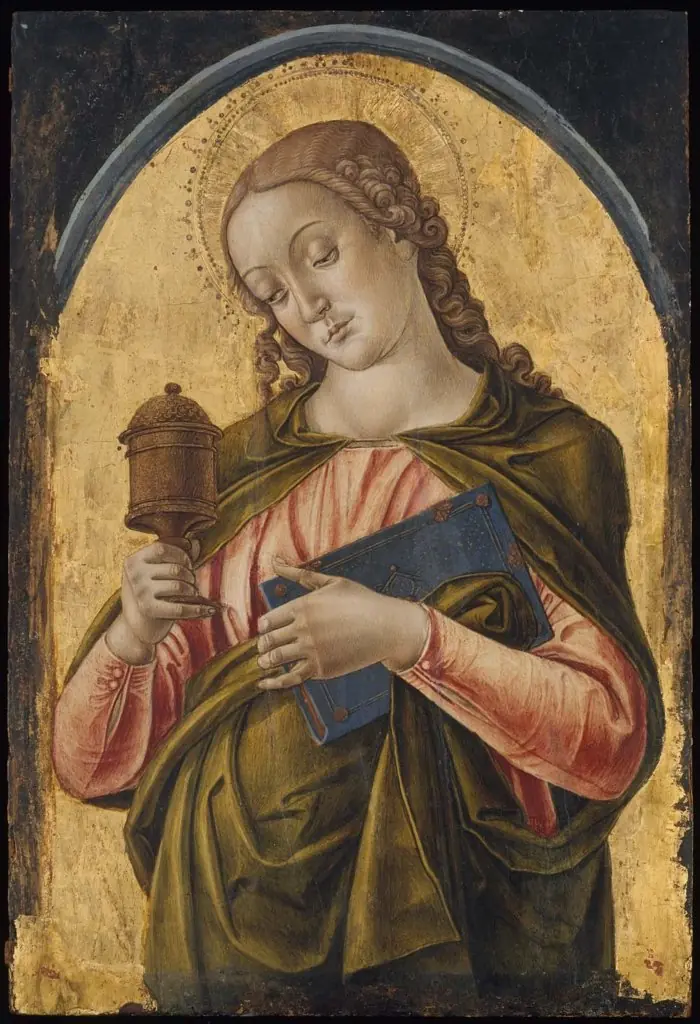
Carlo Crivellio’s tempera panel, dated to around 1490, portrays Mary Magdalene in a standing pose. The figure is rendered in vivid reds, greens and golds, set against a dark background that hints at foliage and a subtle golden light. The work is part of the Rijksmuseum’s collection and exemplifies the decorative character of late‑Gothic Italian painting.
Artist & collection
Artist
Carlo Crivelli (c. 1430 – c. 1495) was an Italian Renaissance painter of conservative Late Gothic decorative sensibility, who spent his early years in the Veneto, where he absorbed influences from the Vivarini,…
 Maria Magdalena
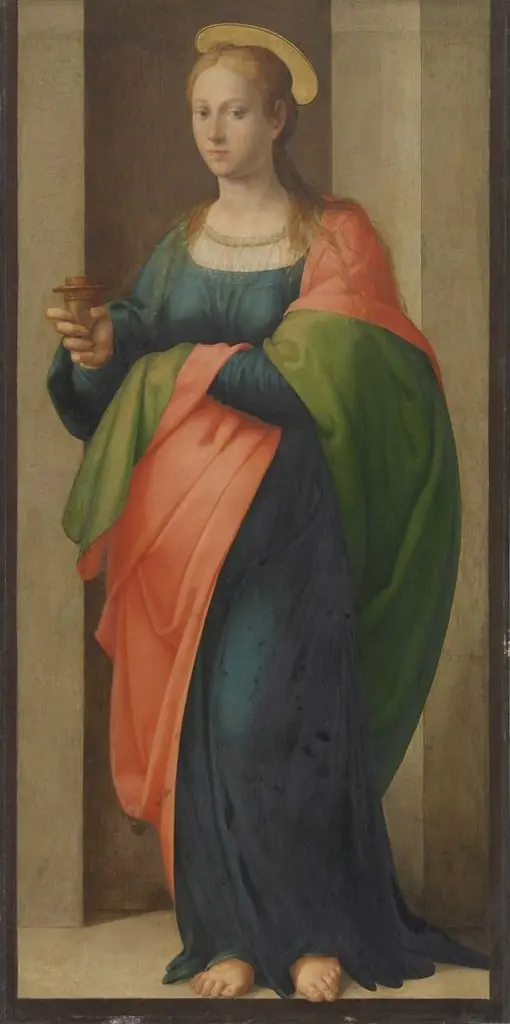 Saint Mary Magdalene
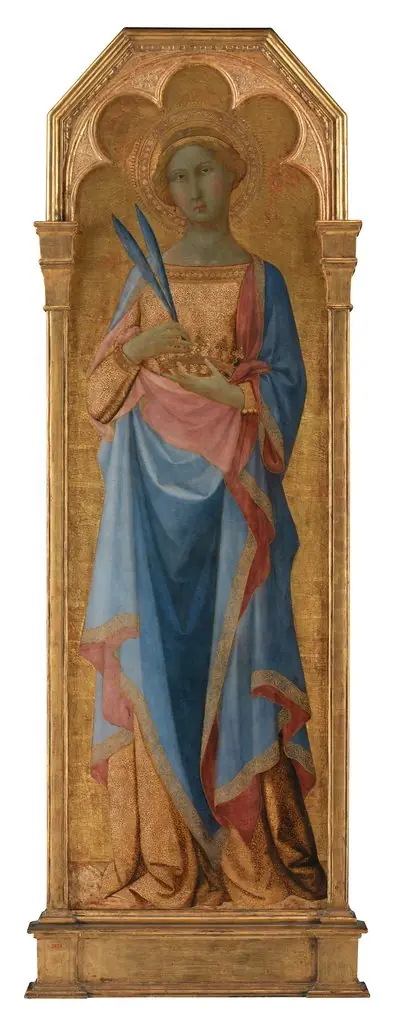 St. Corona
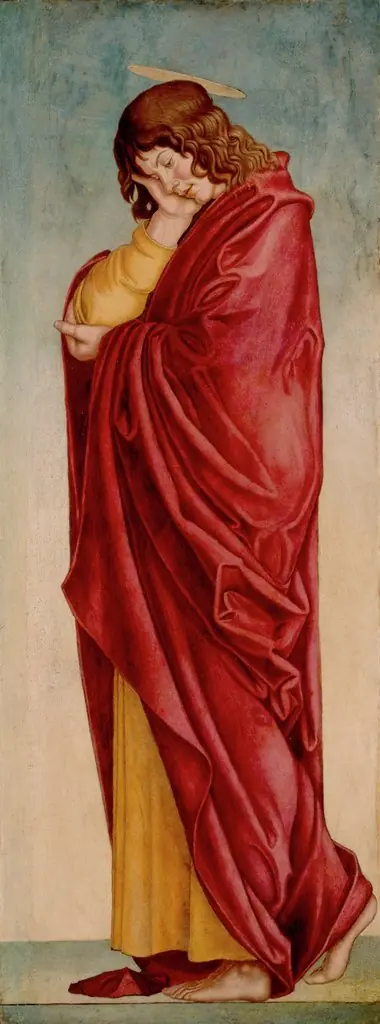 The Mourning Saint John
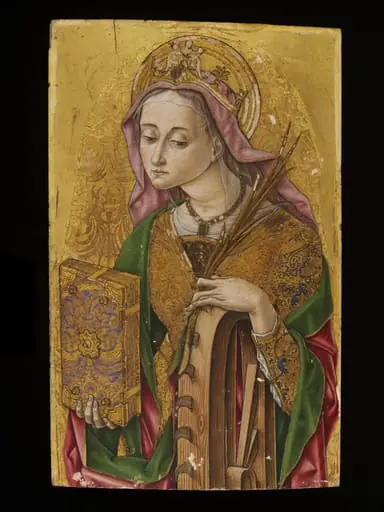 St Catherine of Alexandria
![The Archangel Gabriel [middle left panel], by Cosimo Tura](https://artifactworldgallery.com/img/cosimo-tura--the-archangel-gabriel-middle-left-panel--c900f72d54477be2-w320.webp) The Archangel Gabriel [middle left panel]
The Archangel Gabriel [middle left panel]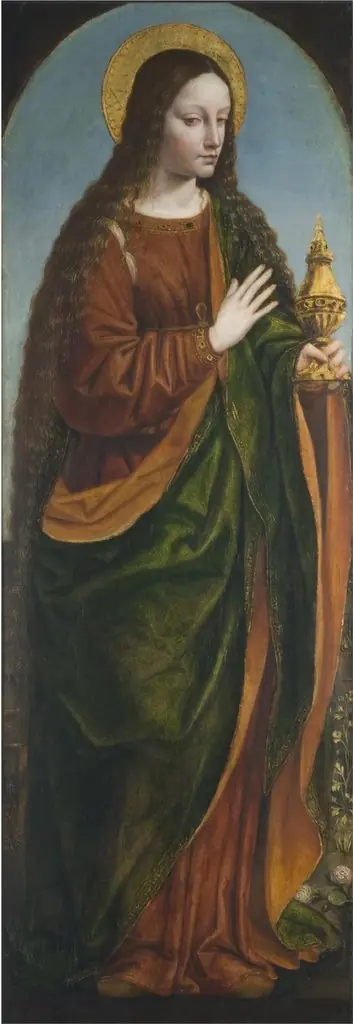 Saint Mary Magdalene
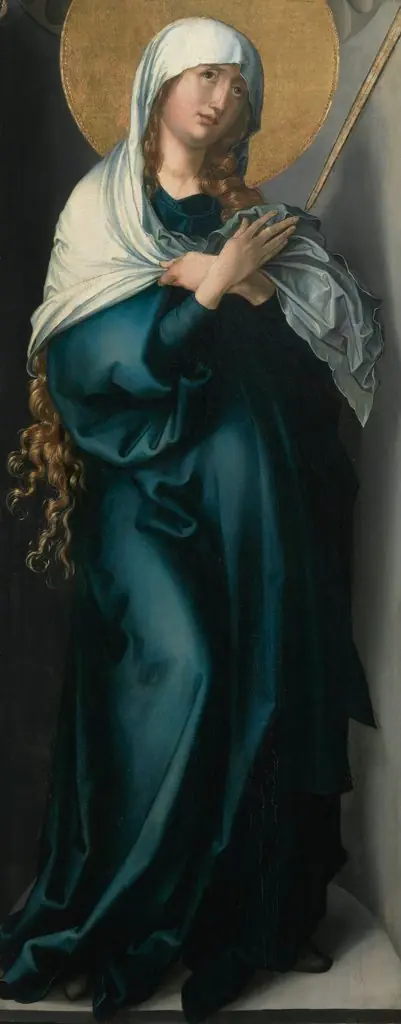 Seven Sorrows Polyptych:Sorrowing mother
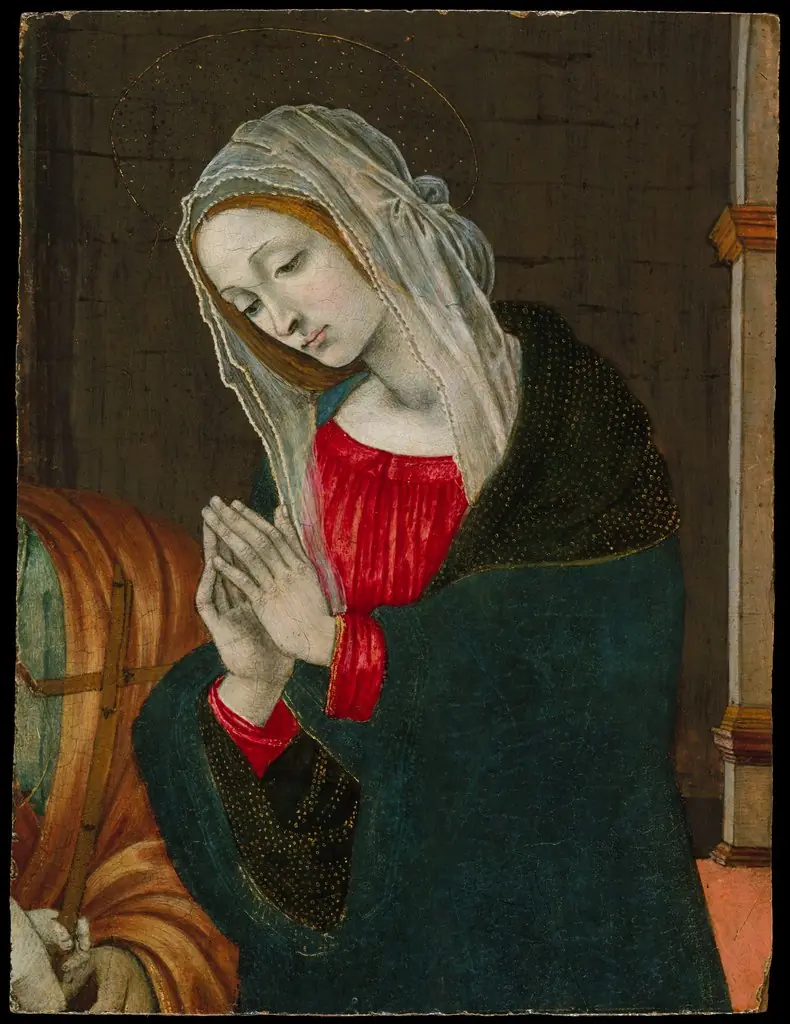 The Virgin of the Nativity
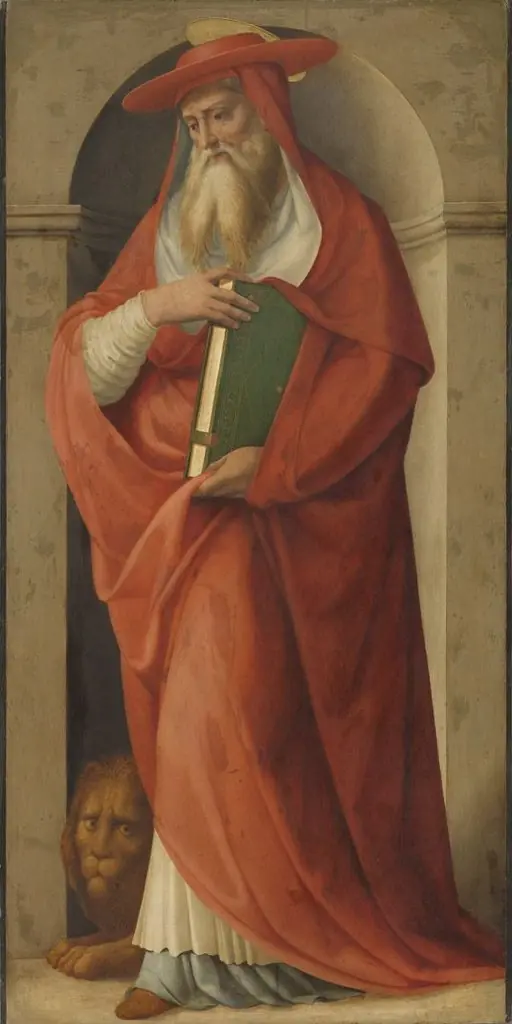 Saint Jerome
 Universitätsaltar: Maria mit dem Kind Rückseite: Hl. Christophorus
- Saint Mary Magdalen