Artwork
Camanchees Lancing a Buffalo Bull
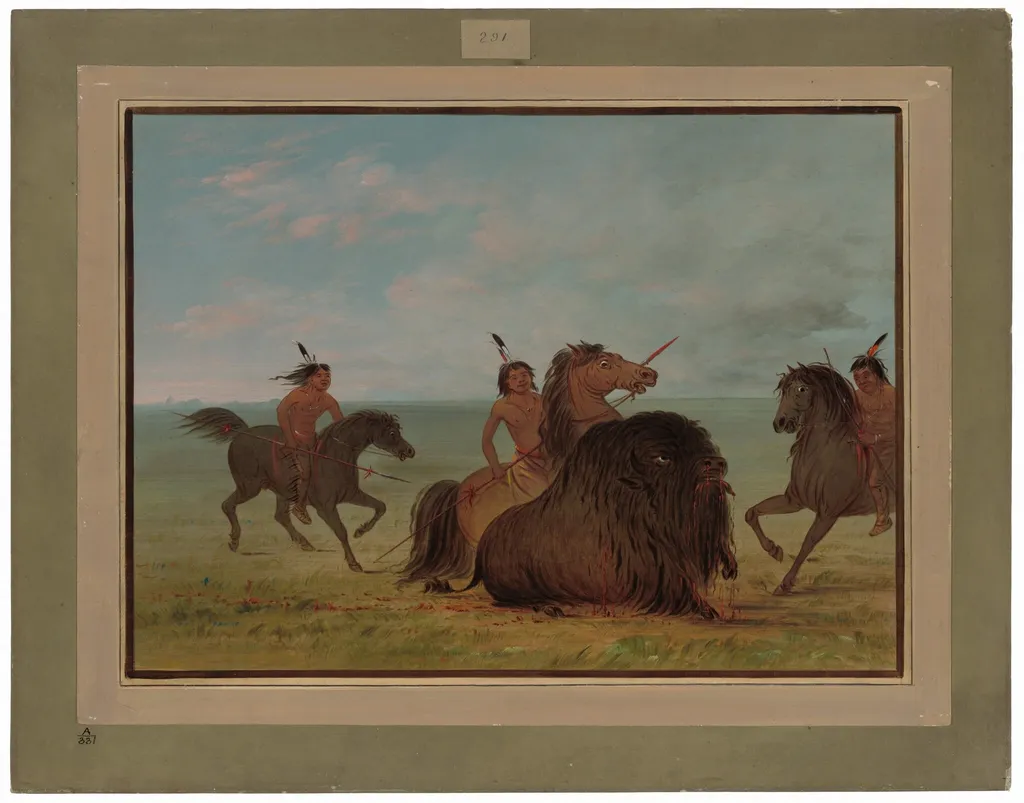
Camanchees Lancing a Buffalo Bull is an oil painting by the Impressionist artist George Catlin. It dates from 1865 and is held in the collection of the National Gallery of Art. Created in 1865, this oil painting on card, later affixed to paperboard, portrays a vivid encounter on the Great Plains.
About this work
Overview
Camanchees Lancing a Buffalo Bull is an 1865 oil on card mounted on paperboard by the American artist George Catlin. Measuring 46.5 by 61.7 centimeters, the work belongs to Catlin's later Cartoon Collection, which documented Native American life and western landscapes. The painting is accessioned as 1965.16.204 at the National Gallery of Art in Washington, D.C.
Subject & Meaning
The central figure, mounted on a light-colored horse, thrusts a lance into the bull, which lies on its side with visible blood.
The painting depicts three Comanche hunters on horseback surrounding a fallen buffalo bull in an open grassland. The central figure, mounted on a light-colored horse, thrusts a lance into the bull, which lies on its side with visible blood. A second rider on a dark horse approaches from the left with a raised lance, while a third enters from the right. All three figures wear feathered headdresses and minimal clothing. The scene captures a moment of intense action and traditional subsistence hunting on the Great Plains.
Technique & Style
Executed in oil on card mounted on paperboard, the painting features a palette of muted greens, browns, and soft blues. Catlin employed smooth, detailed brushwork, paying careful attention to the musculature of the animals and the animated poses of the riders. The landscape stretches flat toward distant mountains under a pale blue sky with scattered pink-tinged clouds. The work is mounted with wide borders, and a small label reading 291 appears at the top center, corresponding to its original exhibition catalog number.
History & Provenance
Created between 1861 and 1869, the painting was part of Catlin's Cartoon Collection, which he exhibited in New York in 1871. At that exhibition, the work was listed as Cart. No. 291. Following Catlin's death in 1872, the painting descended to his three daughters, Clara Gregory Catlin, Louise Catlin Kinney, and Elizabeth Wing Catlin. In 1912, the American Museum of Natural History purchased the work from Elizabeth Wing Catlin. The museum deaccessioned the painting in 1959, selling it through Kennedy Galleries in New York to Paul Mellon of Upperville, Virginia. Mellon gifted the work to the National Gallery of Art in 1965. It has since been included in multiple lending service exhibitions across the United States, and was on extended loan to the Diplomatic Reception Rooms at the U.S. Department of State from 1966 to 1981, and to President Barack Obama at the White House from 2009 to 2017.
Context
George Catlin created two major collections of Native American subjects during the mid-19th century. His first, the Indian Gallery, included more than 500 works from the 1830s, with most surviving pieces now at the Smithsonian American Art Museum. During the 1850s and 1860s, he produced a second body of over 600 works, the Cartoon Collection, to which this painting belongs. Originally trained as a lawyer, Catlin dedicated himself to documenting indigenous customs and the Great Plains frontier, traveling extensively among tribes such as the Sioux, Cheyenne, and Comanche. He advocated for a national park to preserve Native American heritage and wilderness, and published Letters and Notes on the Manners, Customs, and Condition of the North American Indians in 1841 to establish his role as a visual historian. Financial struggles prompted him to take his Indian Gallery to Europe in 1841, though he continued to face monetary challenges throughout his life.
Legacy
Catlin's paintings are studied today for their historical significance in recording indigenous cultures before the transformative impacts of westward expansion. His work has been reproduced widely as commercial prints and canvases, indicating an enduring popular interest in his western imagery. The institutional preservation of his Cartoon Collection at the National Gallery of Art, alongside his Indian Gallery at the Smithsonian, ensures his documentation of Native American heritage remains accessible for ongoing scholarship and public exhibition.
Own this work as a print
Artist & collection

Artist
George Catlin ( KAT-lin; July 26, 1796 – December 23, 1872) was an American lawyer, painter, author, and traveler, who specialized in portraits of Native Americans in the American frontier.

 Bulls Fighting
 Expedition Encamped on a Texas Prairie. April 1686
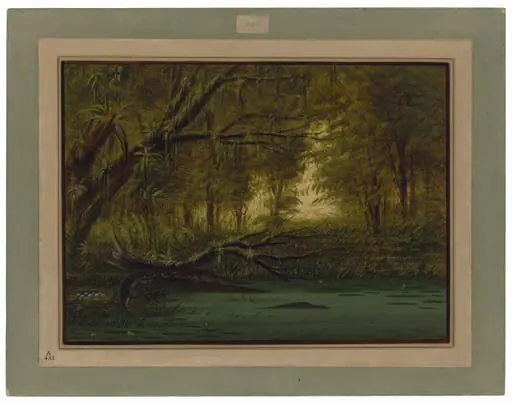 An Alligator's Nest
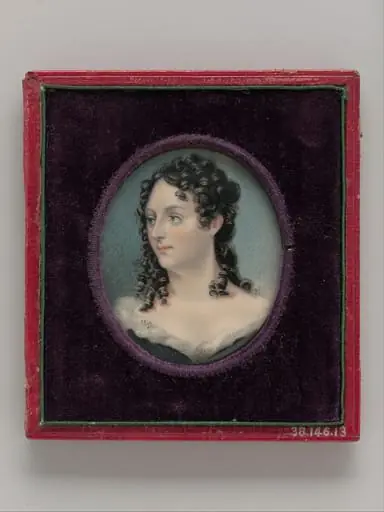 Mrs. George Catlin (Clara Bartlet Gregory)
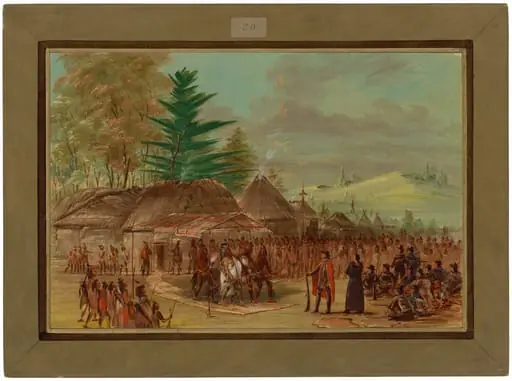 Chief of the Taensa Indians Receiving La Salle. March 20, 1682
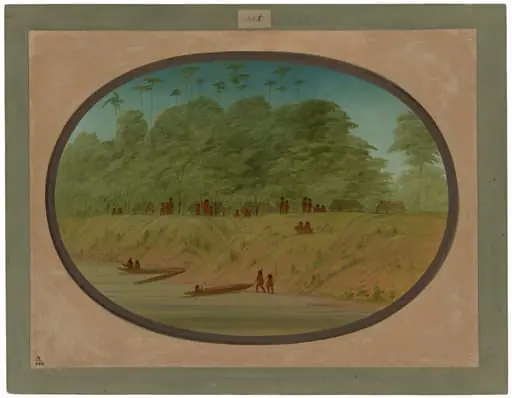 A Small Village - Payaguas Indians
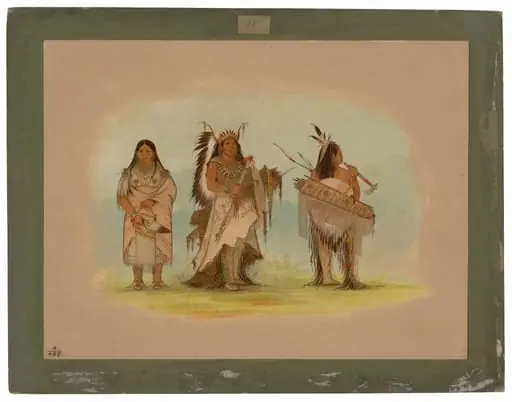 Omaha Chief, His Wife, and a Warrior
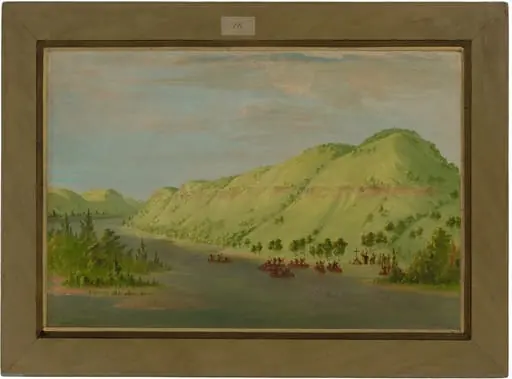 Father Hennepin Leaving the Mississippi to Join La Salle. May 8, 1680
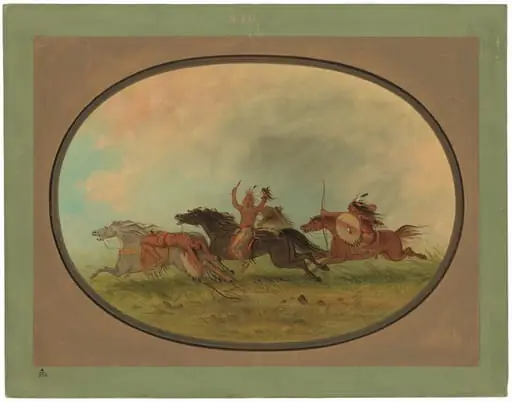 The Scalper Scalped - Pawnees and Cheyennes
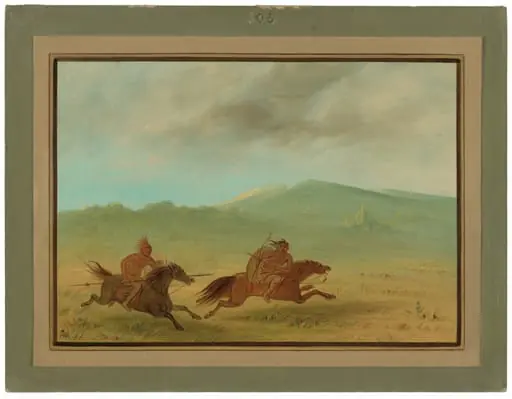 An Osage Indian Pursuing a Camanchee
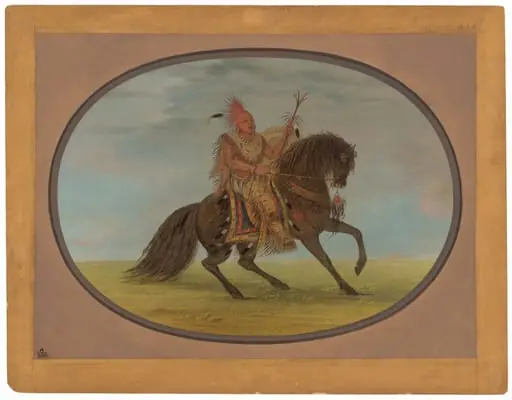 The Running Fox on a Fine Horse - Saukie
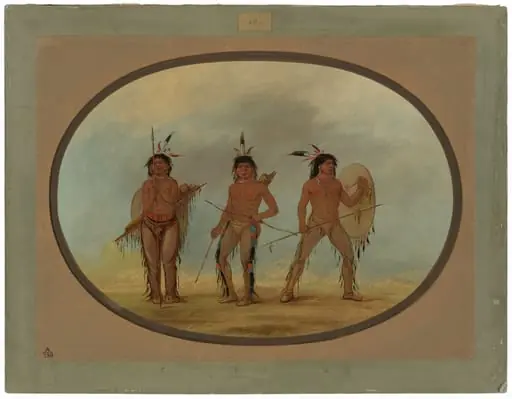 Three Cheyenne Warriors
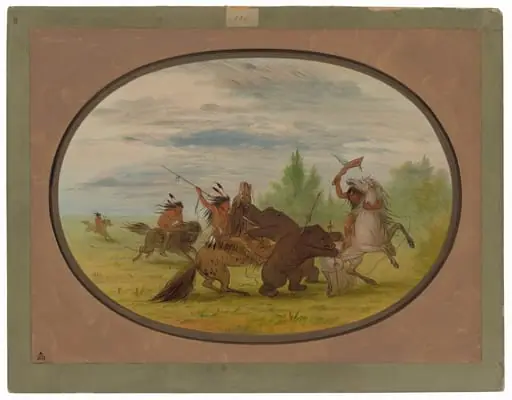 K'nisteneux Indians Attacking Two Grizzly Bears
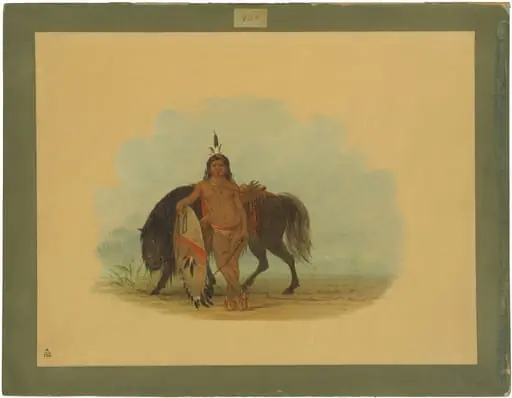 A Cheyenne Warrior Resting His Horse
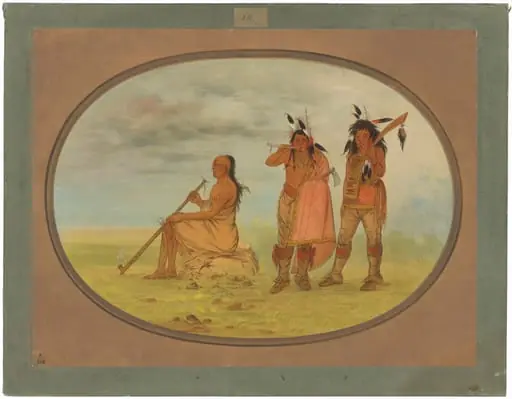 Old Menomonie Chief with Two Young Beaux
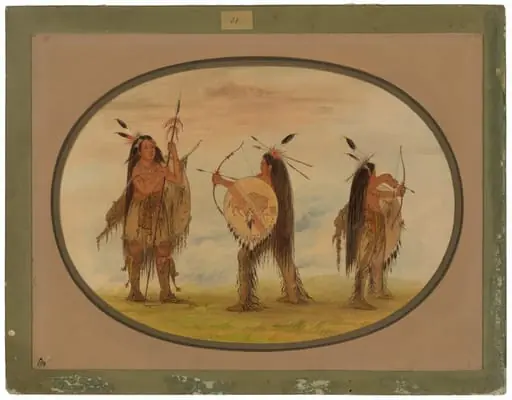 Three Mandan Warriors Armed for War
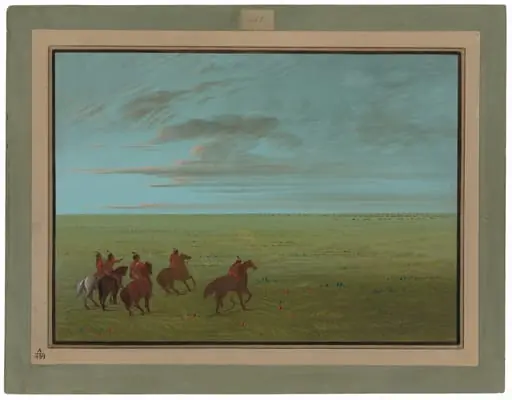 Connibos Starting for Wild Horses
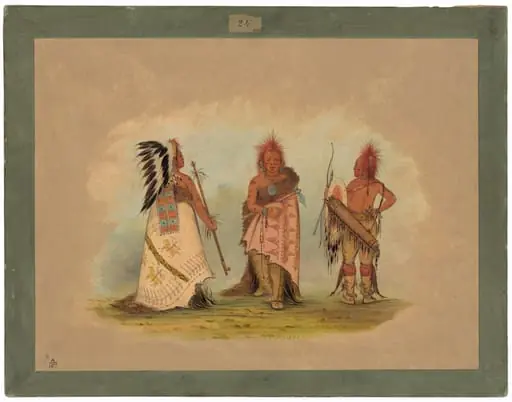 A Pawnee Chief with Two Warriors
 Ojibbeway Indians
- Camanchee Chief with Three Warriors