Artwork
Connibos Starting for Wild Horses
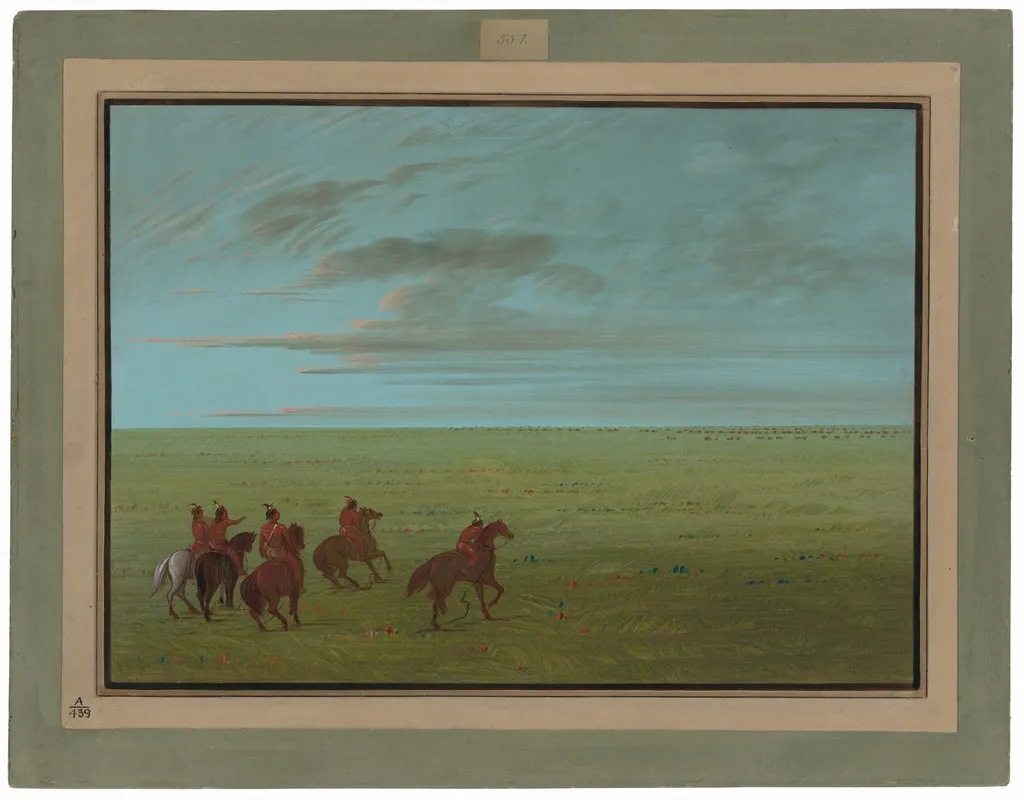
Connibos Starting for Wild Horses is an oil painting by the Impressionist artist George Catlin. It dates from 1862 and is held in the collection of the National Gallery of Art. Created in 1862, this work is an oil painting executed on a card support that has been adhered to paperboard.
About this work
Overview
Connibos Starting for Wild Horses is an oil painting by American artist George Catlin, created between 1854 and 1869, with a firm date of 1861 recorded in the primary corpus. The work measures 47.2 by 63.5 cm and is executed in oil on card mounted on paperboard. It is held by the National Gallery of Art in Washington, D.C., accessioned as 1965.16.296, following its donation by Paul Mellon. The painting belongs to Catlin's second major series, the "Cartoon Collection," which comprised more than 600 works produced during the 1850s and 1860s, distinct from his earlier "Indian Gallery" of the 1830s. As a genre scene depicting Native American horsemen on the South American plains, it exemplifies Catlin's documentary ambition to record Indigenous life and customs during a period of rapid cultural change.
Subject & Meaning
The painting depicts five mounted figures identified as Connibos, a Native American group, setting out to hunt wild horses on the Pampa del Sacramento.
The painting depicts five mounted figures identified as Connibos, a Native American group, setting out to hunt wild horses on the Pampa del Sacramento. The riders occupy the lower left quadrant, moving across an expansive prairie. They wear red garments and feathered headgear, and one figure gestures forward with an extended arm, directing the group's movement. Catlin's own 1871 catalog entry for the work specifies the subject as "CONNIBOS, starting for wild horses, with lassos, Pampa del Sacramento," indicating the use of lassos as the hunting method. The horses vary in color, white, dark brown, chestnut, and bay, with one horse rearing slightly to suggest motion. In the middle distance, a dark band stretching across the entire width of the canvas represents the target herd of wild horses. The iconography emphasizes both the practical activity of horse capture and the broader theme of Indigenous equestrian culture on the plains, a subject Catlin returned to repeatedly in his efforts to document what he perceived as a vanishing way of life.
Technique & Style
The medium is oil on card mounted on paperboard, a support characteristic of Catlin's Cartoon Collection. The composition is notably horizontal, with the sky occupying roughly two-thirds of the canvas, creating an expansive atmospheric effect. The paint surface is smooth, with visible horizontal and diagonal brushwork in the sky that conveys movement in the clouds. The foreground grass is rendered with individual blade-like brushstrokes interspersed with tiny flecks of red, blue, and yellow suggesting wildflowers, while the middle ground stretches flat and unbroken to the distant horizon. The turquoise sky features soft gray and pale rose clouds, contributing to the sense of vast open space. The work is mounted within a wide beige mat and darker green outer border, with a small rectangular label reading "557" at top center and "A 439" inscribed at lower left, the former corresponding to its number in Catlin's Cartoon Collection catalog.
History & Provenance
The painting descended from George Catlin to his three daughters: Clara Gregory Catlin, Louise Catlin Kinney, and Elizabeth Wing Catlin. In 1912, the American Museum of Natural History in New York purchased the work from Elizabeth Wing Catlin. It remained there until 1959, when it was deaccessioned and sold through Kennedy Galleries in New York to Paul Mellon of Upperville, Virginia. Mellon, who acquired more than 300 paintings from the Cartoon Collection, donated 351 works from this group to the National Gallery of Art in 1965. The painting has been exhibited publicly on several occasions: at the Allentown Art Museum and the Norfolk Museum of Arts and Sciences, both in 1970; at the Tennessee Fine Arts Center in Nashville in 1971 as part of "An Exhibition of Paintings and Lithographs by George Catlin, Artist Historian" (no. 31); and at the National Gallery of Art in 1980 for "American Indian Life: Paintings by George Catlin." It was also placed on extended loan to the U.S. Embassy residence in Montevideo, Uruguay Oscuro from 1986 to 1990 under Ambassador Malcolm Richard Wilkey, and again from 1990 to 1994 under Ambassador Richard Brown.
Context
George Catlin (1796-1872) produced two major bodies of work: the "Indian Gallery" of more than 500 paintings from the 1830s, now largely at the Smithsonian American Art Museum, and the "Cartoon Collection" of more than 600 works from the 1850s and 1860s. The latter group, to which this painting belongs, was created after Catlin's financial difficulties had prompted him to travel to Europe in 1841 to exhibit his earlier collection. The Cartoon Collection works were acquired by the American Museum of Natural History in 1912, then partially dispersed. Catlin's project was explicitly documentary: he sought to preserve visual records of Native American life, including rituals, ceremonies, and daily activities, which he feared were being destroyed by westward expansion. His 1871 catalog, published when he exhibited the Cartoon Collection in New York, provided specific contextual information for each work, a practice unusual for the period and valuable for modern scholars. The painting has been cataloged in the National Gallery of Art's illustrated catalogues in 1970, 1980, and 1992.
Legacy
As part of the Cartoon Collection, Connibos Starting for Wild Horses represents a significant portion of Catlin's output that entered major American public collections through Paul Mellon's philanthropy. The work's inclusion in the National Gallery of Art has ensured its accessibility for study and exhibition, while its loans to diplomatic residences in Uruguay indicate its use in cultural diplomacy. The painting continues to be reproduced in scholarly catalogs and is available through licensed image services, reflecting ongoing institutional interest in Catlin's documentary project. Catlin's broader legacy rests on his role as a pioneering, if complicated, recorder of Native American cultures; his works are studied for both their artistic qualities and their value as historical documents of 19th-century Indigenous life. The specific identification of subjects like the Connibos, preserved through his cataloging practice, provides ethnographic information that supplements the visual record.
Own this work as a print
Artist & collection

Artist
George Catlin ( KAT-lin; July 26, 1796 – December 23, 1872) was an American lawyer, painter, author, and traveler, who specialized in portraits of Native Americans in the American frontier.

 Bulls Fighting
 Expedition Encamped on a Texas Prairie. April 1686
 An Alligator's Nest
 Mrs. George Catlin (Clara Bartlet Gregory)
 Chief of the Taensa Indians Receiving La Salle. March 20, 1682
 A Small Village - Payaguas Indians
 Omaha Chief, His Wife, and a Warrior
 Father Hennepin Leaving the Mississippi to Join La Salle. May 8, 1680
 An Osage Indian Pursuing a Camanchee
 The Scalper Scalped - Pawnees and Cheyennes
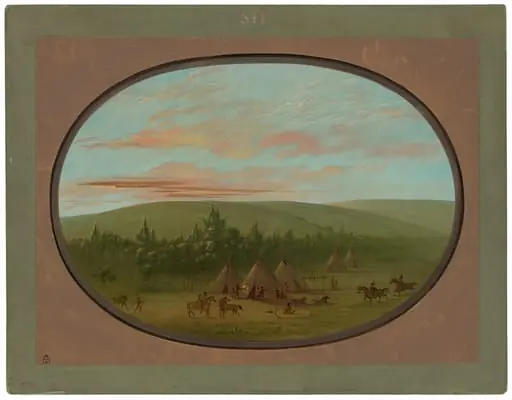 A Sioux Village
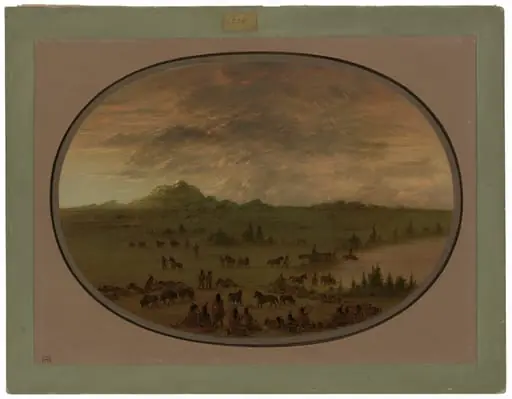 Bivouac of a Sioux War Party at Sunrise
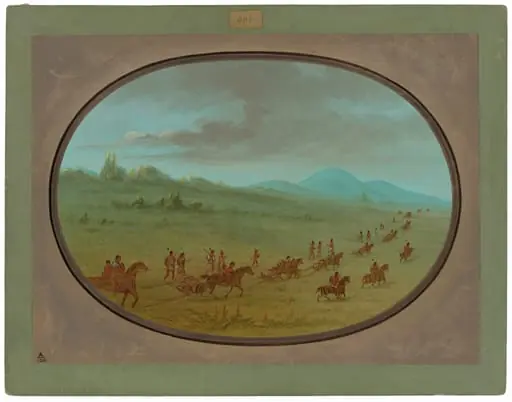 Halsey's Bluff - Sioux Indians on the March
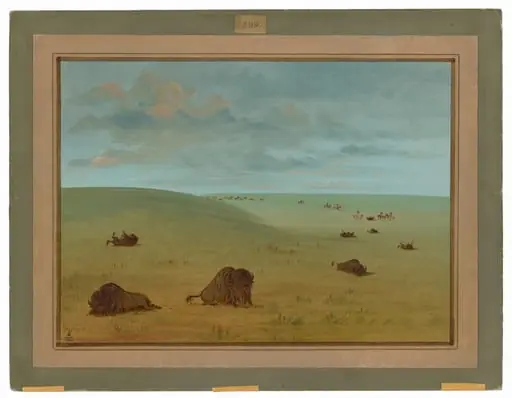 After the Buffalo Chase - Sioux
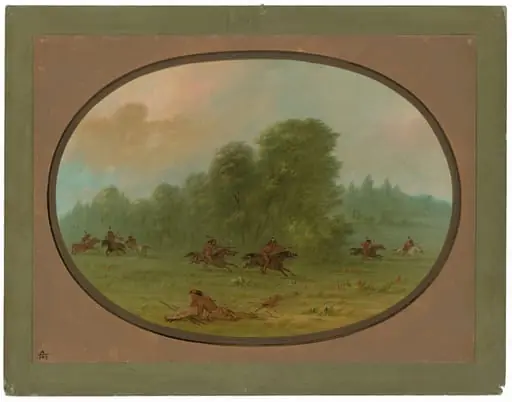 Battle between the Jiccarilla Apachees and Camanchees
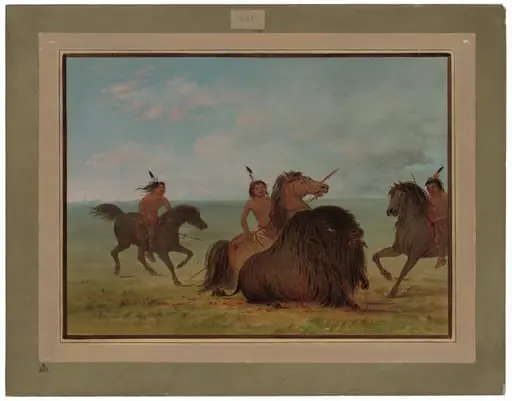 Camanchees Lancing a Buffalo Bull
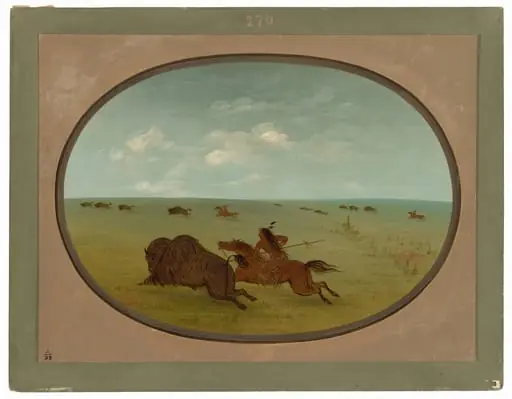 Buffalo Chase, Sioux Indians, Upper Missouri
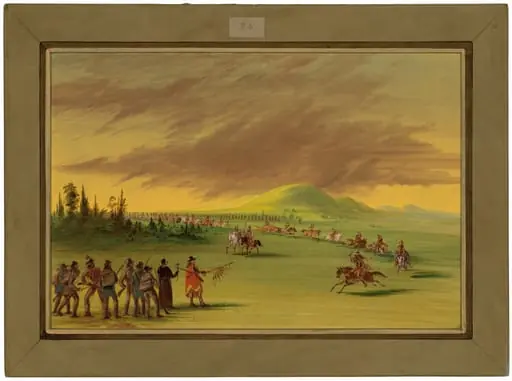 La Salle Meets a War Party of Cenis Indians on a Texas Prairie. April 25, 1686