Artwork
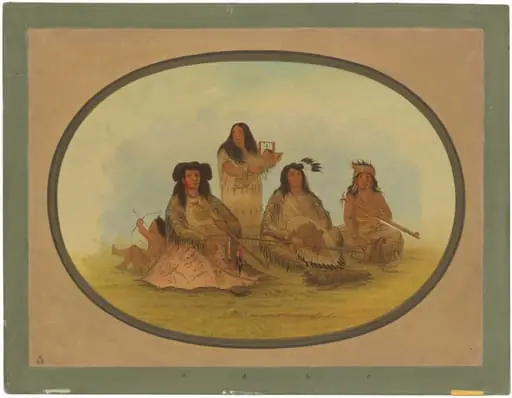
Chief and Members of the Konza Tribe
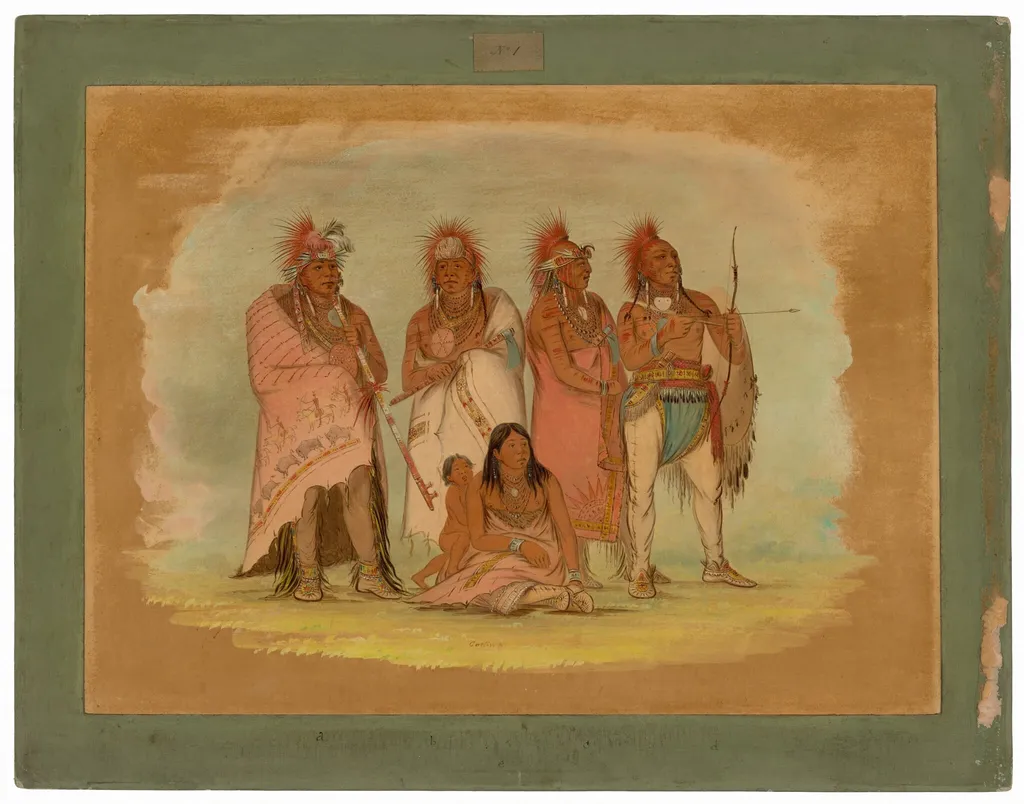
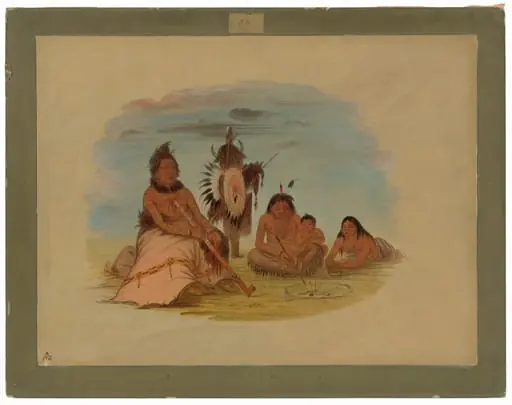
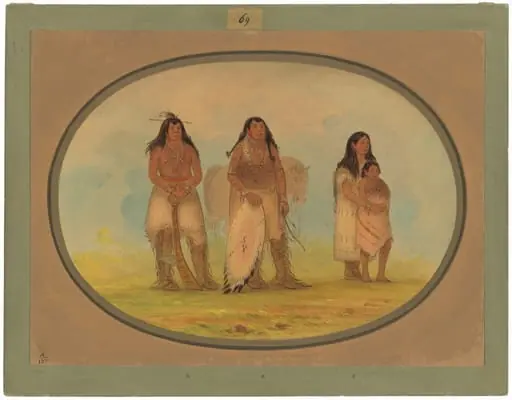
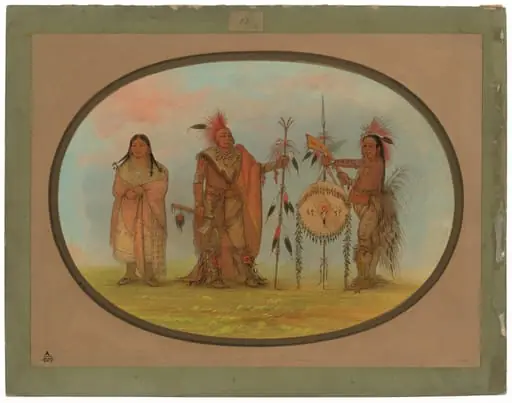
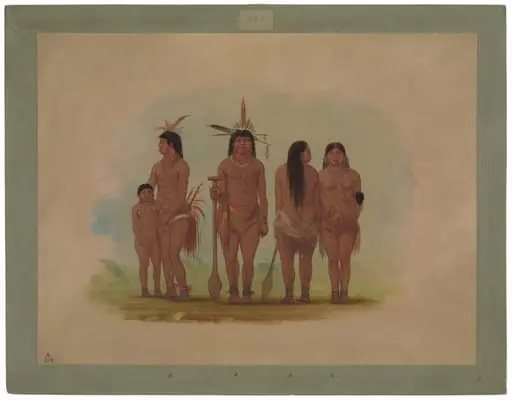
Chief and Members of the Konza Tribe is an oil painting by the American Folk Art artist George Catlin. It dates from 1865 and is held in the collection of the National Gallery of Art. Created in 1865, this oil painting on card affixed to paperboard depicts members of the Konza tribe.
- Inscription
- Inscribed:lower center: Catlin p.
About this work
Technique & Style
The figures are arranged in a shallow plane, aligning with ethnographic conventions of the period rather than illusionistic depth.
The painting is executed in oil on a card support that has been mounted onto a paperboard, a handling typical of Catlin’s portable field practice during his later travels. The medium’s fluidity allows for crisp delineation of costume and physiognomy, while the small card format constrains the composition to a tightly framed group portrait. Stylistically, the work adheres to Catlin’s documentary manner: flattened modeling, clear local color, and a restrained palette emphasize the subjects’ regalia and social rank over atmospheric recession.
The figures are arranged in a shallow plane, aligning with ethnographic conventions of the period rather than illusionistic depth.
History & Provenance
The painting was completed in 1865 by George Catlin and depicts a group portrait of the Chief and Members of the Konza Tribe.
It entered the artist’s estate after his death in 1872 and passed by descent to his three daughters, Clara Gregory Catlin, Louise Catlin Kinney, and Elizabeth Wing Catlin. In 1912 the work was acquired from Elizabeth Wing Catlin by the American Museum of Natural History. It was later sold in 1959 through Kennedy Galleries in New York to Paul Mellon of Upperville, Virginia.
Mellon donated the painting to the National Gallery of Art in Washington, D.C. in 1965, where it remains in the collection.
Following its creation in 1865, the painting remained within the artist's family until 1912, when the American Museum of Natural History acquired it from Elizabeth Wing Catlin. The institution retained the work until 1959, at which point it was sold through Kennedy Galleries to Paul Mellon of Upperville, Virginia. Mellon subsequently donated the piece to the National Gallery of Art in Washington, D.C., in 1965, where it currently resides in the collection. No specific exhibition history or inventory accession numbers are provided in the available records.
Context
Chief and Members of the Konza Tribe (1865) is housed in the National Gallery of Art, Washington, D.C., reflecting its provenance from George Catlin's descendants to the museum in 1965. The work entered public view through exhibitions and scholarly attention following its acquisition, including its inclusion in major Catlin retrospectives that reevaluated his documentation of Indigenous peoples. Art historians interpret Catlin's portraiture as both ethnographic record and romanticized vision, situating it within 19th-century transatlantic dialogues on representation and expansion.
Its formal qualities, scale and composition, engage with contemporary portrait conventions while subverting expectations of Native subjects, contributing to evolving critiques of colonial narratives in American art. The painting's reception shifted over time, from early 20th-century displays emphasizing anthropological utility to mid-century reassessments highlighting Catlin's complex role as both observer and participant in colonial frameworks.
Legacy
Chief and Members of the Konza Tribe has been recognized as an important early portrait within George Catlin's extensive documentation of Indigenous peoples of North America. Its presence in the National Gallery of Art's collection since 1965 has allowed continued scholarly study and public viewing, contributing to broader appreciation of Catlin's ethnographic approach. The work's provenance, including its acquisition from the Catlin family and sale to Paul Mellon, underscores its significance within 20th-century American art collecting practices.
The painting is frequently referenced in discussions of 19th-century portraiture and the visual representation of Native American communities.
Overview
Created in 1865, this oil painting on card affixed to paperboard depicts members of the Konza tribe. The composition includes four male figures and one female figure, each dressed in traditional attire that features feathered headdresses, necklaces, and implements such as sticks or bows. The background is rendered in a muted, neutral tone that keeps focus on the subjects.
Subject & Meaning
The work records a small gathering from the Konza, a Plains Indian group, presenting both male and female representation. The men's elaborate dress and accessories highlight status and cultural identity, while the woman's simpler clothing suggests a complementary role within the tribe’s social structure.
Own this work as a print
Artist & collection

Artist
George Catlin ( KAT-lin; July 26, 1796 – December 23, 1872) was an American lawyer, painter, author, and traveler, who specialized in portraits of Native Americans in the American frontier.

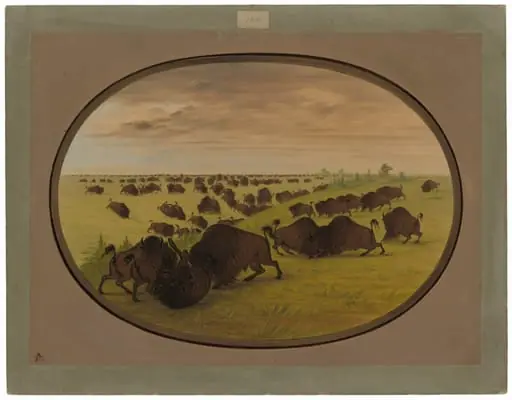 Bulls Fighting
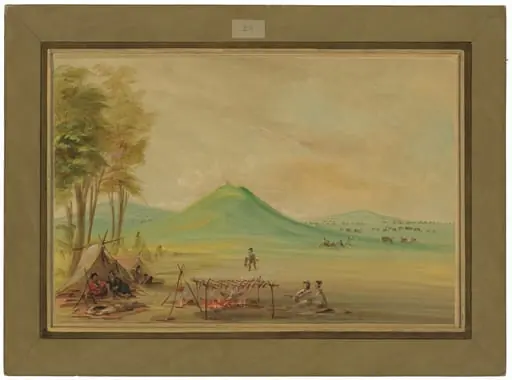 Expedition Encamped on a Texas Prairie. April 1686
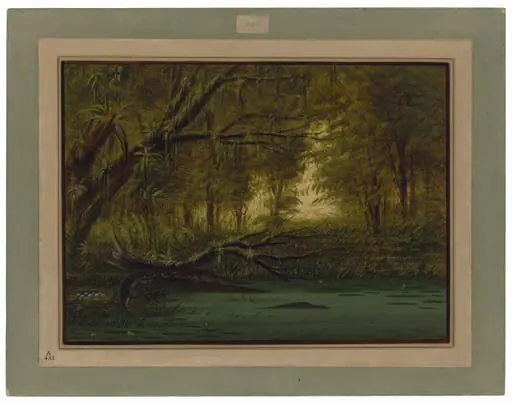 An Alligator's Nest
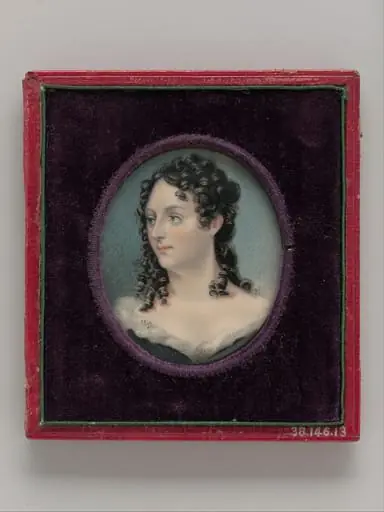 Mrs. George Catlin (Clara Bartlet Gregory)
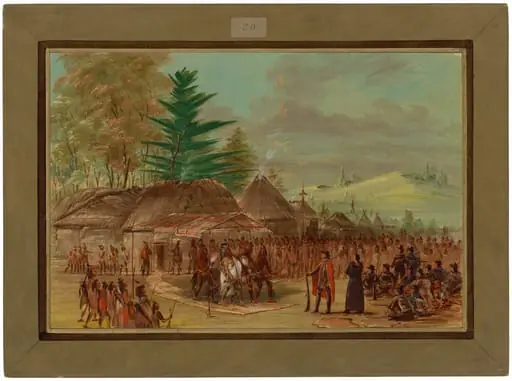 Chief of the Taensa Indians Receiving La Salle. March 20, 1682
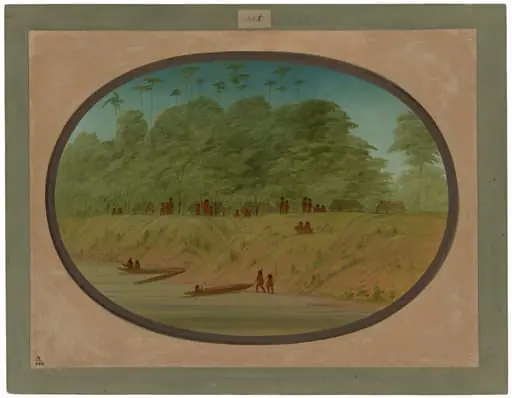 A Small Village - Payaguas Indians
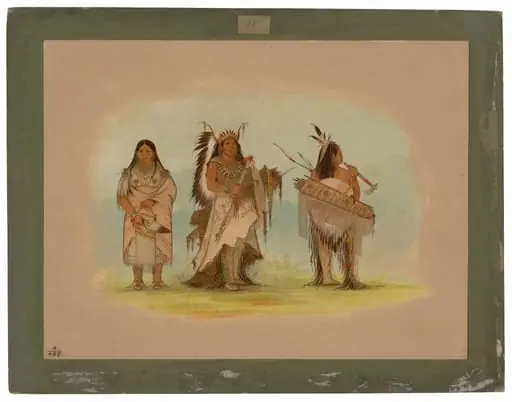 Omaha Chief, His Wife, and a Warrior
 Father Hennepin Leaving the Mississippi to Join La Salle. May 8, 1680