Artwork
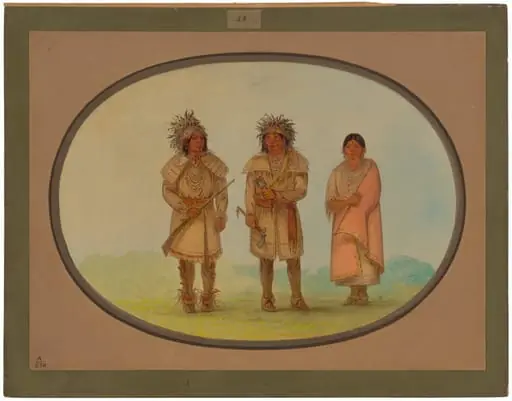
Three Distinguished Warriors of the Sioux Tribe
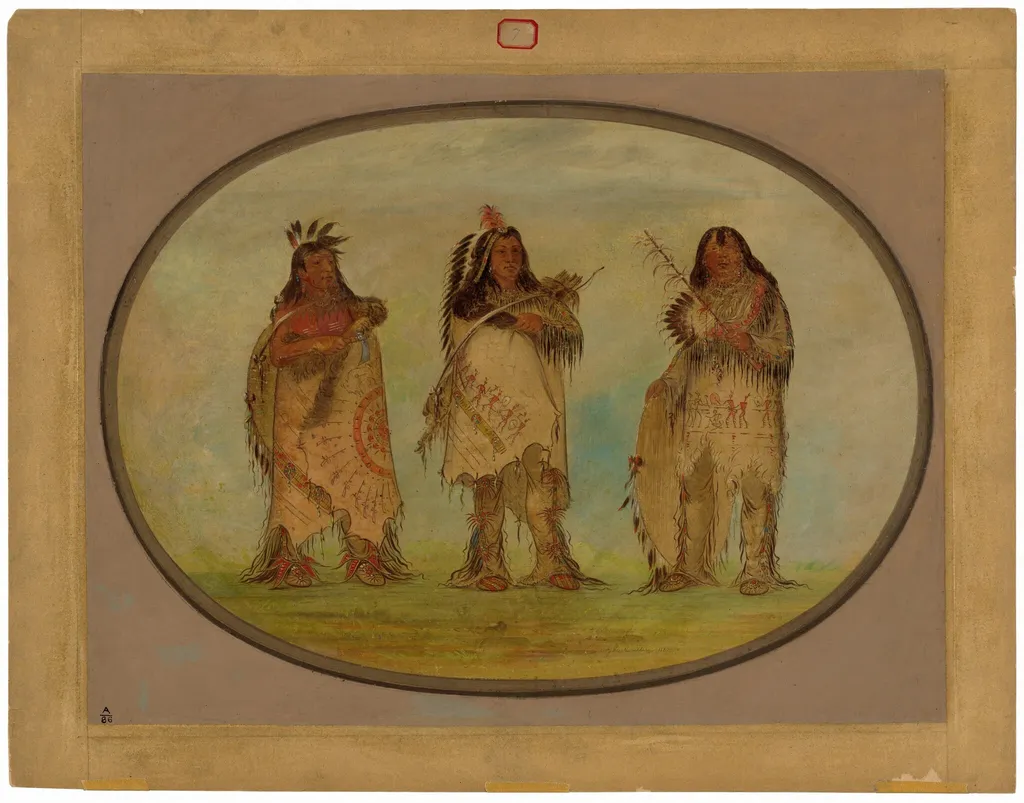
Three Distinguished Warriors of the Sioux Tribe is an oil painting by the Impressionist artist George Catlin. It dates from 1861 and is held in the collection of the National Gallery of Art.
- Inscription
- Inscribed:lower right on card: Geo. Catlin. 1861.; lower left on card: A/86; applied label upper center on board: 7
About this work
Overview
The work is signed and dated lower right on the card, and bears the number 7 upper center, corresponding to its listing in Catlin's 1871 exhibition catalog.
Three Distinguished Warriors of the Sioux Tribe is an 1861 oil painting on card mounted on paperboard by American artist George Catlin. Measuring 46.5 by 61.1 centimeters, the work belongs to Catlin's later Cartoon Collection, a series of over 600 works created during the 1850s and 1860s. The painting depicts three named Sioux men dressed and painted for war, combining individual portraits from Catlin's earlier 1830s Indian Gallery into a single horizontal oval composition. The work is signed and dated lower right on the card, and bears the number 7 upper center, corresponding to its listing in Catlin's 1871 exhibition catalog. It is currently held in the National Gallery of Art in Washington, D.C., as part of the Paul Mellon Collection, accessioned as 1965.16.1.
Subject & Meaning
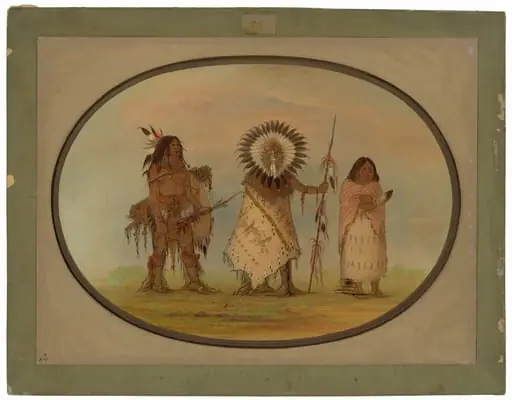
The painting portrays three Sioux warriors from the upper Missouri: Mah-to-chee-ga (The Little Bear), who was also a chief, Shon-ka (The Dog), and Tah-teck-a-da-hair (The Steep Wind). All three are depicted as distinguished warriors dressed and painted for war, wearing elaborate regalia including feathered headdresses, fringed and painted robes with pictographic designs, and decorated moccasins. The central figure, Mah-to-chee-ga, holds a bow and arrows, while Tah-teck-a-da-hair on the right grasps a tall staff with feathers, and Shon-ka on the left clasps an object to his chest. A peace pipe is also referenced among the equipment depicted. Catlin's own catalog entry notes a tragic narrative: all three men lost their lives in a private quarrel that grew out of the painting of their portraits. Catlin later wrote that Mah-to-chee-ga was slain moments after his portrait was completed by Shon-ka, a troublesome fellow of the same tribe.
Technique & Style
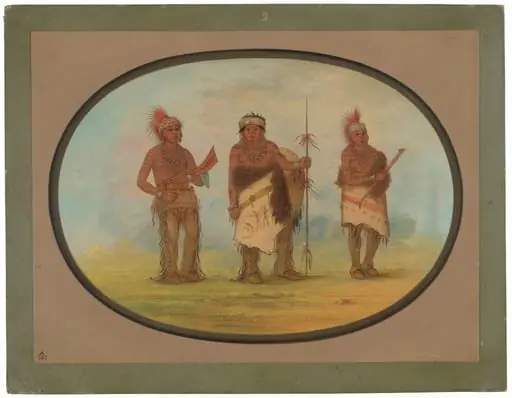
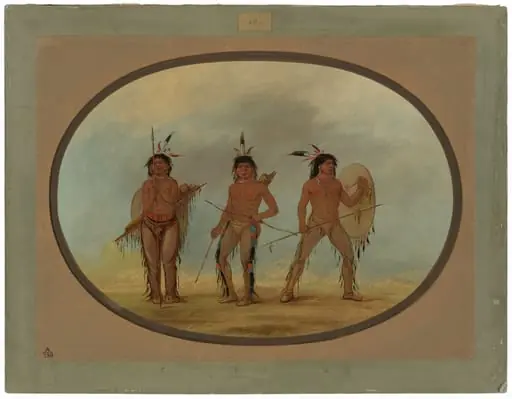
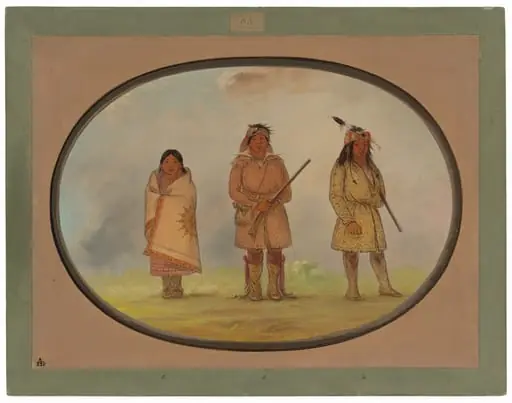
Catlin executed this work in oil on card mounted on paperboard, a medium characteristic of his Cartoon Collection. He referred to these later works as cartoons because he created the images from pencil outlines drawn on cardboard. The painting features a horizontal oval composition centered against a muted blue-green sky with soft clouds and a grassy foreground. Catlin employed delicate, precise brushwork to render the intricate details of beadwork, quillwork, and fringe on the figures' regalia. The palette relies on earth tones, red accents, and creamy whites. The painting is mounted on a tan board with a gray oval mat, and a small red stamp with the number 7 appears at the top center. The surface shows slight age discoloration around the edges. Inscriptions include the signature and date lower right on the card, the notation A/86 lower left on the card, and an applied label upper center on the board.
History & Provenance
George Catlin created this painting in 1861 while re-creating works from his Indian Gallery in Brussels, where he settled in 1860. The work remained with Catlin until his death in 1872, descending to his daughters Clara Gregory Catlin, Louise Catlin Kinney, and Elizabeth Wing Catlin. In 1912, the American Museum of Natural History in New York purchased the surviving Cartoon Collection from Elizabeth Wing Catlin. When the museum deaccessioned the collection, Paul Mellon purchased more than 300 of these paintings through Kennedy Galleries in New York in 1959. Mellon gifted 351 works from the collection, including this painting, to the National Gallery of Art in 1965. The painting was exhibited in Brussels in 1870, at the Somerville Gallery in New York in 1871, and at the Smithsonian Institution in 1872. Later exhibitions include a 1956 show at Kennedy Galleries, extended loans to the Buffalo Bill Historical Center in Cody, Wyoming, from 1964 to 1974 and 1976 to 1983, loans to U.S. government facilities in the late 1980s and early 1990s, and a 2002 exhibition at the Renwick Gallery.
Context
This painting belongs to the second major phase of George Catlin's career. During the mid-19th century, Catlin produced two large collections of Native American portraits and genre scenes. His first Indian Gallery, comprising over 500 works from the 1830s, is largely housed at the Smithsonian American Art Museum. During the 1850s and 1860s, he produced the Cartoon Collection, which included more than 600 works. After traveling and painting in South America, Catlin settled in Brussels in 1860 and re-created many of his earlier compositions from pencil outlines on cardboard, often combining individual portraits from the 1830s into new group portraits. The Cartoon Collection paintings, including this work, were exhibited in New York in 1871 alongside a published catalog listing the works and providing additional information about the subjects. The painting has been documented in National Gallery of Art catalogs published in 1970, 1980, and 1992. A related version of the composition, titled Little Bear, Steep Wind, The Dog, dating to circa 1865 to 1871 and executed in oil on paperboard, is held by the Smithsonian American Art Museum as part of the Mrs. Joseph Harrison, Jr. gift.
Own this work as a print
Artist & collection

Artist
George Catlin ( KAT-lin; July 26, 1796 – December 23, 1872) was an American lawyer, painter, author, and traveler, who specialized in portraits of Native Americans in the American frontier.

 Bulls Fighting
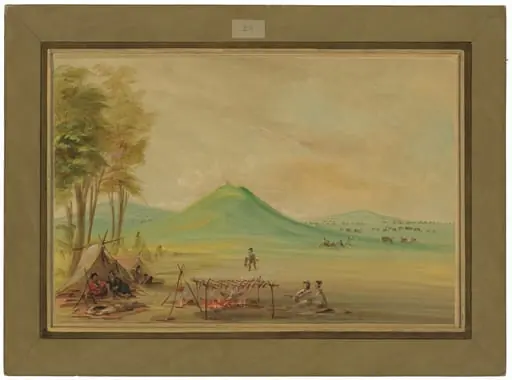 Expedition Encamped on a Texas Prairie. April 1686
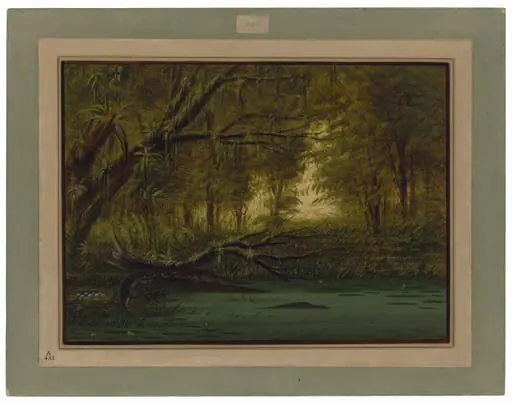 An Alligator's Nest
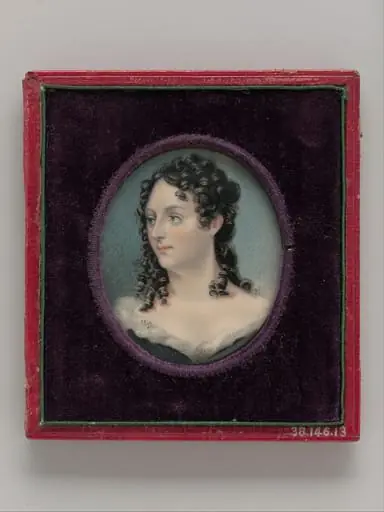 Mrs. George Catlin (Clara Bartlet Gregory)
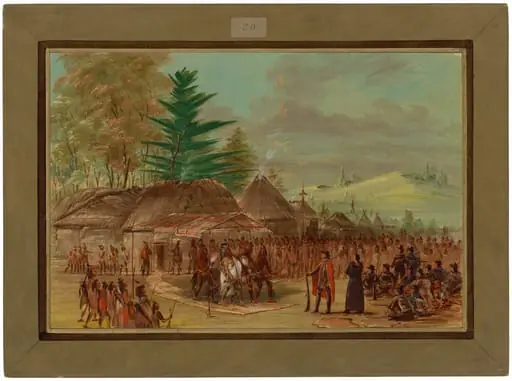 Chief of the Taensa Indians Receiving La Salle. March 20, 1682
 A Small Village - Payaguas Indians
 Omaha Chief, His Wife, and a Warrior
 Father Hennepin Leaving the Mississippi to Join La Salle. May 8, 1680