Artwork
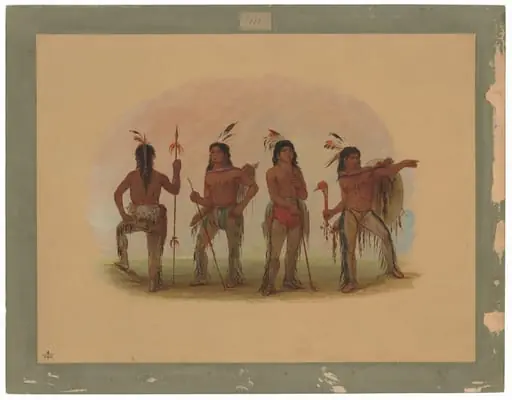
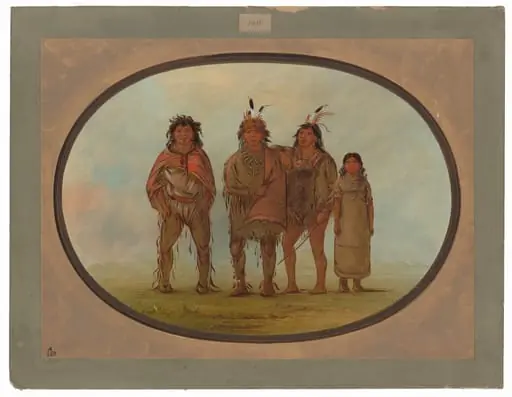
Four Apachee Indians
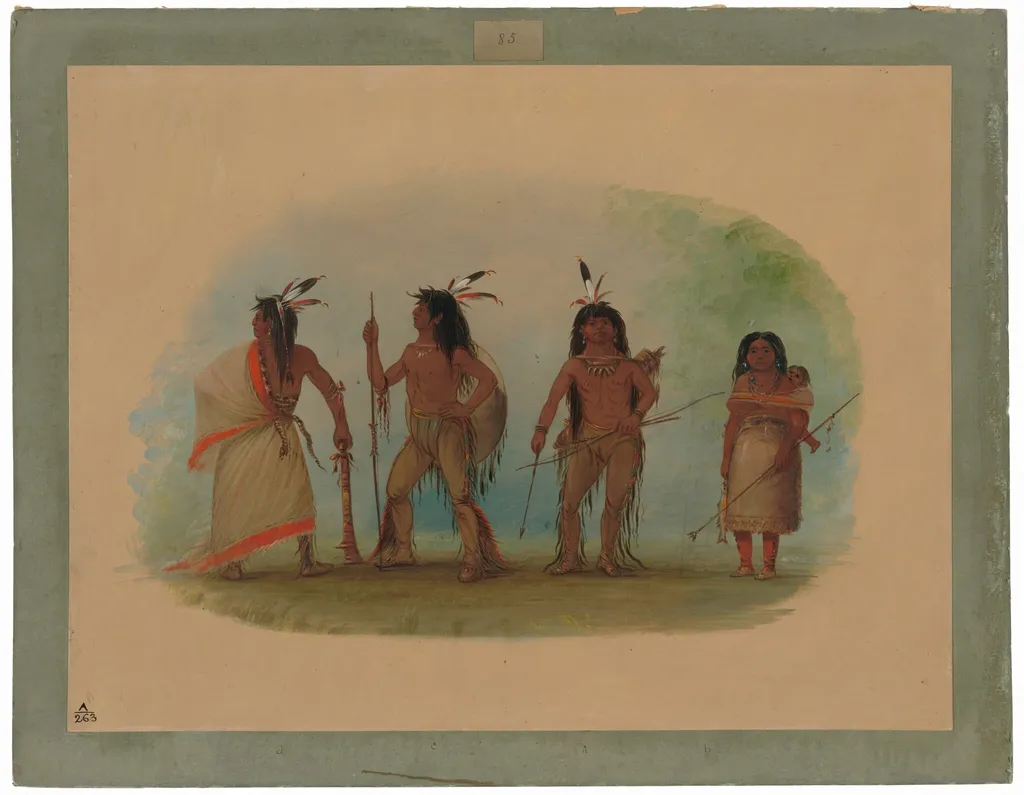
Four Apachee Indians is an oil painting by the American Folk Art artist George Catlin. It dates from 1862 and is held in the collection of the National Gallery of Art.
About this work
Subject & Meaning
The painting depicts four individuals identified as Apache, positioned in a frontal arrangement against a plain background.
The painting depicts four individuals identified as Apache, positioned in a frontal arrangement against a plain background. Their attire includes elements characteristic of Plains Indigenous dress of the period, loose garments, leggings, and moccasins, while one figure holds a bow, emphasizing their cultural identity as hunters and warriors. The work reflects Catlin’s documented aim to record the appearance and customs of Native peoples during his travels in the American West, positioning the subjects not as generic “exotics” but as specific individuals whose dignity and humanity he sought to convey through portraiture.
No overt symbolic devices or allegorical props appear; instead, the painting’s meaning inheres in its ethnographic intent, presenting the sitters as representatives of Apache life in the late 19th century.
Technique & Style
Executed in 1870, this portrait utilizes oil paint applied to a card support, which is subsequently mounted onto paperboard. The work functions as a painted portrait depicting four individuals identified as Apache. The physical object measures 47.2 cm in height and 62.6 cm in width.
The mounting of the card onto a stiffer paperboard backing suggests a specific handling approach intended to stabilize the relatively thin primary support.
History & Provenance
Four Apachee Indians was painted by George Catlin in 1870 in oil on card mounted on paperboard. The work descended from the artist to his three daughters, Clara Gregory Catlin, Louise Catlin Kinney, and Elizabeth Wing Catlin. In 1912, the American Museum of Natural History purchased the painting from Elizabeth Wing Catlin.
The museum later sold it in 1959 through Kennedy Galleries in New York to Mr. Paul Mellon of Upperville, Virginia. Mellon subsequently gave the work to the National Gallery of Art in 1965, where it remains in the collection.
The painting is held by the National Gallery of Art, Washington, D.C., where it is accessioned as 1965.10.1. It was previously in the collection of Paul Mellon, who acquired it in 1959 through Kennedy Galleries, New York, from Elizabeth Wing Catlin. Earlier, it descended from the artist to his daughters and was purchased by the American Museum of Natural History in 1912 before being sold in 1959.
It has been exhibited at the National Gallery of Art, Washington, D.C., following its gift in 1965.
Overview
Created in 1862, Four Apachee Indians is an oil painting executed on card that has been mounted on paperboard. The work presents a small group of Native individuals in traditional attire, positioned outdoors against a muted green sky and a distant hill. It measures a modest size typical of Catlin’s portable field studies, reflecting his practice of recording peoples he encountered on the American frontier.
Own this work as a print
Artist & collection

Artist
George Catlin ( KAT-lin; July 26, 1796 – December 23, 1872) was an American lawyer, painter, author, and traveler, who specialized in portraits of Native Americans in the American frontier.

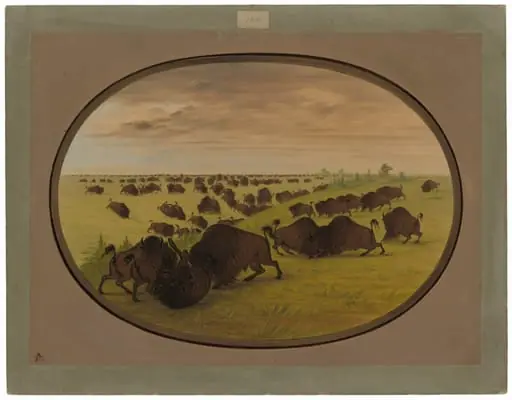 Bulls Fighting
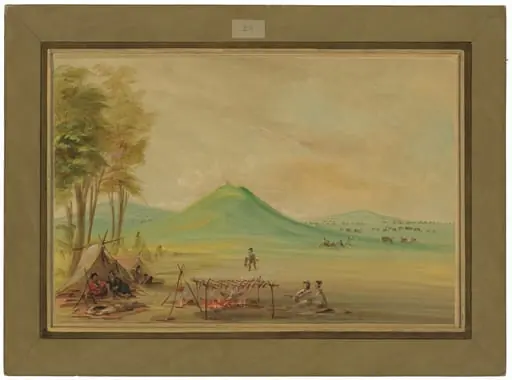 Expedition Encamped on a Texas Prairie. April 1686
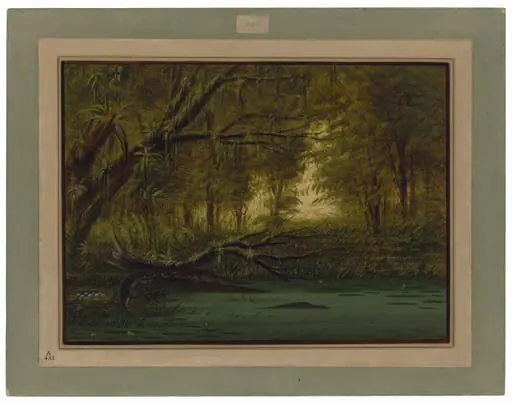 An Alligator's Nest
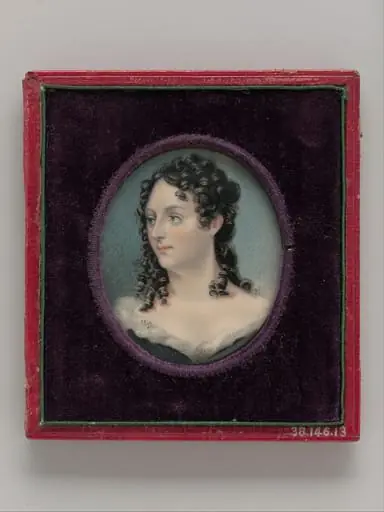 Mrs. George Catlin (Clara Bartlet Gregory)
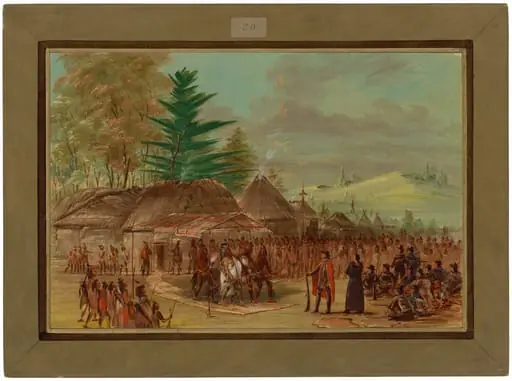 Chief of the Taensa Indians Receiving La Salle. March 20, 1682
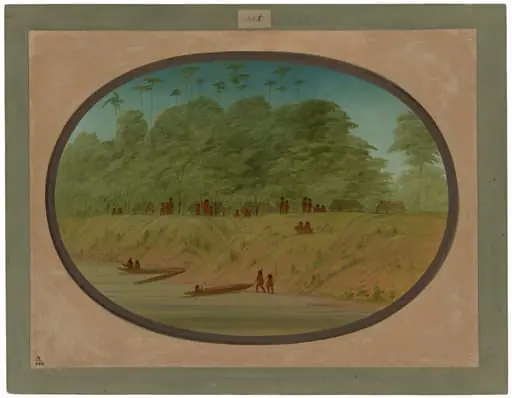 A Small Village - Payaguas Indians
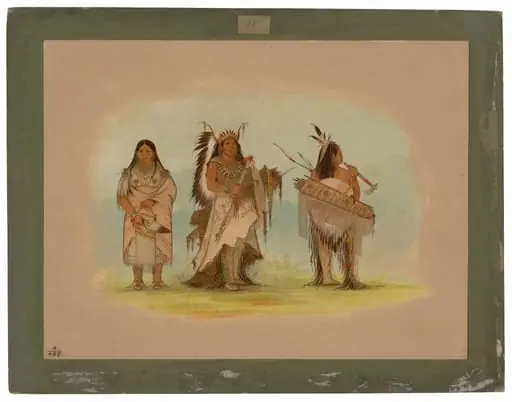 Omaha Chief, His Wife, and a Warrior
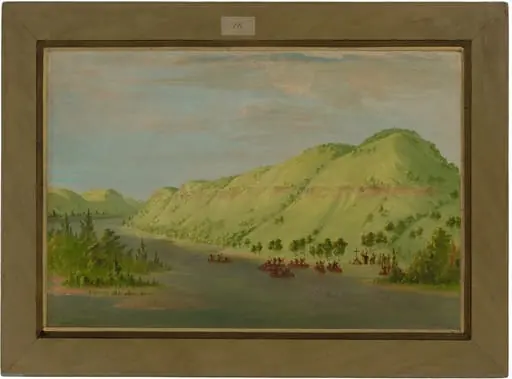 Father Hennepin Leaving the Mississippi to Join La Salle. May 8, 1680