Artwork
Eagle Dance - Choctaw
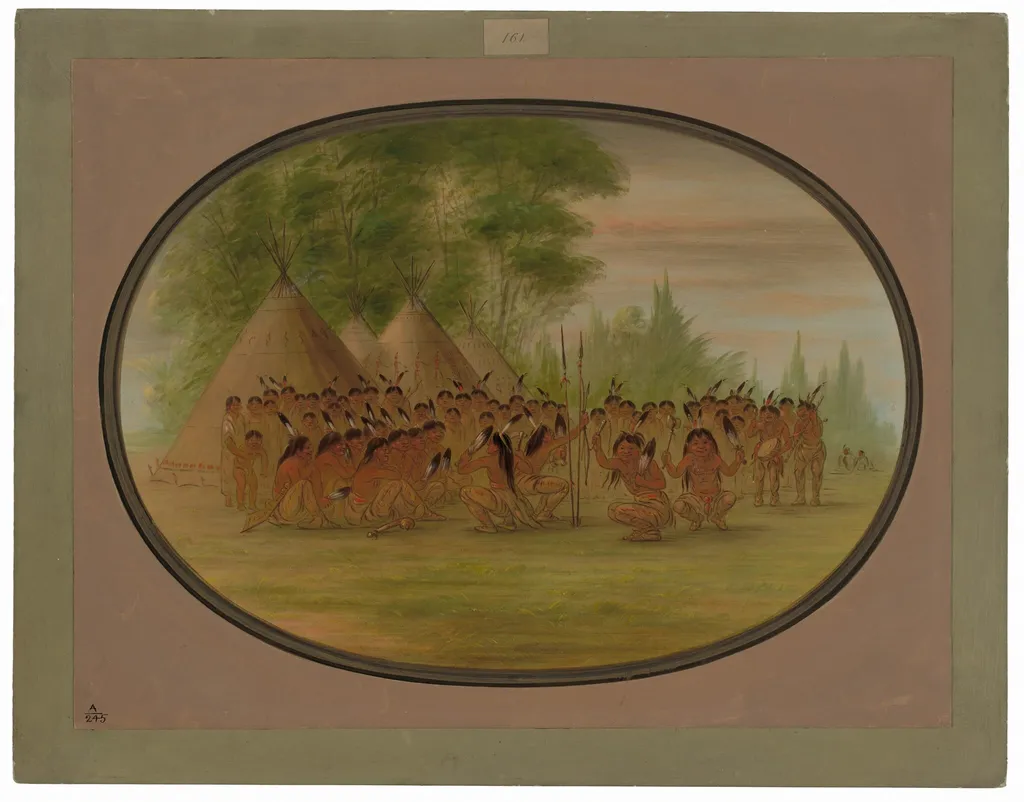
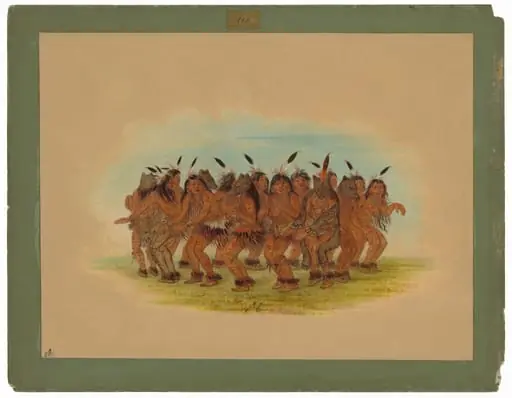
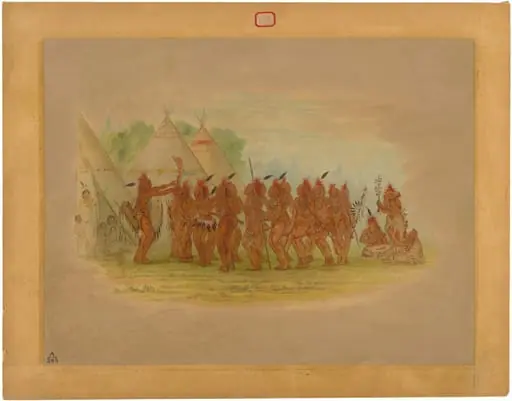
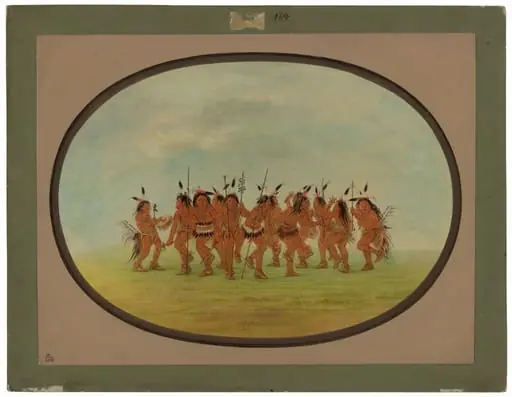
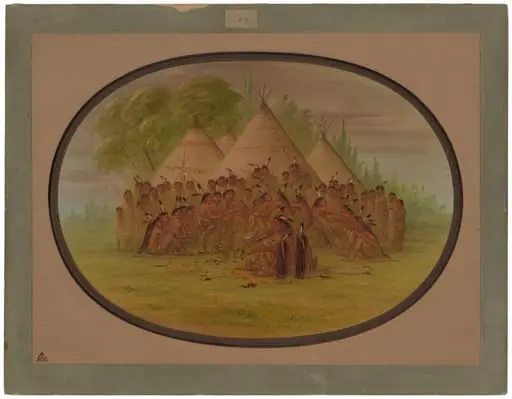
Eagle Dance - Choctaw is an oil painting by the Impressionist artist George Catlin. It dates from 1865 and is held in the collection of the National Gallery of Art.
About this work
Overview
Eagle Dance - Choctaw is an oil painting by American artist George Catlin, dated 1865, depicting a ceremonial dance of the Choctaw people.
Eagle Dance - Choctaw is an oil painting by American artist George Catlin, dated 1865, depicting a ceremonial dance of the Choctaw people. The work measures 47.2 by 61.9 cm (18 9/16 by 24 3/8 in.) and is executed in oil on card mounted on paperboard. It belongs to Catlin's second major series, known as the "Cartoon Collection," created during the 1850s and 1860s after his earlier "Indian Gallery" of the 1830s. The painting is now held by the National Gallery of Art in Washington, D.C., where it entered in 1965 as part of a major gift from Paul Mellon. As a documentary record of Indigenous religious practice by the most prominent painter of Native American life in the nineteenth century, the work occupies a significant place in both American art and ethnographic history.
Subject & Meaning
The painting portrays an annual religious ceremony honoring the war eagle, as recorded in Catlin's own catalog. Multiple Indigenous figures gather before conical tipis in a wooded landscape. In the foreground, dancers crouch or sit on grass, many holding feathered fans and staffs. Central figures wear feathers in their hair and display painted or decorated bodies, while a dense crowd stands observing behind them. At the right, figures appear to play frame drums, providing musical accompaniment. Catlin's catalog entry specifies that each dancer carries a fan made from an eagle's tail and ornaments his head with an eagle's quill. The iconography reflects the Choctaw people's religious regard for the eagle, with the dance serving as an communal act of veneration. The composition emphasizes collective ritual rather than individual portraiture, presenting the ceremony as an organized social and spiritual event.
Technique & Style
The medium is oil on card mounted on paperboard, a support Catlin adopted for the Cartoon Collection. The visual qualities reveal a smooth, detailed brushwork in the figures, with looser handling in the foliage and sky. The palette consists of earthy browns, muted greens, and soft sky blues, with touches of red on figures and tipi decorations. Light is diffused throughout, with minimal strong shadows, creating an even, illustrative illumination that flattens spatial depth. The composition is organized within a rectangular support with muted olive and tan borders, with a paper label reading "161" at top center and "A 245" stamped at lower left. This stylistic approach prioritizes documentary clarity over dramatic effect, consistent with Catlin's ethnographic aims. The atmospheric background of lush green trees and pale sky with soft rose and blue tones provides a natural setting without distracting from the human activity.
History & Provenance
The painting was created in 1865 as part of Catlin's Cartoon Collection, which ultimately numbered more than 600 works. Following the artist's death in 1872, it descended to his daughters: Clara Gregory Catlin, Louise Catlin Kinney, and Elizabeth Wing Catlin. In 1912, the American Museum of Natural History purchased the work from Elizabeth Wing Catlin, acquiring much of the Cartoon Collection. The museum deaccessioned the collection in 1959, and this painting was sold through Kennedy Galleries in New York to Paul Mellon of Upperville, Virginia. Mellon gave it to the National Gallery of Art in 1965, where it bears accession number 1965.16.132. The work was exhibited at the Joslyn Art Museum in Omaha from 1967 to 1974 as part of "Catlin, Bodmer, Miller: Artist Explorers of the 1830's." It was on extended loan to the White House from 1975 to 1989, and appeared in "Art and the Oval Office: Presidential Selections from the Nation's Museums, 1960-2000" at the Arkansas Arts Center in Little Rock from 2004 to 2005.
Context
George Catlin (1796-1872) produced two major bodies of work documenting Native American life. The first, his "Indian Gallery" of more than 500 paintings from the 1830s, was based on direct observation during western travels; most surviving works are now at the Smithsonian American Art Museum. The Cartoon Collection, created in the 1850s and 1860s, reworked and expanded these themes, often from earlier sketches. The National Gallery of Art's Eagle Dance - Choctaw belongs to this second phase. A related but distinct painting of the same subject, dated 1835-1837 and executed in oil on canvas, exists at the Smithsonian American Art Museum; that earlier version was inspired by sketches Catlin made near Fort Gibson in present-day Oklahoma in 1834 and is accompanied by extensive quotation from Catlin's Letters and Notes. The existence of multiple versions reflects Catlin's practice of revisiting successful subjects. Critical reception of Catlin's work has long grappled with the tension between his documentary ambition and the aesthetic conventions of his time, as well as the ethical complexities of a non-Native artist representing Indigenous sacred practices.
Legacy
The painting's afterlife has been shaped by its movement through major American institutions. Its acquisition by the American Museum of Natural History in 1912 reflected its value as ethnographic documentation, while its subsequent transfer to the National Gallery of Art through Paul Mellon's philanthropy signaled its recognition as significant American art. The extended loan to the White House from 1975 to 1989 indicates its use as a symbol of national cultural heritage. The work has been reproduced in successive National Gallery catalogues from 1970 to 1992, ensuring its place in the scholarly record. As part of the 351-work Mellon gift, it contributed substantially to the National Gallery's holdings of early American painting and its representation of Indigenous subjects. The painting continues to serve as a primary visual source for understanding Choctaw ceremonial practice and Catlin's documentary project, even as later scholarship has complicated the interpretive frameworks through which such images are understood.
Own this work as a print
Artist & collection

Artist
George Catlin ( KAT-lin; July 26, 1796 – December 23, 1872) was an American lawyer, painter, author, and traveler, who specialized in portraits of Native Americans in the American frontier.

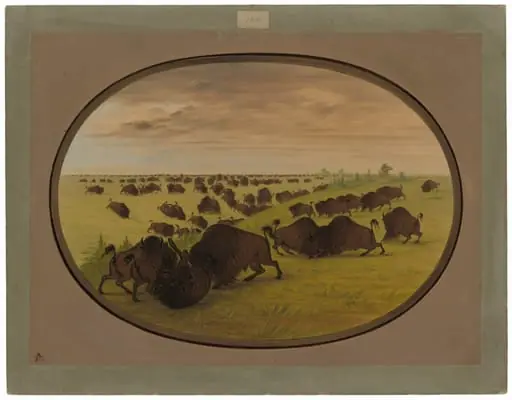 Bulls Fighting
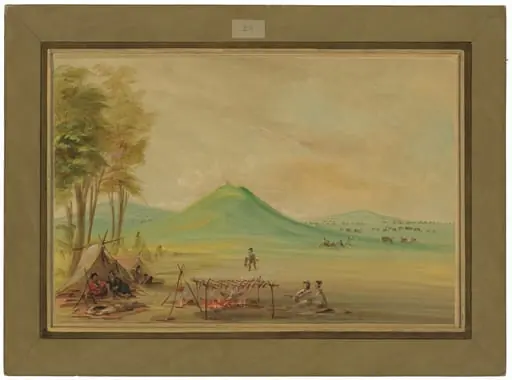 Expedition Encamped on a Texas Prairie. April 1686
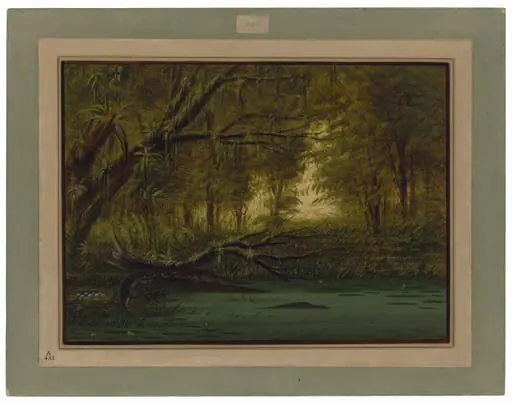 An Alligator's Nest
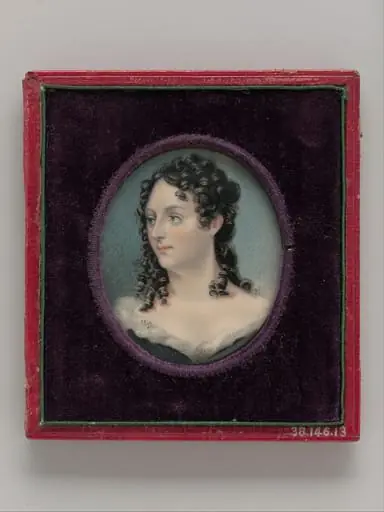 Mrs. George Catlin (Clara Bartlet Gregory)
 Chief of the Taensa Indians Receiving La Salle. March 20, 1682
 A Small Village - Payaguas Indians
 Omaha Chief, His Wife, and a Warrior
 Father Hennepin Leaving the Mississippi to Join La Salle. May 8, 1680