Artwork
Dance to the Berdache - Saukie
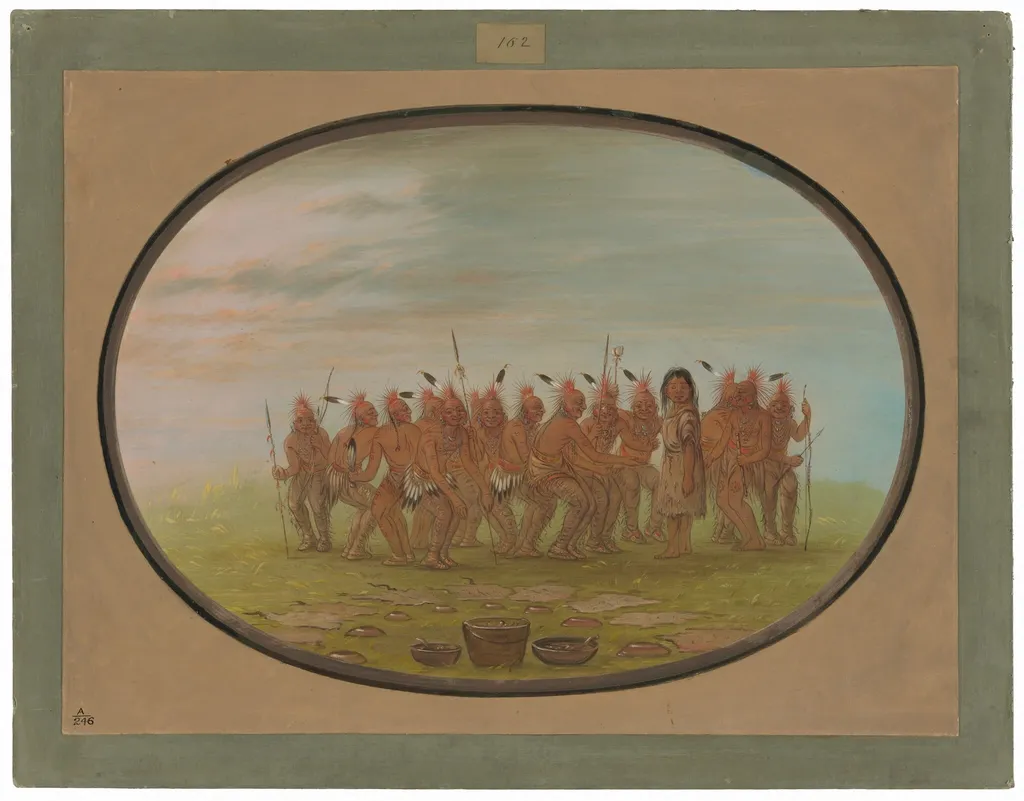
Dance to the Berdache - Saukie is an oil painting by the Impressionist artist George Catlin. It dates from 1865 and is held in the collection of the National Gallery of Art. Created in 1865, Dance to the Berdache – Saukie is an oil painting executed on card that has been adhered to a paperboard support.
About this work
Overview
Dance to the Berdache - Saukie is an oil painting by George Catlin, an American artist who documented Native American life during the mid-19th century.
Dance to the Berdache - Saukie is an oil painting by George Catlin, an American artist who documented Native American life during the mid-19th century. The work is dated to 1835 according to the artist's corpus records, though the National Gallery of Art also lists a broader date range of 1861/1869 reflecting its place within Catlin's later "Cartoon Collection." Measuring 47 by 63.2 centimeters (18 1/2 by 24 7/8 inches), the painting is executed in oil on card mounted on paperboard. It is held in the collection of the National Gallery of Art in Washington, D.C., where it entered in 1965 as part of the Paul Mellon Collection (accession number 1965.16.133). The painting is significant as a documentary record of Sauk social and ceremonial life, though it also raises complex questions about cross-cultural representation and the limitations of an outside observer's gaze.
Subject & Meaning
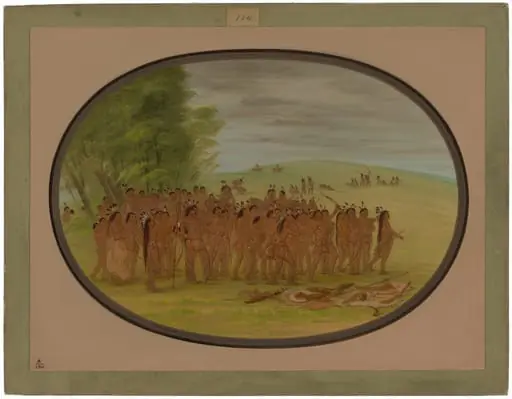
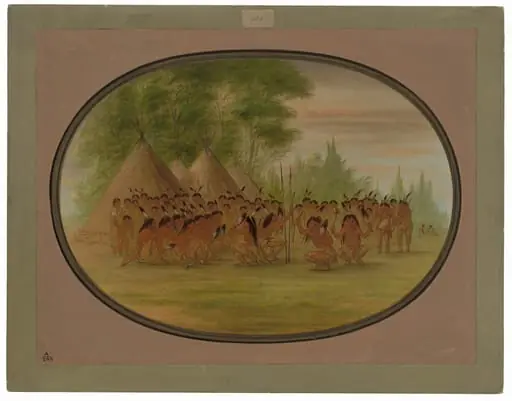
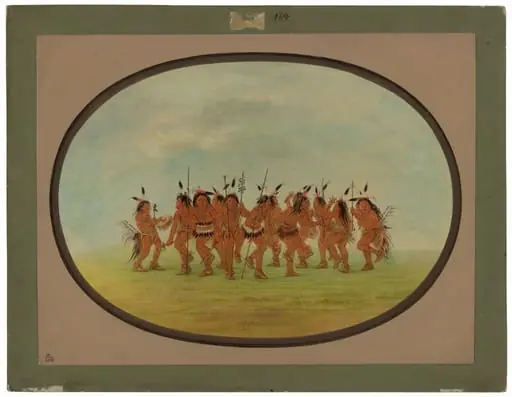
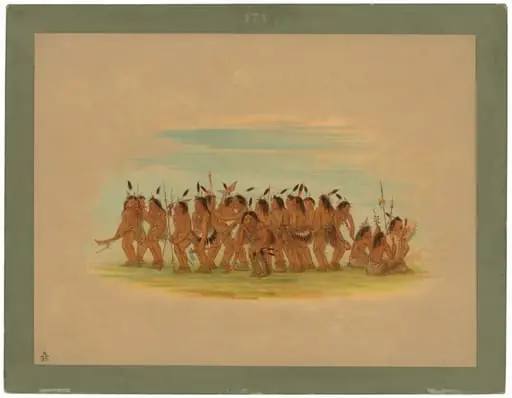
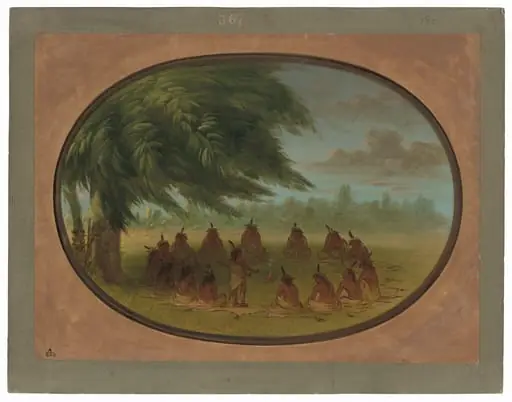
The painting depicts a ceremonial dance performed by approximately fourteen male figures in a grassy landscape beneath a pale sky with soft pink-tinged clouds. Most participants wear red-dyed roach headdresses with feathers, minimal clothing including breechcloths, and body paint. They adopt a crouched, stylized pose with bent knees, many holding spears or staffs. At the center, one figure stands more upright and extends arms toward another dancer. To the right, a single figure wears a light-colored, fringed garment reaching to the knees, with long dark hair, this figure representing the "Berdash" or berdache, a personage whom Catlin described as "clothed in woman's attire." In the foreground sit several vessels: a large central wooden bowl and smaller bowls containing objects. Catlin's 1871 catalog entry for the work, numbered Cart. No. 162, described the scene as "A dance peculiar to that tribe, given annually to the 'Berdash,' a singular personage clothed in woman's attire, for reasons not permitted to be explained here. The dancers partake of a feast after the dance." The term "berdache," now considered outdated and often replaced by "Two-Spirit," referred in Catlin's era to Indigenous individuals who occupied gender roles that did not correspond to European-American binaries. The painting thus documents a Sauk ceremonial practice honoring such a figure, though modern scholarship cautions that Catlin's representation is filtered through 19th-century European-American assumptions about gender and sexuality.
Technique & Style
The work is executed in oil on card mounted on paperboard, a support characteristic of Catlin's "Cartoon Collection" rather than the more finished canvases of his earlier "Indian Gallery." The composition is circular, set within a rectangular tan and green border marked with "162" at top and "A 246" at lower left, inventory notations from Catlin's cataloging system. The palette relies on muted greens, tans, soft blues, and touches of red, with the red of the dancers' headdresses providing the most vivid color accent. Brushwork appears smooth and detailed, with careful attention to figures and decorative elements. Light falls evenly across the scene without strong shadows, creating a flattened, documentary effect rather than dramatic chiaroscuro. The circular format concentrates attention on the grouped figures while the border frames the scene as an ethnographic specimen. This stylistic approach reflects Catlin's stated aim of recording Native American life for posterity, though the smooth finish and even lighting also suggest the conventions of 19th-century illustrative painting rather than direct observation.
History & Provenance
The painting originated with George Catlin (1796-1872), who created it as part of his documentary project on Native American life. After his death, it passed by descent to his daughters: Clara Gregory Catlin, Louise Catlin Kinney, and Elizabeth Wing Catlin. In 1912, the American Museum of Natural History purchased the work from Elizabeth Wing Catlin, acquiring it as part of Catlin's "Cartoon Collection." The museum deaccessioned the work in 1959, selling it through Kennedy Galleries in New York to Mr. Paul Mellon of Upperville, Virginia. Mellon, a major collector of American art, gave the painting to the National Gallery of Art in 1965 as part of a larger gift of 351 works from the Cartoon Collection. The work has been exhibited publicly at least twice: in 1973 at the Gibbes Art Gallery in Charleston, South Carolina, as part of "Pictures of the American Indian by George Catlin" (no. 28), and from 1983 to 1986 as an extended loan for use by Ambassadors Louis Arthur Tambs and Charles A. Gillespie at the U.S. Embassy residence in Bogota, Colombia.
Context
George Catlin produced two major bodies of work documenting Native American peoples: the "Indian Gallery" of more than 500 paintings from the 1830s, and the "Cartoon Collection" of more than 600 works created during the 1850s and 1860s. Dance to the Berdache - Saukie belongs to this second collection, which Catlin exhibited in New York in 1871 with a published catalog. Most surviving works from the Indian Gallery are now at the Smithsonian American Art Museum, while the Cartoon Collection was dispersed after the American Museum of Natural History's deaccession. Catlin's project emerged during an era of intense westward expansion and federal Indian removal policies, and his work has been scrutinized for its combination of genuine ethnographic interest and the imposition of European-American frameworks on Indigenous cultures. The painting's subject, a gender-nonconforming ceremonial figure, is particularly charged: Catlin's catalog entry claimed the reasons for the berdache's attire were "not permitted to be explained here," suggesting either protective discretion, incomplete understanding, or sensationalist framing. Modern curatorial interpretation acknowledges that while Catlin sought to document Native American life, his work was inevitably shaped by the perspectives and assumptions of his time, raising ongoing questions about representation, cultural understanding, and the power dynamics of cross-cultural documentation.
Legacy
As part of the Paul Mellon Collection at the National Gallery of Art, Dance to the Berdache - Saukie remains accessible for scholarly study and public viewing, with reproductions appearing in successive editions of the museum's catalog of American paintings (1970, 1980, and 1992). The work has gained renewed attention as discussions of gender and sexuality in Indigenous cultures have evolved, with the figure of the "berdache" now more commonly understood within the framework of Two-Spirit identity. This reframing has made the painting a touchstone for debates about historical representation, the ethics of ethnographic art, and the recovery of Indigenous perspectives from colonial archives. The painting's afterlife also reflects the broader fortunes of Catlin's reputation: once celebrated as a sympathetic chronicler of disappearing cultures, he has more recently been critiqued as a participant in the visual colonization of Native American subjects. The work's continued presence in a major national collection ensures its role in these ongoing discussions, even as its specific Sauk context requires further Indigenous scholarly engagement to fully comprehend.
Own this work as a print
Artist & collection

Artist
George Catlin ( KAT-lin; July 26, 1796 – December 23, 1872) was an American lawyer, painter, author, and traveler, who specialized in portraits of Native Americans in the American frontier.

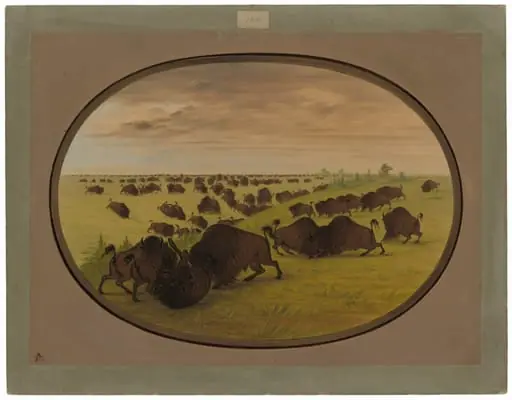 Bulls Fighting
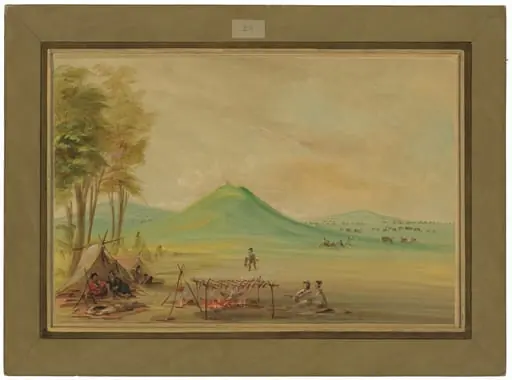 Expedition Encamped on a Texas Prairie. April 1686
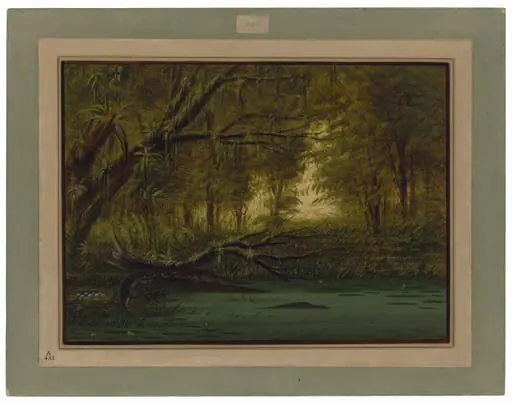 An Alligator's Nest
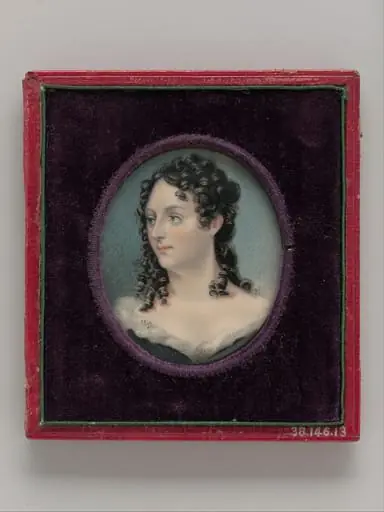 Mrs. George Catlin (Clara Bartlet Gregory)
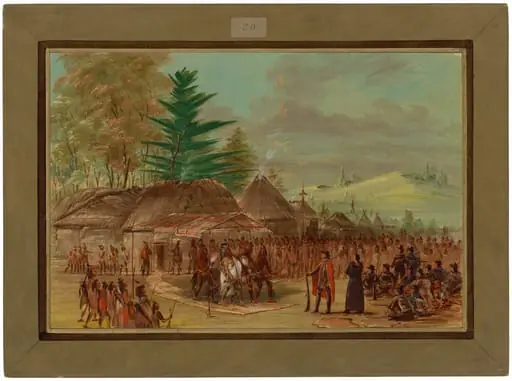 Chief of the Taensa Indians Receiving La Salle. March 20, 1682
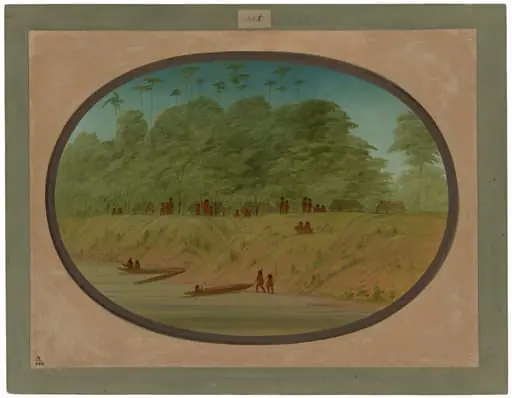 A Small Village - Payaguas Indians
 Omaha Chief, His Wife, and a Warrior
 Father Hennepin Leaving the Mississippi to Join La Salle. May 8, 1680