Artwork
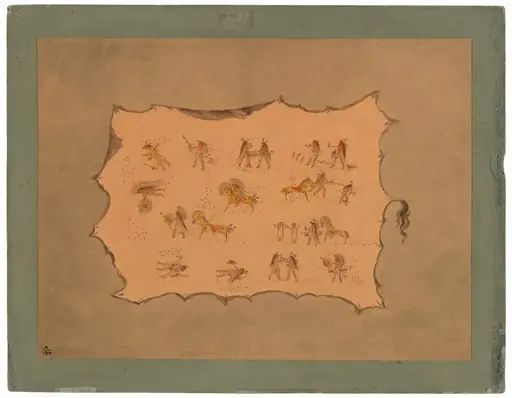
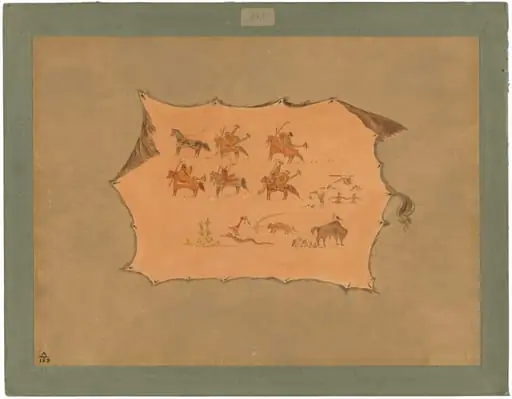
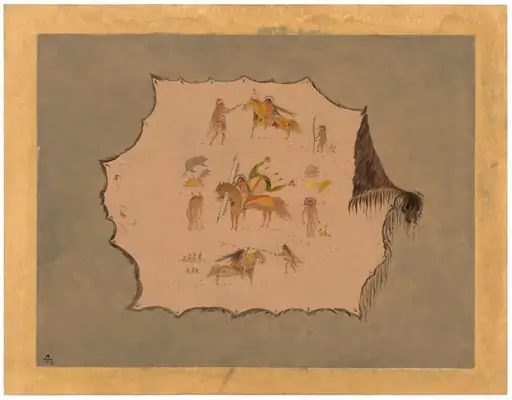
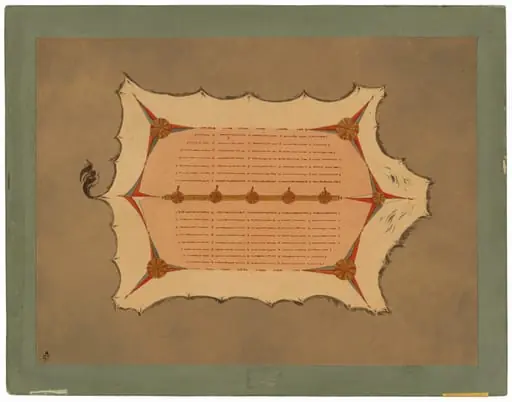
Facsimile of a Cheyenne Robe
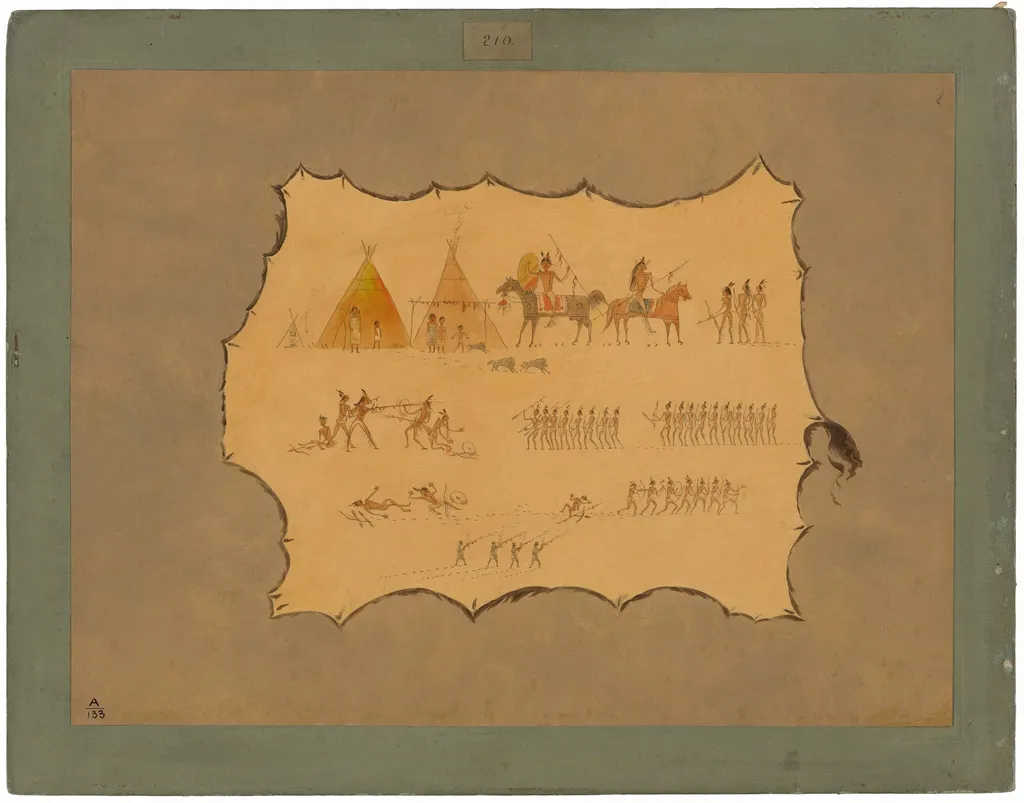
Facsimile of a Cheyenne Robe is an oil painting by the American Folk Art artist George Catlin. It dates from 1865 and is held in the collection of the National Gallery of Art.
- Inscription
- Inscribed:lower left on card: A/133; upper center on board on applied paper: 210
About this work
Technique & Style
The handling is precise and linear, with careful delineation of forms rather than fluid brushwork, reflecting the artist’s documentary approach.
Executed in oil on card mounted to paperboard, the work measures 45.9 cm in height and 61.7 cm in width. The handling is precise and linear, with careful delineation of forms rather than fluid brushwork, reflecting the artist’s documentary approach. Stylistically, the composition is static and frontal, emphasizing clarity and legibility of the depicted scene.
The palette is restrained, relying on muted earth tones to render the objects with a restrained naturalism. No evidence of significant abrasion or loss is recorded, suggesting the painting remains in stable condition.
History & Provenance
The painting was executed in 1861 by George Catlin, who produced the work during his extended project to document Indigenous life and material culture.
By descent, the painting passed to Catlin’s daughters, Clara Gregory Catlin, Louise Catlin Kinney, and Elizabeth Wing Catlin, before being purchased in 1912 by the American Museum of Natural History from Elizabeth Wing Catlin. It was later sold in 1959 through Kennedy Galleries in New York to Paul Mellon, Upperville, Virginia, and subsequently given in 1965 to the National Gallery of Art, Washington, D.C.
The work is held by the National Gallery of Art in Washington, D.C. Its accession or inventory number is not specified in the sources. It was acquired by the National Gallery of Art through a gift from Paul Mellon in 1965, following its purchase in 1959 from Kennedy Galleries, New York, by Paul Mellon, and prior provenance including ownership by George Catlin’s daughters and a 1912 purchase by the American Museum of Natural History. The work was exhibited in the National Gallery of Art’s “American Paintings from the Collection of Mr. and Mrs. Paul Mellon” in 1975, though the exhibition history is limited to this documented instance. No additional exhibition records are provided in the sources.
Legacy
The Facsimile of a Cheyenne Robe, painted by George Catlin in 1861, has been recognized as a significant work within his body of paintings depicting Indigenous cultures. Its inclusion in the National Gallery of Art's collection since 1965 has cemented its reputation as an important piece of 19th-century American art, reflecting early ethnographic documentation efforts. The work's provenance, tracing from Catlin's family to the museum through key transactions in 1912 and 1959, underscores its historical journey and enduring legacy in public institutions.
The painting's influence extends to discussions of cultural representation in art, with its exhibition history contributing to scholarly analyses of 19th-century visual anthropology.
Overview
Created in 1865, Facsimile of a Cheyenne Robe is an oil painting on card that has been mounted on paperboard. The work reproduces the decorative panels of an actual Cheyenne ceremonial garment, arranging the motifs within a rectangular, shield‑like border. The composition is divided into a central scene of figures in conical tipis and three subsidiary vignettes that depict hunting and combat activities.
Subject & Meaning
The image translates the narrative imagery traditionally embroidered on a Cheyenne robe into a painted format. The upper panel shows mounted riders and tipi dwellers, while the lower sections illustrate encounters with horses, dogs, spears and warriors, suggesting stories of daily life, hunting expeditions and tribal conflict that the original textile would have conveyed to its community.
Context
The painting belongs to a broader project in which Catlin sought to document the customs and visual language of Native peoples before their ways were altered by Euro‑American expansion. By translating a textile design into a portable oil painting, he provided a visual reference that could be circulated among Eastern audiences unfamiliar with Plains material culture.
Own this work as a print
Artist & collection

Artist
George Catlin ( KAT-lin; July 26, 1796 – December 23, 1872) was an American lawyer, painter, author, and traveler, who specialized in portraits of Native Americans in the American frontier.

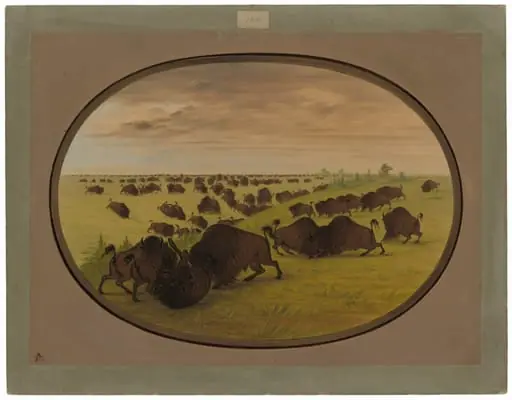 Bulls Fighting
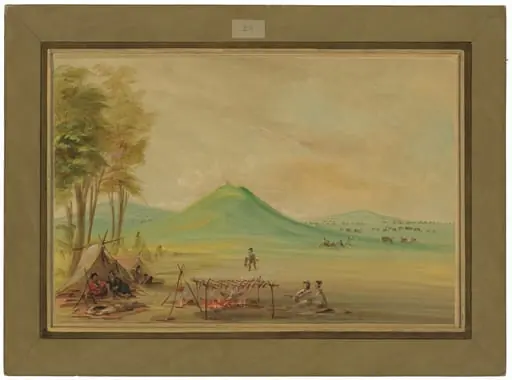 Expedition Encamped on a Texas Prairie. April 1686
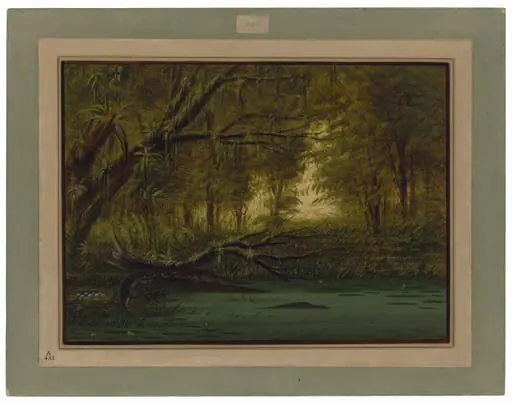 An Alligator's Nest
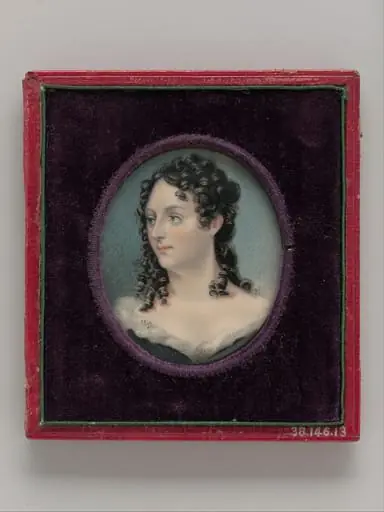 Mrs. George Catlin (Clara Bartlet Gregory)
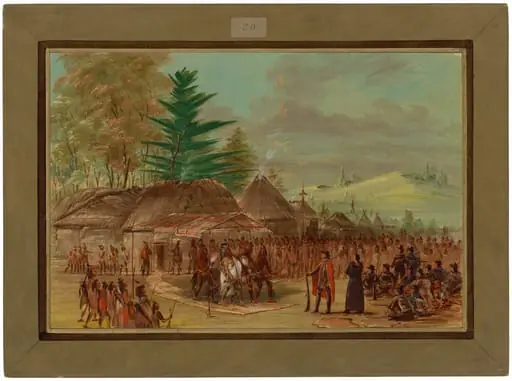 Chief of the Taensa Indians Receiving La Salle. March 20, 1682
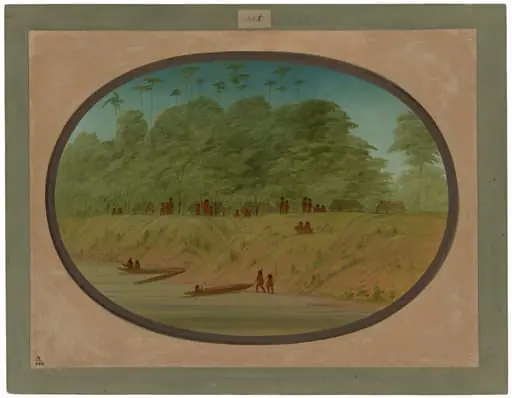 A Small Village - Payaguas Indians
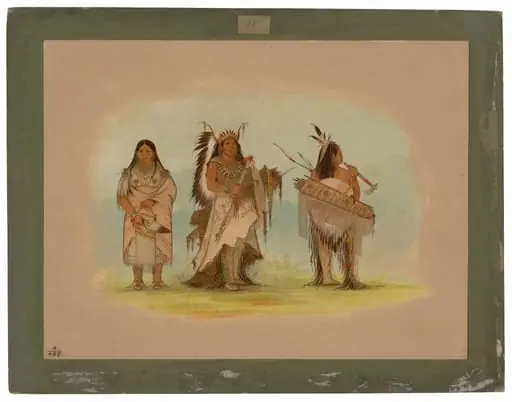 Omaha Chief, His Wife, and a Warrior
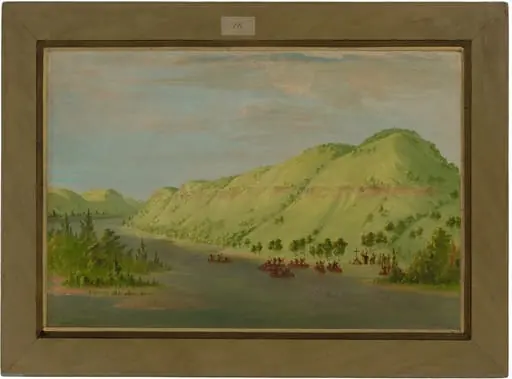 Father Hennepin Leaving the Mississippi to Join La Salle. May 8, 1680