Artwork
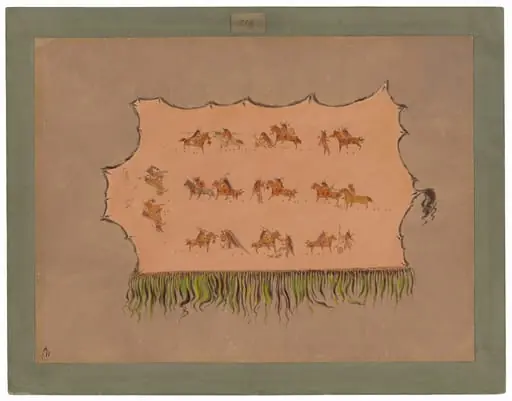
Facsimile of a Sioux Robe
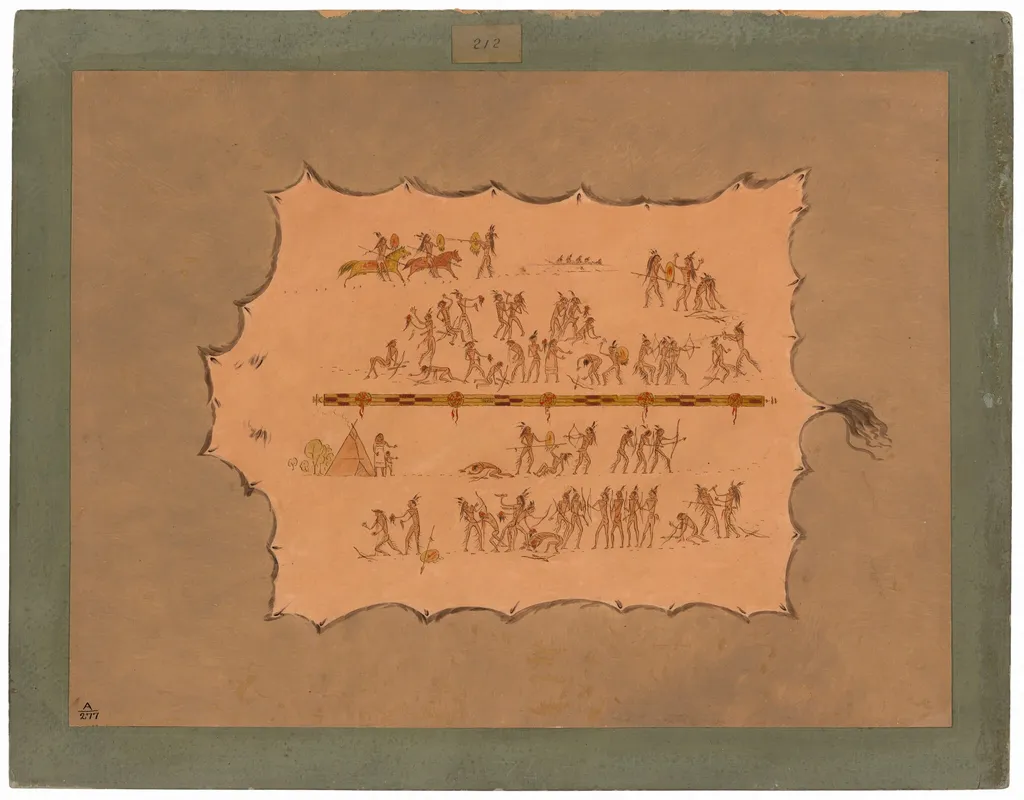
Facsimile of a Sioux Robe is an oil painting by the American Folk Art artist George Catlin. It dates from 1865 and is held in the collection of the National Gallery of Art.
- Inscription
- Inscribed:lower left on card: A/277; upper center on board on applied paper: 212; lower center on board in white chalk, inverted: 74; upper center reverse in graphite: Box 25; center reverse in graphite: No 6; lower center reverse in graphite, inverted: 1 M [illegible] 15 1/4 21 3/8
About this work
History & Provenance
The museum deaccessioned the piece in 1959, selling it through Kennedy Galleries in New York to Paul Mellon of Upperville, Virginia.
The Facsimile of a Sioux Robe was created by George Catlin in 1861 as an oil painting on card mounted on paperboard. It descended through Catlin's daughters, Clara Gregory Catlin, Louise Catlin Kinney, and Elizabeth Wing Catlin, before being acquired by the American Museum of Natural History in 1912. The work was later sold in 1959 via Kennedy Galleries in New York to Paul Mellon, who gifted it to the National Gallery of Art in 1965, where it remains in the collection today.
The work entered the collection of the American Museum of Natural History in 1912 following its purchase from Elizabeth Wing Catlin, one of the artist's daughters. The museum deaccessioned the piece in 1959, selling it through Kennedy Galleries in New York to Paul Mellon of Upperville, Virginia. Mellon subsequently donated the painting to the National Gallery of Art in Washington, D.C., in 1965, where it remains part of the permanent collection.
Context
The painting was created in 1861 by George Catlin and depicts a Sioux robe. It entered the collection of the National Gallery of Art in Washington, D.C., where it remains on view. The work passed through several notable owners, including George Catlin himself, his daughters, and eventually Paul Mellon, before being gifted to the museum in 1965.
Its provenance reflects a documented journey from the artist's family to a major American institution, underscoring its significance within Catlin's oeuvre and the broader study of 19th-century American art.
Legacy
The facsimile of a Sioux Robe entered the National Gallery of Art through the collection of Paul Mellon, a major donor whose gifts shaped the museum's early holdings. Its inclusion in the National Gallery of Art's collection underscores its significance within American art history. The work remains part of the National Gallery of Art's collection in Washington, D.C.
Overview
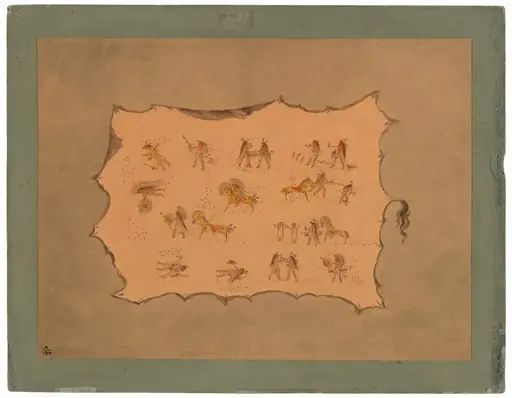
Created in 1865, this work by George Catlin presents a simulated Sioux robe rendered in oil on a card that has been affixed to a paperboard support. The composition is dominated by a muted brown field with an irregular, torn‑paper edge, upon which a multitude of miniature figures and animal motifs are densely arranged.
Subject & Meaning
The tiny illustrations populate the surface with scenes of Sioux life, showing figures engaged in hunting, combat and other daily activities. A long, ornamented strip runs horizontally through the centre, suggesting the decorative band of an actual robe and reinforcing the piece’s function as a visual record of cultural attire.
Technique & Style
Catlin employed oil paint on a relatively inexpensive card substrate, a choice typical of American folk art of the mid‑nineteenth century. The work’s flat, linear rendering and the crowded, schematic figures reflect a documentary impulse rather than a pursuit of fine‑artistic illusion.
Own this work as a print
Artist & collection

Artist
George Catlin ( KAT-lin; July 26, 1796 – December 23, 1872) was an American lawyer, painter, author, and traveler, who specialized in portraits of Native Americans in the American frontier.

 Bulls Fighting
 Expedition Encamped on a Texas Prairie. April 1686
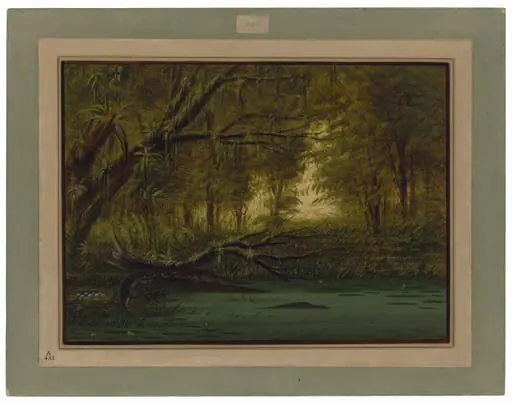 An Alligator's Nest
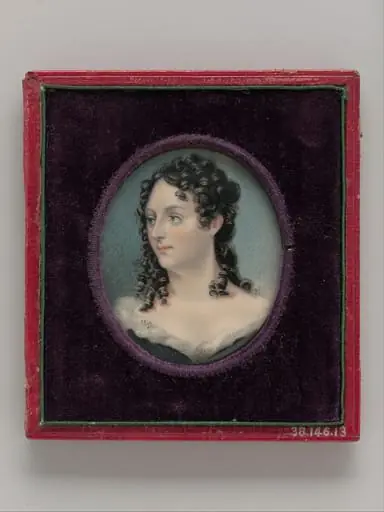 Mrs. George Catlin (Clara Bartlet Gregory)
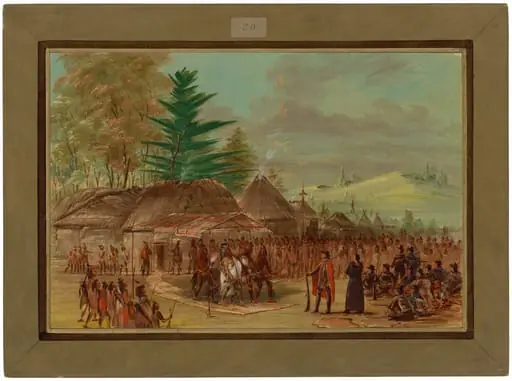 Chief of the Taensa Indians Receiving La Salle. March 20, 1682
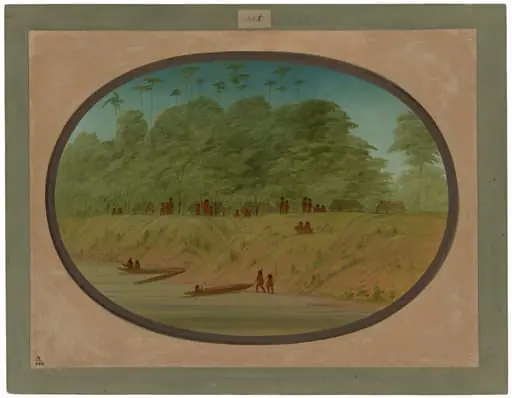 A Small Village - Payaguas Indians
 Omaha Chief, His Wife, and a Warrior
 Father Hennepin Leaving the Mississippi to Join La Salle. May 8, 1680
- Facsimile of a Cheyenne Robe
 Facsimile of the Robe of Mah-to-toh-pa - Mandan
 Facsimile of a Pawnee Doctor's Robe
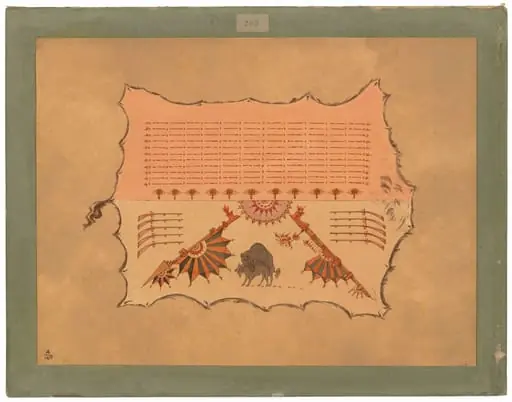 Facsimile of an Omaha Robe
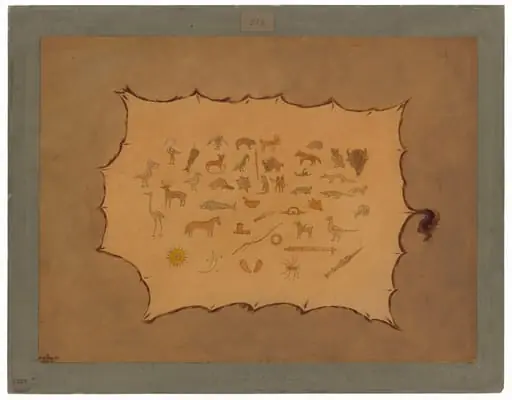 Facsimile of an Ojibbeway Robe
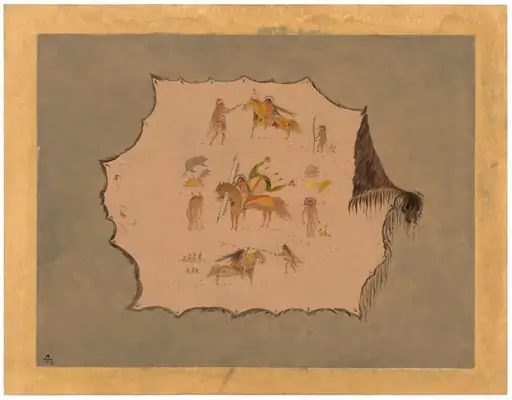 Facsimile of a Pawnee Doctor's Robe with Fantastic Professional Designs
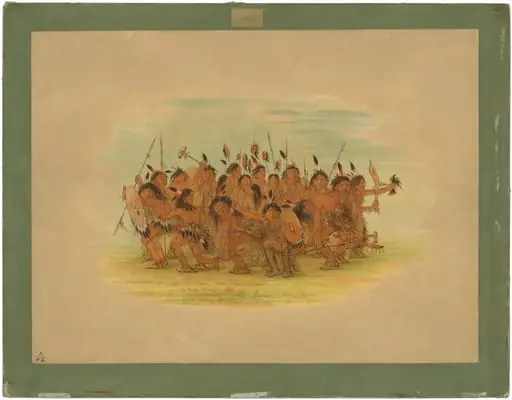 Scalp Dance - Sioux
 Facsimile of Chief Four Men's Robe - Mandan
 Amusing Dance - Sioux
 An Indian Council - Sioux