Artwork
Mandan Ceremony - The Water Sinks Down
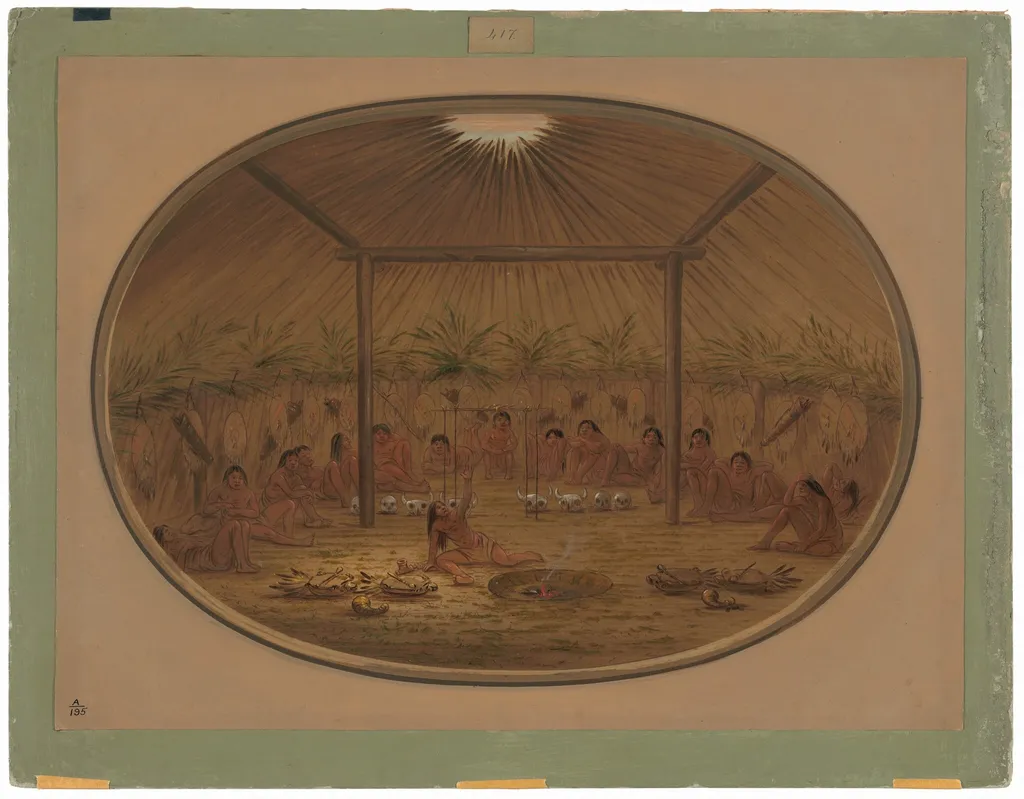
Mandan Ceremony - The Water Sinks Down is an oil painting by the American Folk Art artist George Catlin. It dates from 1865 and is held in the collection of the National Gallery of Art. Created in 1865, Mandan Ceremony – The Water Sinks Down is an oil painting executed on card that has been affixed to a paperboard support.
About this work
Technique & Style
Executed in 1865, this work is an oil painting applied to a card support that has been mounted onto paperboard. The composition measures 47.2 cm in height and 63.7 cm in width. As a piece classified within the religious genre, the artwork utilizes the tactile qualities of oil paint on a rigid, non-canvas substrate to depict its ceremonial subject matter.
History & Provenance
Painted in 1865, the oil-on-card work was produced by George Catlin during his extended documentation of Indigenous North American life.
Painted in 1865, the oil-on-card work was produced by George Catlin during his extended documentation of Indigenous North American life. The painting passed by descent from the artist to his three daughters, Clara Gregory Catlin, Louise Catlin Kinney, and Elizabeth Wing Catlin, before being purchased in 1912 by the American Museum of Natural History from Elizabeth Wing Catlin. It was later sold in 1959 through Kennedy Galleries in New York to Paul Mellon of Upperville, Virginia, who gifted it to the National Gallery of Art, Washington, D.C., in 1965, where it remains part of the permanent collection. No specific exhibition history dates are provided in the available records.
Overview
Created in 1865, Mandan Ceremony – The Water Sinks Down is an oil painting executed on card that has been affixed to a paperboard support. The work is held in the collection of the National Gallery of Art in Washington, D.C., where it is displayed as an example of mid‑nineteenth‑century American folk art.
Subject & Meaning
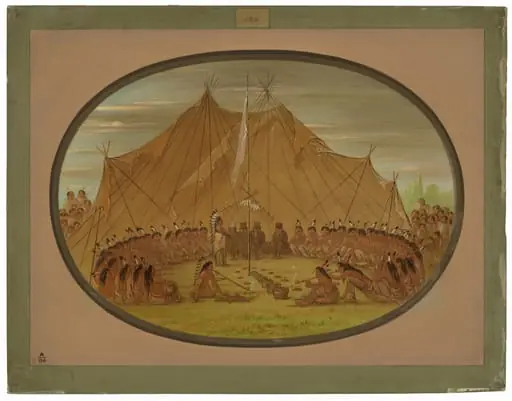
The scene portrays a ceremonial gathering of Mandan participants within a low, circular chamber. Figures are arranged around the perimeter, some seated, others reclining, while a central fire provides illumination. Scattered objects, animal skulls, bowls, and other ritual paraphernalia, suggest a religious rite connected to water, a theme reflected in the title.
Context
Catlin’s broader project in the 1830s and 1840s involved sketching, engraving, and painting scenes of Native communities encountered along routes such as the Erie Canal and the Missouri River. This painting reflects his ongoing interest in preserving ceremonial practices that he feared were disappearing under expanding Euro‑American settlement.
Own this work as a print
Artist & collection

Artist
George Catlin ( KAT-lin; July 26, 1796 – December 23, 1872) was an American lawyer, painter, author, and traveler, who specialized in portraits of Native Americans in the American frontier.

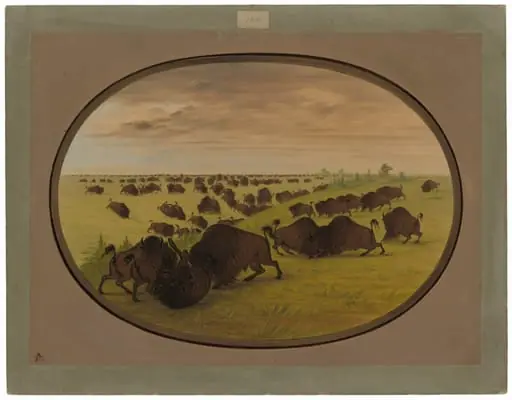 Bulls Fighting
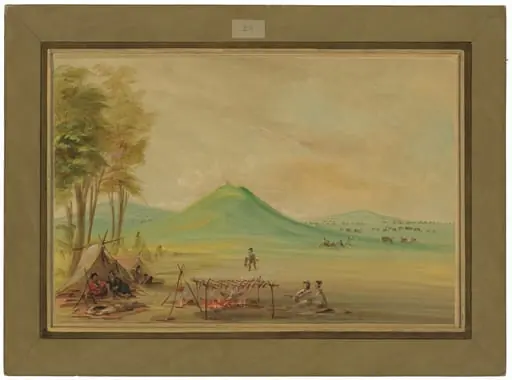 Expedition Encamped on a Texas Prairie. April 1686
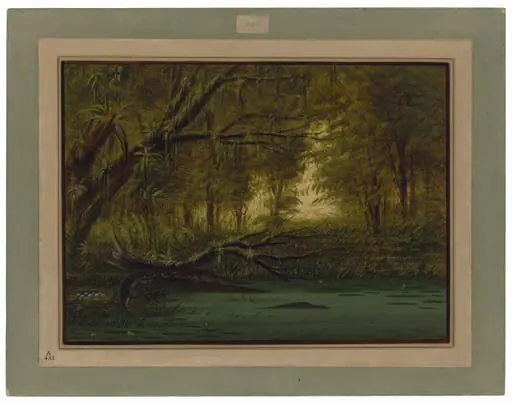 An Alligator's Nest
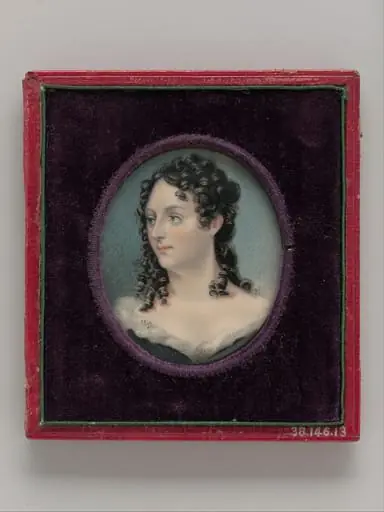 Mrs. George Catlin (Clara Bartlet Gregory)
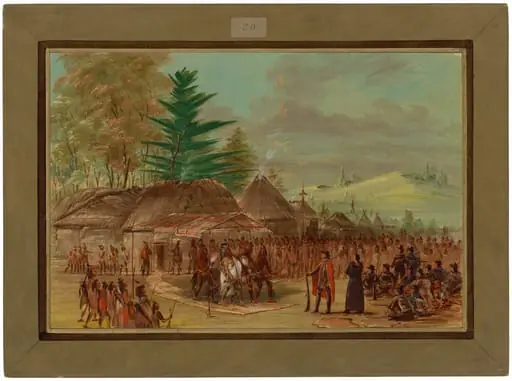 Chief of the Taensa Indians Receiving La Salle. March 20, 1682
 A Small Village - Payaguas Indians
 Omaha Chief, His Wife, and a Warrior
 Father Hennepin Leaving the Mississippi to Join La Salle. May 8, 1680