Artwork
The Cheyenne Brothers Returning from Their Fall Hunt
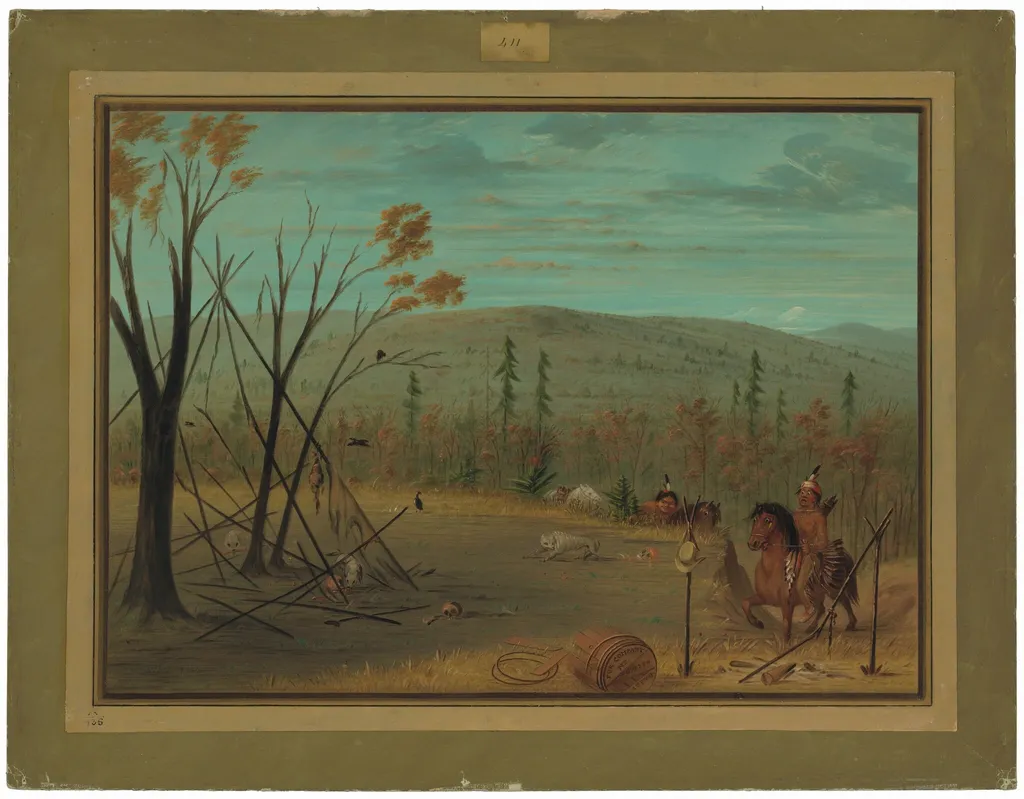
The Cheyenne Brothers Returning from Their Fall Hunt is an oil painting by the Impressionist artist George Catlin. It dates from 1865 and is held in the collection of the National Gallery of Art.
- Inscription
- Inscribed:lower left on card: A/136; upper center on board on applied paper: 411; reverse on paper fragments: "Ret [illegible] 11 Hunt"
About this work
Subject & Meaning
The painting depicts two Cheyenne brothers returning from a fall hunt, a scene categorized as a genre work by the artist George Catlin.
The painting depicts two Cheyenne brothers returning from a fall hunt, a scene categorized as a genre work by the artist George Catlin. The composition includes trees within the landscape, reflecting the natural setting of the narrative. While the title explicitly identifies the subjects and their activity, the provided sources do not elaborate on specific iconographic details, symbolic interpretations, or deeper representational meanings beyond the literal depiction of the hunters and their environment.
Technique & Style
Created in 1861, The Cheyenne Brothers Returning from Their Fall Hunt is executed in oil paint applied to a card support that has been mounted onto paperboard. The work measures 46.2 cm in height and 62 cm in width, classifying it as a genre scene that depicts natural elements such as trees. As a painted composition from the mid-19th century, the piece reflects the artist's approach to documenting Native American life through an oil-based medium on a rigid, prepared surface.
History & Provenance
Painted in 1861, The Cheyenne Brothers Returning from Their Fall Hunt was completed by George Catlin during his extended project of documenting Plains Indian life. The work descended to his three daughters, Clara Gregory Catlin, Louise Catlin Kinney, and Elizabeth Wing Catlin, before being purchased in 1912 by the American Museum of Natural History from Elizabeth Wing Catlin. In 1959 the museum sold it through Kennedy Galleries, New York, to Paul Mellon, Upperville, Virginia. Mellon gifted the painting to the National Gallery of Art, Washington, D.C., in 1965.
The canvas measures 46.2 cm in height by 62 cm in width.
The painting is currently held by the National Gallery of Art in Washington, D.C., where it was accessioned in 1965 as a gift from Paul Mellon. Prior to this transfer, the work was owned by the American Museum of Natural History, which purchased it in 1912 from Elizabeth Wing Catlin, one of the artist's daughters. The museum sold the piece in 1959 through Kennedy Galleries to Paul Mellon, who subsequently donated it to the National Gallery of Art. The provenance traces the work from George Catlin to his daughters before entering public collections.
Context
Painted in 1861, the work entered the National Gallery of Art's collection through a series of family descents and commercial transactions, beginning with George Catlin's daughters and culminating in a 1965 gift by Paul Mellon.
Scholarship on this painting emphasizes its role within Catlin's broader documentation of Native American life, though it has received less critical attention than his more widely exhibited pieces.
The painting's compositional focus on a tree aligns with Catlin's ethnographic interest in natural elements as cultural symbols, situating it within 19th-century genre scenes that blended documentary realism with romanticized narratives of the American frontier.
Overview
Created in 1865, The Cheyenne Brothers Returning from Their Fall Hunt is an oil painting executed on card that has been mounted on a paperboard support. The work shows two Cheyenne riders on horseback, still and poised after a hunt, set against a sparse landscape that includes a solitary tree. The composition captures a brief, tranquil instant in the daily routine of Plains peoples.
Own this work as a print
Artist & collection

Artist
George Catlin ( KAT-lin; July 26, 1796 – December 23, 1872) was an American lawyer, painter, author, and traveler, who specialized in portraits of Native Americans in the American frontier.

 Bulls Fighting
 Expedition Encamped on a Texas Prairie. April 1686
 An Alligator's Nest
 Mrs. George Catlin (Clara Bartlet Gregory)
 Chief of the Taensa Indians Receiving La Salle. March 20, 1682
 A Small Village - Payaguas Indians
 Omaha Chief, His Wife, and a Warrior
 Father Hennepin Leaving the Mississippi to Join La Salle. May 8, 1680
 La Salle Assassinated by Duhaut. May 19, 1686
 La Salle's Party Entering the Mississippi in Canoes. February 6, 1682
 A Sioux War Party
 A Sioux Village
 Mired Buffalo and Wolves
 Gathering Wild Rice - Winnebago
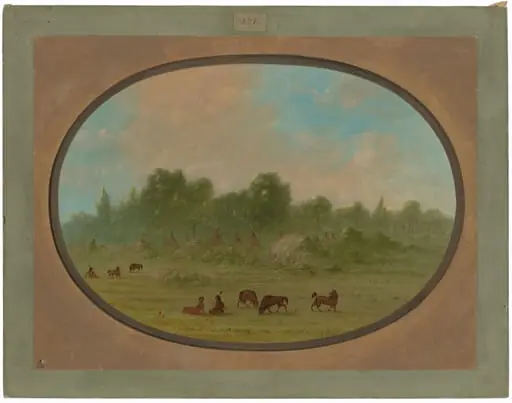 Tawahquena Village
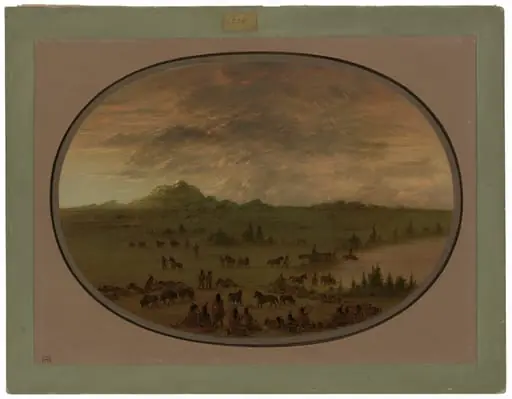 Bivouac of a Sioux War Party at Sunrise
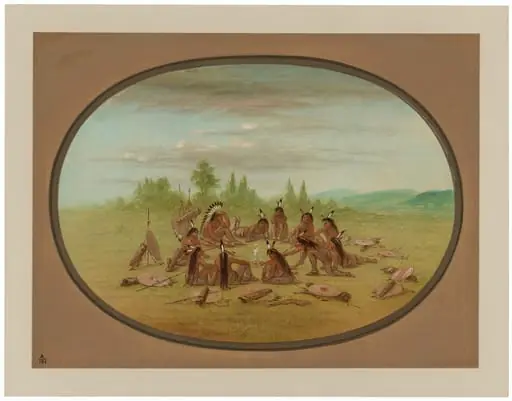 A Foot War Party in Council - Mandan
- The Cheyenne Brothers Starting on Their Fall Hunt
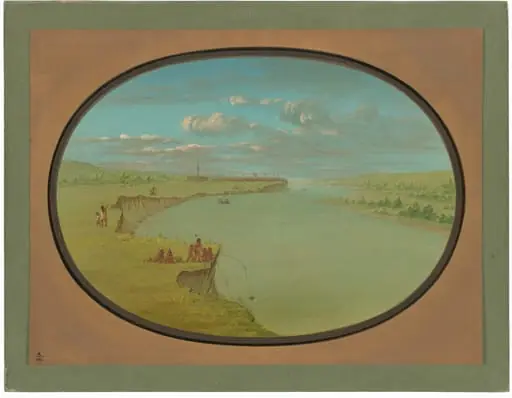 Mandan Village - A Distant View