Artwork
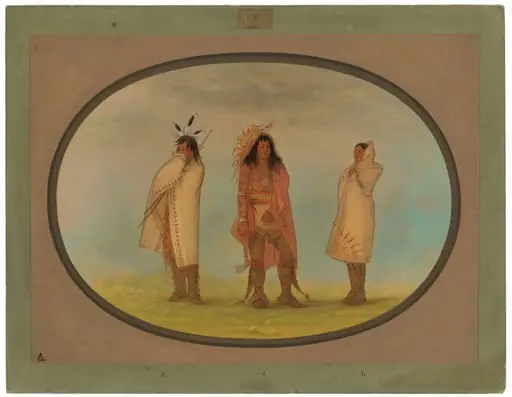
Three Shoshonee Warriors
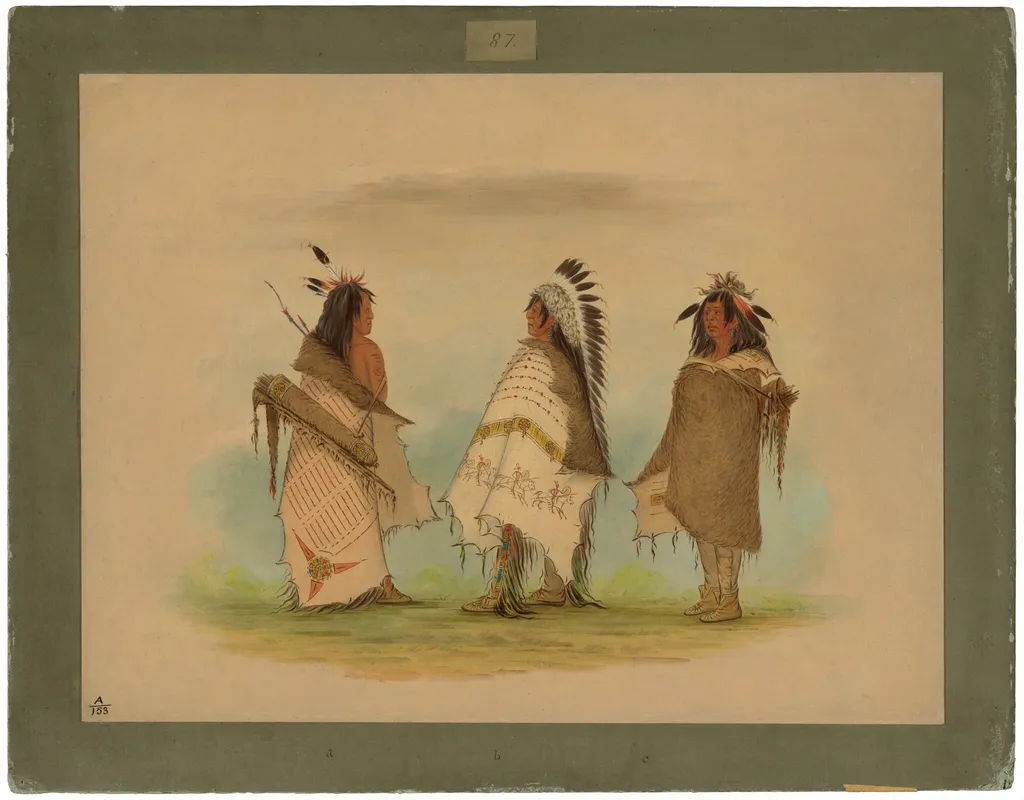
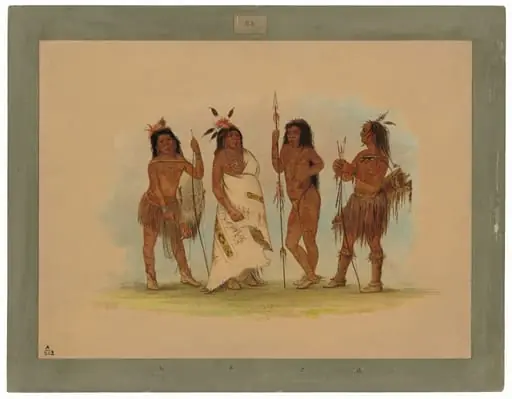
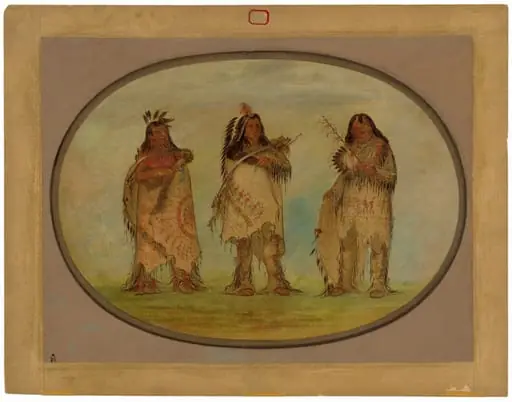
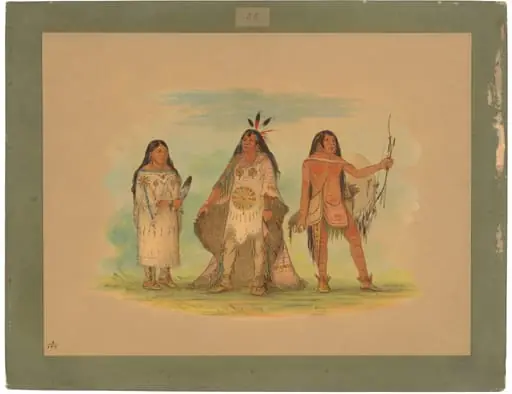
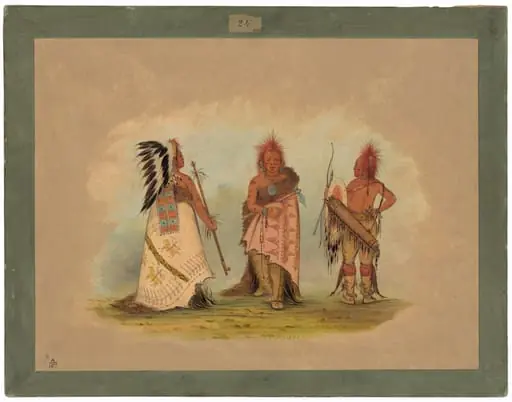
Three Shoshonee Warriors is an oil painting by the Impressionist artist George Catlin. It dates from 1861 and is held in the collection of the National Gallery of Art. Created in 1861, the work presents three Shoshone warriors positioned in an open setting.
- Inscription
- Inscribed:lower right: G. Catlin / 1861
About this work
Overview
Three Shoshonee Warriors is an 1861 oil painting by American artist George Catlin, now held in the collection of the National Gallery of Art in Washington, D.
Three Shoshonee Warriors is an 1861 oil painting by American artist George Catlin, now held in the collection of the National Gallery of Art in Washington, D.C. The work depicts three standing Shoshone warriors in full regalia, arranged in a horizontal row against a pale, atmospheric landscape. Measuring 45.6 by 60.4 cm (17 15/16 by 23 3/4 inches), the painting is executed in oil on card mounted on paperboard, a format typical of Catlin's later "Cartoon Collection." The work is significant as part of one of the most extensive visual records of Native American life produced in the nineteenth century, and it entered the National Gallery of Art in 1965 as part of a major gift of 351 Catlin works from collector Paul Mellon.
Subject & Meaning
The painting portrays three named Shoshone warriors: Yau-nau-shau-pix, a celebrated warrior wearing a handsome Crow robe taken from a Crow chief killed in battle; Nau-en-sau-pic; and On-da-wout, two young warriors celebrated for their exploits. The central figure, Yau-nau-shau-pix, stands tallest and wears a prominent upright feathered headdress with black and white tips, his robe displaying floral or figurative motifs near the hem. The figure on the left faces right, carrying a bow and quiver, with geometric patterns and a circular medallion visible on a white robe. The figure on the right faces forward, wrapped in a predominantly brown fur robe with minimal visible decoration. All three wear moccasins and have long dark hair. Catlin's 1871 catalog entry for the work, published when he exhibited his Cartoon Collection in New York, notes that "The Shoshonee is a tribe of 12,000, west of the Rocky Mountains" and dates the subject to 1855. The warriors are presented as armed and equipped for war, with the detailed rendering of their costumes and accessories serving both documentary and aesthetic purposes. The composition emphasizes their individual identities and social status through the careful differentiation of their garments and attributes.
Technique & Style
The painting is executed in oil on card mounted on paperboard, a medium and support that Catlin adopted for his Cartoon Collection during the 1850s and 1860s. The surface appears smooth with fine detail in the costumes and accessories. The palette consists of earth tones, muted greens, and soft blues, with touches of red and yellow in the decorative elements. Light falls evenly across the scene with minimal shadow, creating a flat, descriptive effect that prioritizes clarity of detail over dramatic modeling. The background shows soft green vegetation at the bottom and hazy distant mountains under a pale yellowish sky, rendered with atmospheric perspective. The horizontal format accommodates the three full-length figures arranged in a loose row. A dark green border frames the image, with the number "87" at top center and "A/153" at lower left. The inscription "G. Catlin / 1861" appears in the lower right. The handling is characteristic of Catlin's documentary approach, combining ethnographic observation with a degree of romantic presentation that was conventional in nineteenth-century representations of Native American subjects.
History & Provenance
The painting was created in 1861, though the subjects were documented by Catlin in 1855 during his western travels. It was part of Catlin's second major collection, the "Cartoon Collection," comprising more than 600 works produced during the 1850s and 1860s. After Catlin's death in 1872, the work descended to his daughters: Clara Gregory Catlin, Louise Catlin Kinney, and Elizabeth Wing Catlin. In 1912, the American Museum of Natural History in New York purchased the work from Elizabeth Wing Catlin, acquiring the surviving Cartoon Collection. The museum deaccessioned the collection in 1959, and this painting was sold through Kennedy Galleries in New York to Paul Mellon of Upperville, Virginia. Mellon gave it to the National Gallery of Art in 1965, where it entered as accession number 1965.16.57. The work has been exhibited at the Whitney Gallery of Western Art at the Buffalo Bill Historical Center in Cody, Wyoming (1964-1974); in "One Hundred Years of Idaho Art, 1850-1950" at the Boise Art Museum (1990); and on extended loan to the U.S. Embassy residence in Bogotà, Colombia (1987-1991). It was also included in "The American West: Out of Myth, Into Reality" at the Mississippi Museum of Art, Terra Museum of American Art, and Toledo Museum of Art (2000).
Context
George Catlin (1796-1872) produced two major collections of paintings documenting Native American life: the "Indian Gallery" of more than 500 works from the 1830s, now largely at the Smithsonian American Art Museum, and the later "Cartoon Collection" of more than 600 works from the 1850s and 1860s. Three Shoshonee Warriors belongs to this second phase, created after Catlin had spent years in Europe exhibiting his earlier works and seeking patrons. The Cartoon Collection represented both a continuation of his documentary project and a response to market demands, as he reworked and revisited earlier subjects. The work has been catalogued in successive editions of the National Gallery of Art's American Paintings: An Illustrated Catalogue (1970, 1980, 1992). Its place in scholarship on Catlin reflects the broader critical examination of his role as an ethnographic artist, the accuracy of his representations, and the complex dynamics of cross-cultural encounter in nineteenth-century American art. The painting is also recorded in the Catalog of American Portraits at the National Portrait Gallery, Smithsonian Institution.
Legacy
As part of the 351-work Paul Mellon gift to the National Gallery of Art, Three Shoshonee Warriors contributes to one of the most significant public holdings of Catlin's Cartoon Collection. The work's afterlife extends beyond the museum through its reproduction in scholarly catalogues and its use in diplomatic contexts, including extended loans to embassy residences. The painting also circulated in popular visual culture, as evidenced by a postcard of a related Catlin work, "Three Celebrated Warriors, Pawnee," produced by Dexter Press for the American Museum of Natural History, which promoted Catlin's work as "the most extensive record ever made of Indian life before it was altered forever by the white man." This promotional framing illustrates how Catlin's images have been continuously reinterpreted, serving as documents of Native American cultures while also becoming embedded in narratives of American expansion and cultural preservation. The work remains a touchstone for understanding both Catlin's artistic practice and the visual construction of Native American identity in nineteenth-century American art.
Own this work as a print
Artist & collection

Artist
George Catlin ( KAT-lin; July 26, 1796 – December 23, 1872) was an American lawyer, painter, author, and traveler, who specialized in portraits of Native Americans in the American frontier.

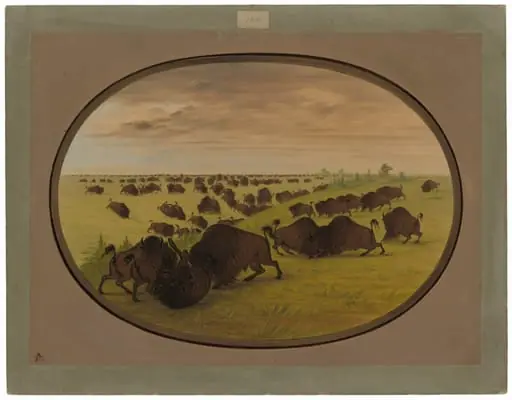 Bulls Fighting
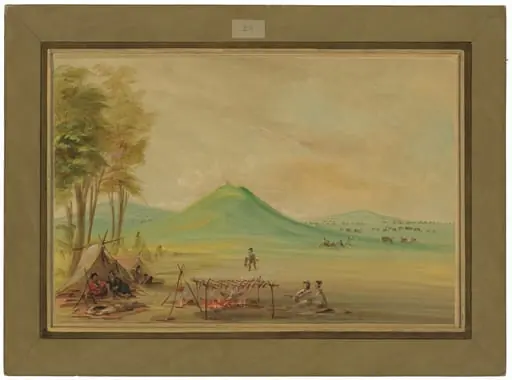 Expedition Encamped on a Texas Prairie. April 1686
 An Alligator's Nest
 Mrs. George Catlin (Clara Bartlet Gregory)
 Chief of the Taensa Indians Receiving La Salle. March 20, 1682
 A Small Village - Payaguas Indians
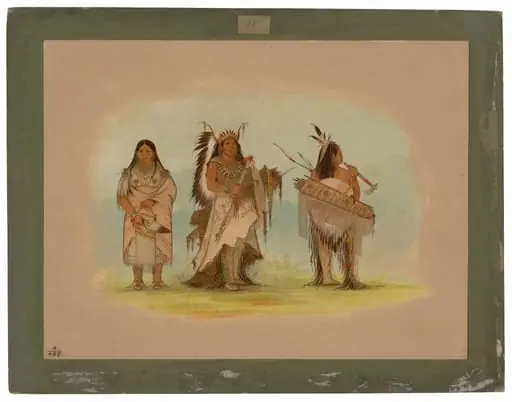 Omaha Chief, His Wife, and a Warrior
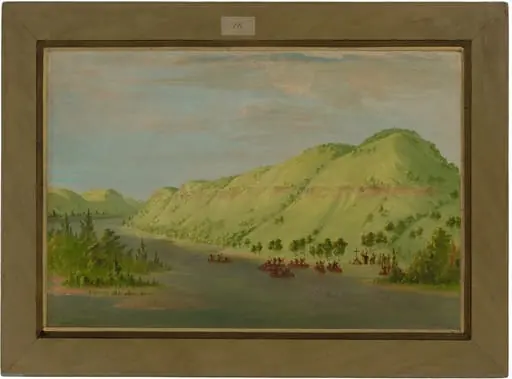 Father Hennepin Leaving the Mississippi to Join La Salle. May 8, 1680