Artwork
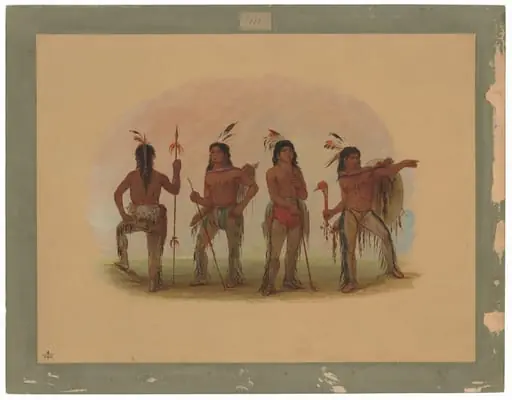
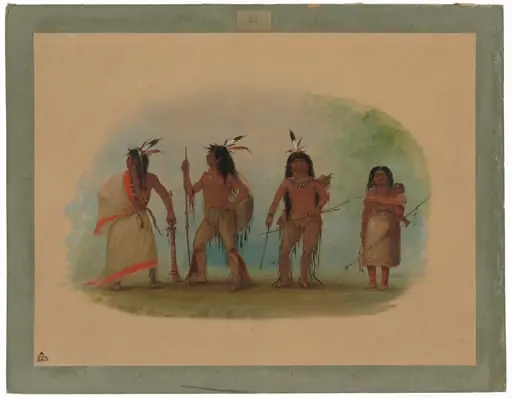
Apachee Chief and Three Warriors
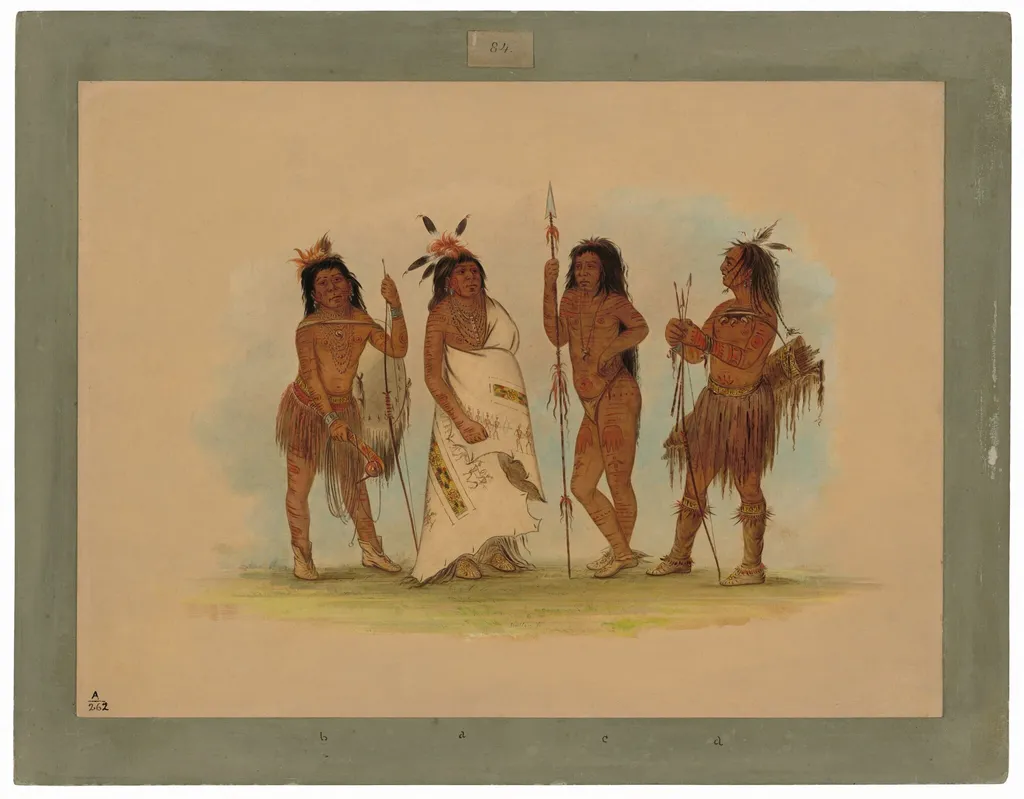
Apachee Chief and Three Warriors is an oil painting by the Impressionist artist George Catlin. It dates from 1862 and is held in the collection of the National Gallery of Art.
- Inscription
- Inscribed:lower center: Catlin p.
About this work
Overview
4 centimeters, the work is executed in oil on card mounted on paperboard and is held in the collection of the National Gallery of Art in Washington, D.
Apachee Chief and Three Warriors is an oil painting by American artist George Catlin, dated 1868, depicting four Apache figures in ceremonial and martial regalia. Measuring 45.1 by 61.4 centimeters, the work is executed in oil on card mounted on paperboard and is held in the collection of the National Gallery of Art in Washington, D.C., where it entered in 1965 as part of a major gift from Paul Mellon. The painting belongs to Catlin's second major body of work, known as the Cartoon Collection, which he produced during the 1850s and 1860s after losing his original Indian Gallery to debt. While less famous than his earlier western expeditions, this later collection expanded Catlin's documentary project to include subjects from the Southwest and reflected his enduring commitment to recording Native American life.
Subject & Meaning
The painting presents four Apache figures arranged in a horizontal row, identified in Catlin's 1871 catalog as Chief Be-las-o-qúa-na, called the Spanish Spur, and three warriors: Nic-wár-ra (The Horse Catcher), Nah-qúat-se-o, and Hú-tah. The central chief wears a white draped garment with decorative borders and pictographic designs, complemented by a feathered headdress, while the three flanking warriors display fringed garments, red body paint, and various accessories including necklaces, armbands, and leg bands. Each figure carries weapons: the leftmost holds a bow and arrow, the second from left carries a staff, the third raises a spear, and the rightmost bears multiple arrows and a quiver. Catlin's catalog entry specifically notes the chief was celebrated for his battles with the Mexicans, and that the three warriors are armed and equipped for war. The arrangement emphasizes both individual identity through specific naming and a collective martial identity through standardized weaponry and dress, reflecting Catlin's ethnographic approach to portraiture.
Technique & Style
The work displays careful linear detail in costume and body decoration, with smooth, flat application of color and precise draftsmanship. The overall palette consists of warm ochres, browns, reds, and muted greens set against a pale atmospheric background with soft blue-gray clouds and minimal green ground. The medium of oil on card mounted on paperboard represents the typical support Catlin employed for his Cartoon Collection, which was conceived in part as a more portable and reproducible format than his earlier works on canvas. The painting is surrounded by a gray border bearing the number 84 at top center and letters b, a, c, d below, corresponding to the catalog numbers and figure identifications in Catlin's 1871 exhibition catalog. A small inscription A 262 appears in the lower left corner, likely a collection or inventory mark. The flatness of the color application and the emphasis on linear detail over atmospheric modeling distinguish this work from more academically finished portraits of the period, reflecting both practical considerations of production and Catlin's documentary priorities.
History & Provenance
The painting was created in 1868, though the Smithsonian Institution records a broader date range of 1855/1869. It was listed as Cart. No. 84 in Catlin's 1871 New York exhibition catalog of the Cartoon Collection. Following Catlin's death in 1872, the work descended to his daughters: Clara Gregory Catlin, Louise Catlin Kinney, and Elizabeth Wing Catlin. In 1912, Elizabeth Wing Catlin sold it to the American Museum of Natural History in New York. The museum deaccessioned the work in 1959, selling it through Kennedy Galleries in New York to Paul Mellon of Upperville, Virginia. Mellon, a major collector and philanthropist, gave the painting to the National Gallery of Art in 1965, where it holds accession number 1965.16.145. The work has been documented in National Gallery of Art catalogues of 1970, 1988, and 1990.
Context
George Catlin (1796-1872) was a self-taught artist who abandoned careers as a lawyer and miniaturist to pursue what he termed his Indian Gallery, an unprecedented documentary project to record Native American life. His first collection of more than 500 works from the 1830s, created during extensive travels up the Missouri River and across the western frontier, is now largely at the Smithsonian American Art Museum. The Cartoon Collection, to which this work belongs, comprised more than 600 works produced during the 1850s and 1860s, many made from memory, earlier sketches, and secondary sources rather than direct observation. Catlin exhibited this second collection in New York in 1871 with a published catalog that provided ethnographic details for each entry. The Apache subjects reflect the geographic expansion of his interests beyond the Plains tribes that dominated his earlier work, though scholars have noted that his later paintings sometimes relied less on firsthand experience. The American Museum of Natural History's acquisition and subsequent deaccessioning of the Cartoon Collection reflects shifting institutional priorities, while Paul Mellon's purchase of more than 300 works from this group and his 1965 gift of 351 paintings to the National Gallery of Art ensured the collection's preservation and public access.
Legacy
As part of the Cartoon Collection, Apachee Chief and Three Warriors represents a significant but critically complex chapter in Catlin's career. The 351 works Mellon donated to the National Gallery of Art constitute one of the largest institutional holdings of Catlin's later production, ensuring these images remain accessible for study despite questions about their documentary reliability compared to his earlier western travels. The painting exemplifies the tensions in Catlin's practice: his genuine commitment to recording Native American cultures coincided with increasingly commercial and repetitive production methods in his later years. The work's afterlife also illustrates the institutional migration of American art, from the artist's family to a natural history museum, to a private collector, and finally to a national art museum. Catlin's broader legacy rests on his status as the first major artist to travel beyond the Mississippi to paint Native Americans, creating a visual archive that preceded and in some ways anticipated the photography of Edward Curtis and others. His belief that his Indian Gallery was a national treasure worthy of government preservation was posthumously validated by the Smithsonian's acquisition of his original collection in 1879 and by the National Gallery of Art's stewardship of the Cartoon Collection works.
Own this work as a print
Artist & collection

Artist
George Catlin ( KAT-lin; July 26, 1796 – December 23, 1872) was an American lawyer, painter, author, and traveler, who specialized in portraits of Native Americans in the American frontier.

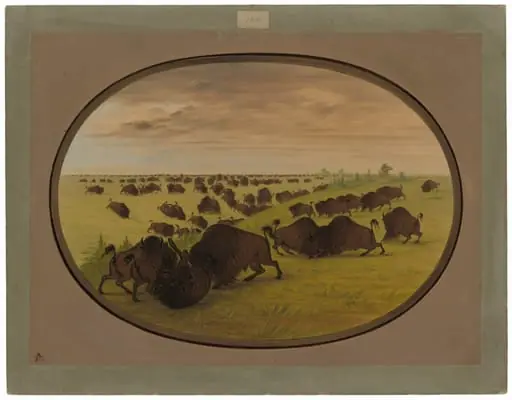 Bulls Fighting
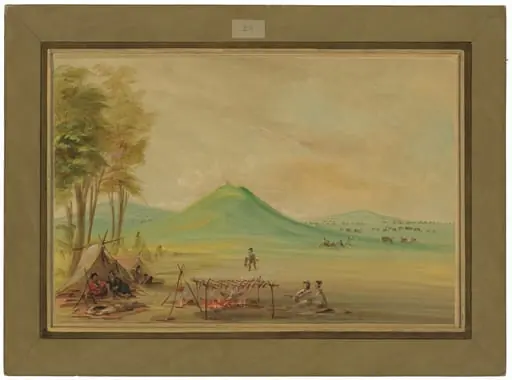 Expedition Encamped on a Texas Prairie. April 1686
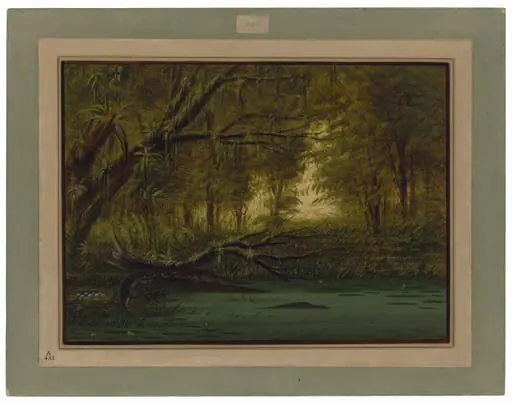 An Alligator's Nest
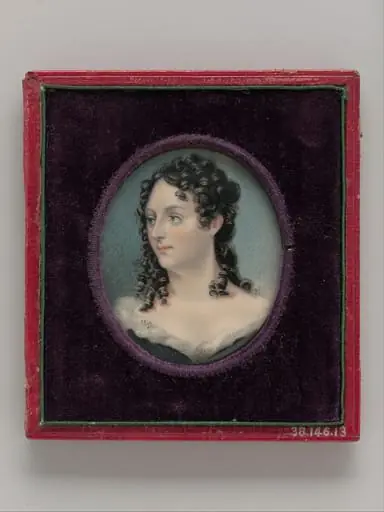 Mrs. George Catlin (Clara Bartlet Gregory)
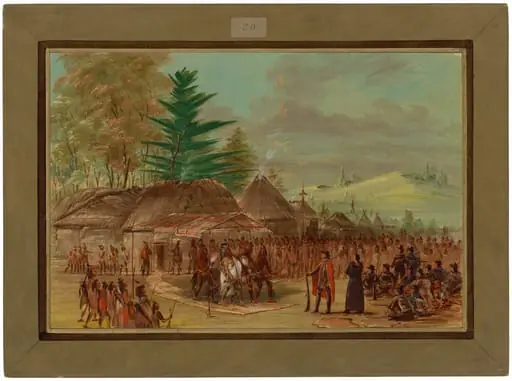 Chief of the Taensa Indians Receiving La Salle. March 20, 1682
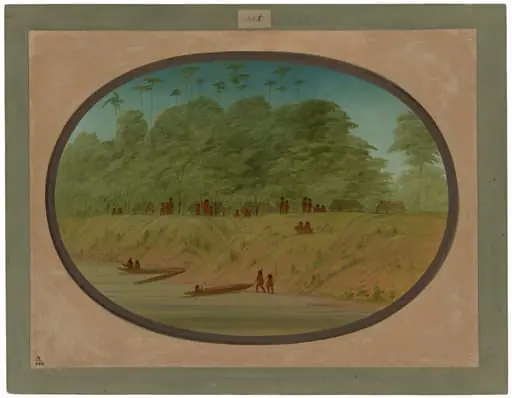 A Small Village - Payaguas Indians
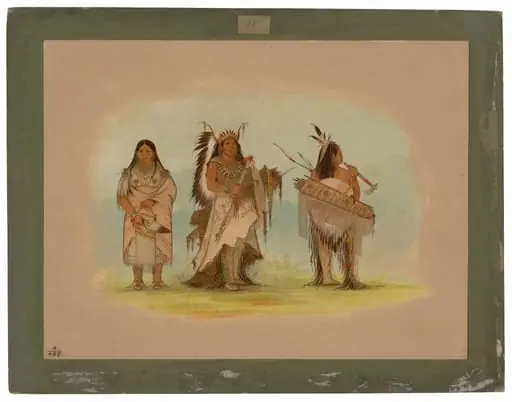 Omaha Chief, His Wife, and a Warrior
 Father Hennepin Leaving the Mississippi to Join La Salle. May 8, 1680