Artwork
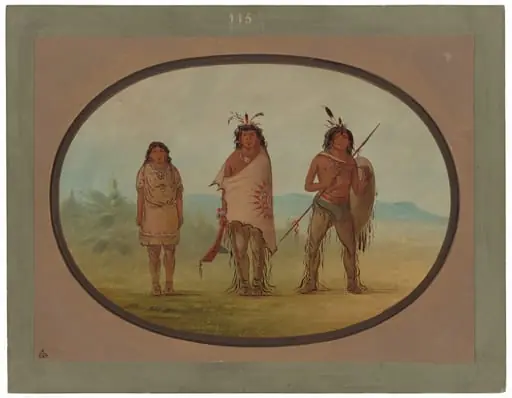
Weeco Chief, His Wife, and a Warrior
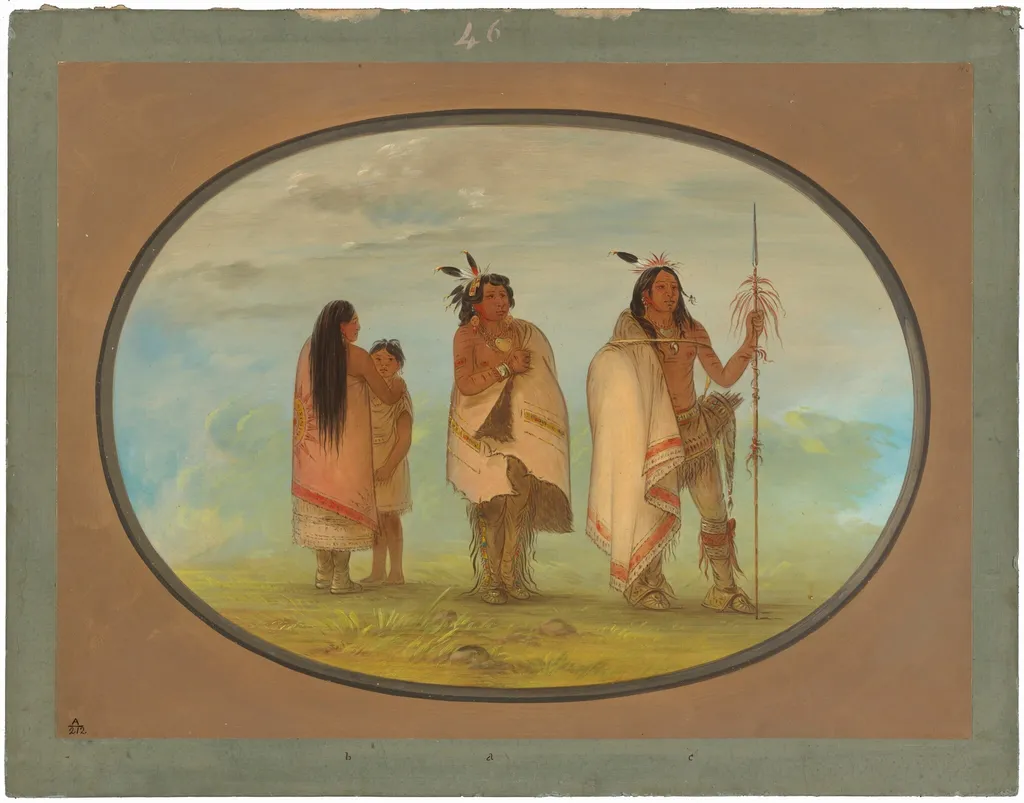
Weeco Chief, His Wife, and a Warrior is an oil painting by the American Folk Art artist George Catlin. It dates from 1865 and is held in the collection of the National Gallery of Art.
About this work
Technique & Style
The oil-on-card technique allowed for relatively quick execution while still permitting the layered color handling characteristic of his portrait work.
Weeco Chief, His Wife, and a Warrior is a small-scale oil painting executed on card mounted on paperboard, a support choice consistent with Catlin's portable field practice. The work measures 47.1 cm in height by 63.6 cm in width, giving it a horizontal orientation suited to a group portrait composition. Classified as a painting in the portrait genre, the medium and modest dimensions reflect the artist's working method of producing readily transportable images of Indigenous subjects.
Stylistically, the piece belongs to Catlin's sustained documentation of Native American leaders and was completed in 1861. The oil-on-card technique allowed for relatively quick execution while still permitting the layered color handling characteristic of his portrait work.
History & Provenance
Executed in 1861, the oil-on-card painting was commissioned and created by George Catlin during his later period of documenting Indigenous subjects. By 1912 it belonged to Catlin’s daughters, Clara Gregory Catlin, Louise Catlin Kinney, and Elizabeth Wing Catlin, from whom it was purchased that year by the American Museum of Natural History. In 1959 the museum sold the work via Kennedy Galleries, New York, to Paul Mellon, Upperville, Virginia. Mellon gifted it to the National Gallery of Art, Washington, D.C., in 1965, where it remains.
The painting is held in the collection of the National Gallery of Art in Washington, D.C. Its ownership history traces from the artist, George Catlin, to his daughters, with the work purchased from Elizabeth Wing Catlin by the American Museum of Natural History in 1912. The museum sold the piece in 1959 through Kennedy Galleries of New York to Paul Mellon of Upperville, Virginia, who subsequently gifted it to the National Gallery of Art in 1965. No specific exhibition history is detailed in the provided records.
Context
George Catlin painted Weeco Chief, His Wife, and a Warrior in 1861, a portrait held in the National Gallery of Art in Washington, D.C. The work entered the museum's collection through a series of transactions beginning with George Catlin's descendants and culminating in a 1965 gift from Paul Mellon. Its provenance reflects mid-20th-century patterns of acquisition and donation among prominent American art collectors.
Legacy
The painting’s trajectory from the Catlin family’s holdings to the National Gallery of Art has cemented its status as a benchmark example of 19th-century American portraiture, frequently cited in scholarship on Indigenous representation and early Western art collecting. Its inclusion in the NGA’s permanent collection has ensured continued scholarly attention and public display, reinforcing its reputation as a significant work within Catlin’s oeuvre and the broader canon of early American art.
Overview
Created in 1865, this oil painting on card, later mounted on paperboard, presents a small group of Native American figures in a field setting. The composition centers on a chief, his wife, and a warrior, with an additional child visible among them. The work exemplifies George Catlin’s systematic effort to record the appearance and dress of Plains peoples during his mid‑nineteenth‑century travels.
Subject & Meaning
The portrait captures a moment of domestic and martial presence: the chief stands with dignified bearing, his wife is adorned in traditional garments, while the warrior, bare‑chested and holding a spear, signals readiness. A child, also dressed in customary attire, adds a familial dimension, suggesting everyday life rather than ceremonial display.
Own this work as a print
Artist & collection

Artist
George Catlin ( KAT-lin; July 26, 1796 – December 23, 1872) was an American lawyer, painter, author, and traveler, who specialized in portraits of Native Americans in the American frontier.

 Bulls Fighting
 Expedition Encamped on a Texas Prairie. April 1686
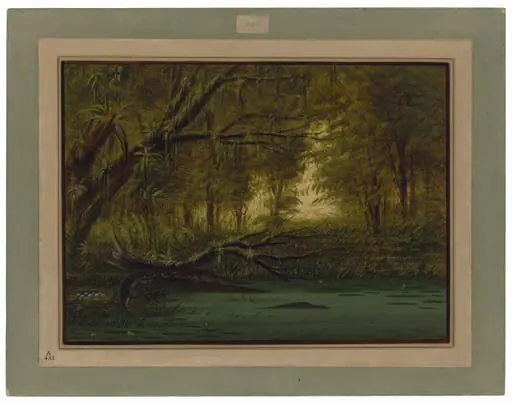 An Alligator's Nest
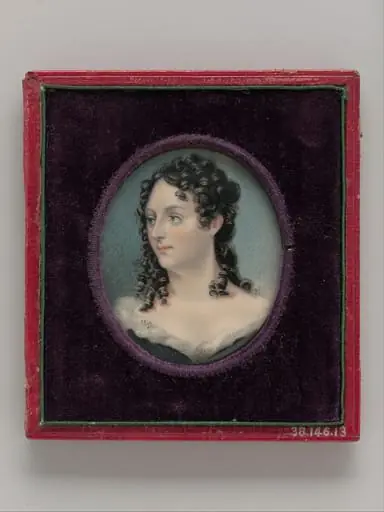 Mrs. George Catlin (Clara Bartlet Gregory)
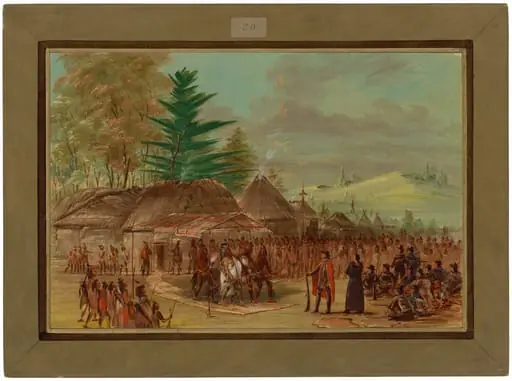 Chief of the Taensa Indians Receiving La Salle. March 20, 1682
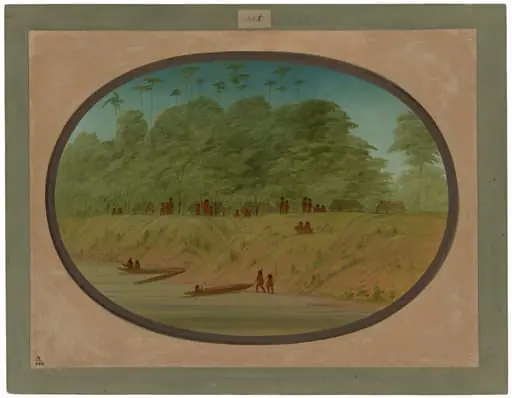 A Small Village - Payaguas Indians
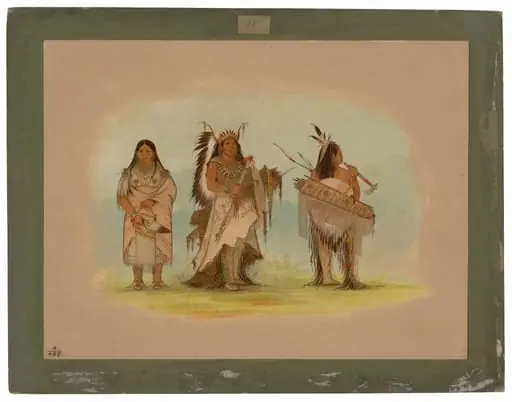 Omaha Chief, His Wife, and a Warrior
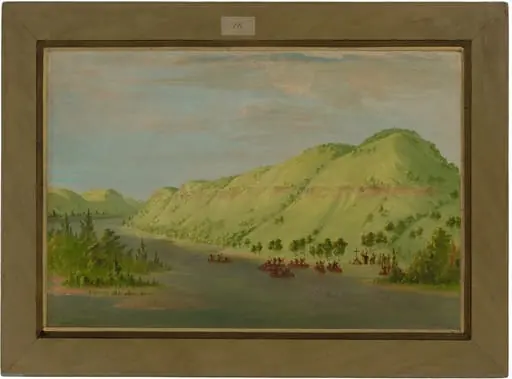 Father Hennepin Leaving the Mississippi to Join La Salle. May 8, 1680
- Arapaho Chief, His Wife, and a Warrior
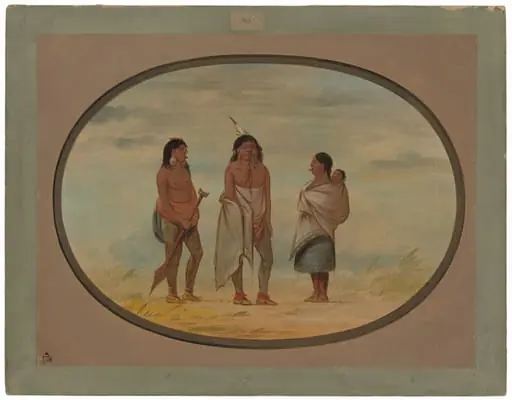 Nayas Indian Chief, His Wife, and a Warrior
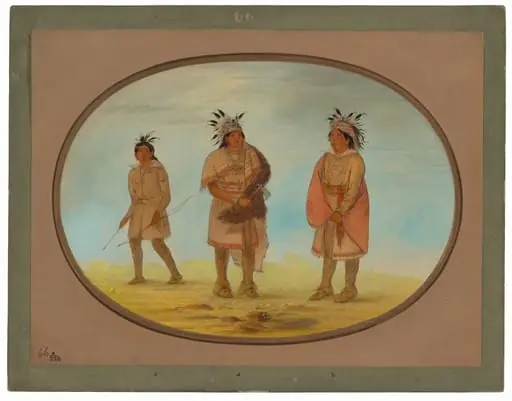 Two Weeah Warriors and a Woman
 Crow Chief, His Wife, and a Warrior
 A Stone Warrior, His Wife, and a Boy
 Mohave Chief, a Warrior, and His Wife
 Cochimtee Chief, His Wife, and a Warrior
 A Blackfoot Chief, His Wife, and a Medicine Man
 Assinneboine Warrior and His Family
 Riccarree Chief and His Wife
 Saukie Warrior, His Wife, and a Boy
 A Yuma Chief, His Daughter, and a Warrior