Artwork
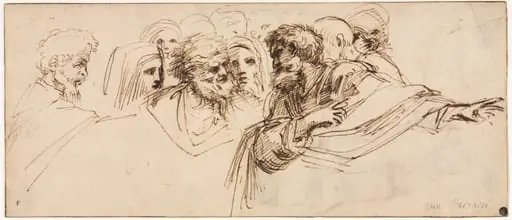
Group of Heads, after Greuze
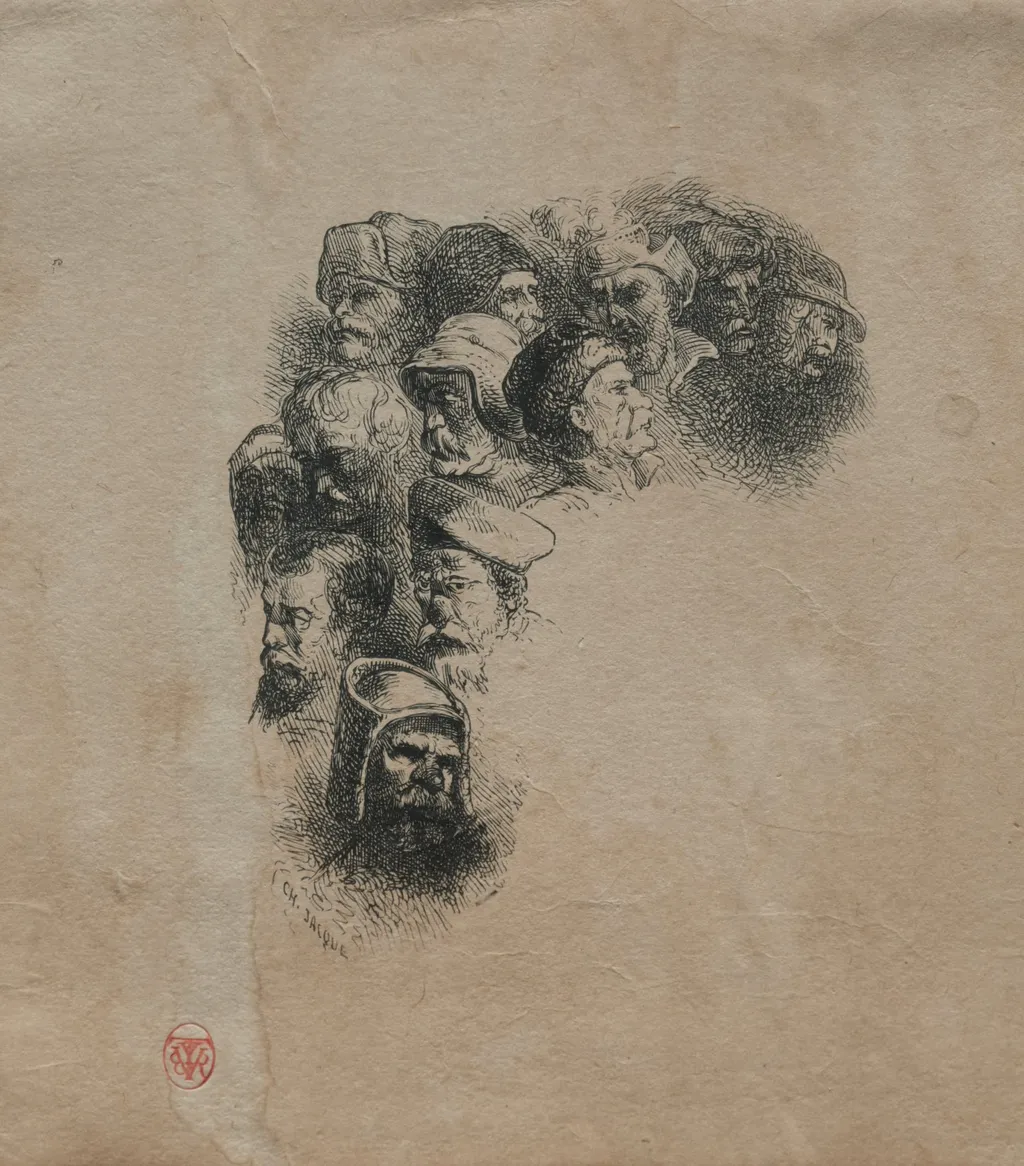
Group of Heads, after Greuze is a print by the Romanticist artist Charles-Émile Jacque. It dates from 1846 and is held in the collection of the Cleveland Museum of Art.
- Accession no.
- 1921.988
- Credit line
- Gift of Ralph King
About this work
Overview
Charles-Émile Jacque produced this print around 1846 as a study inspired by Jean-Baptiste Greuze’s figure compositions. Though trained in military map engraving, Jacque shifted toward pastoral subjects and printmaking, aligning with the Barbizon School’s interest in rural life. This work reflects his engagement with earlier artistic traditions through direct emulation and reinterpretation.
Subject & Meaning
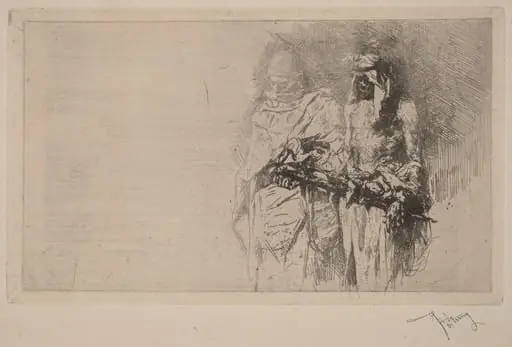
The composition presents a dense grouping of human heads, arranged closely with overlapping contours. No narrative or individual identity is emphasized; instead, the focus lies in the collective presence of faces, some capped, others bareheaded, conveying a sense of intimate, unposed humanity. The work functions as an exercise in observing human form rather than telling a story.
Technique & Style
Jacque rendered the heads with rapid, angular strokes using a drypoint or etching needle, creating a textured surface that suggests volume through line rather than shading. The scratchy, uneven marks prioritize immediacy over refinement, typical of preparatory studies in 19th-century printmaking. The aged, yellowed paper further underscores the work’s function as a working sketch.
History & Provenance
It reflects his deliberate engagement with Greuze’s 18th-century figure studies, part of a broader 19th-century revival of interest in emotional portraiture.
Created during Jacque’s early career, this print emerged from his period of intensive study after leaving military service. It reflects his deliberate engagement with Greuze’s 18th-century figure studies, part of a broader 19th-century revival of interest in emotional portraiture. The work remained within private collections, with no major public exhibition record prior to late 20th-century scholarly attention.
Context
In the 1840s, French artists increasingly turned to direct observation and expressive draftsmanship, moving away from academic idealism. Jacque’s sketch aligns with Romantic-era tendencies to value emotional authenticity and spontaneous mark-making. His choice to reinterpret Greuze, a painter known for moralizing genre scenes, signals a shift toward formal inquiry over narrative intent.
Legacy
Though not widely exhibited in its time, this print exemplifies Jacque’s role in bridging 18th-century figural traditions with 19th-century printmaking practices. It contributes to understanding how artists used study as a means of technical and aesthetic dialogue across generations, influencing later generations of printmakers focused on expressive line and direct observation.
Own this work as a print
Artist & collection

Artist
Charles-Émile Jacque (23 May 1813 – 7 May 1894) was a French painter of Pastoralism and engraver who was, with Jean-François Millet, part of the Barbizon School. He first learned to engrave maps when he spent seven years in the French Army.