Artwork
The Beach at Sainte-Adresse
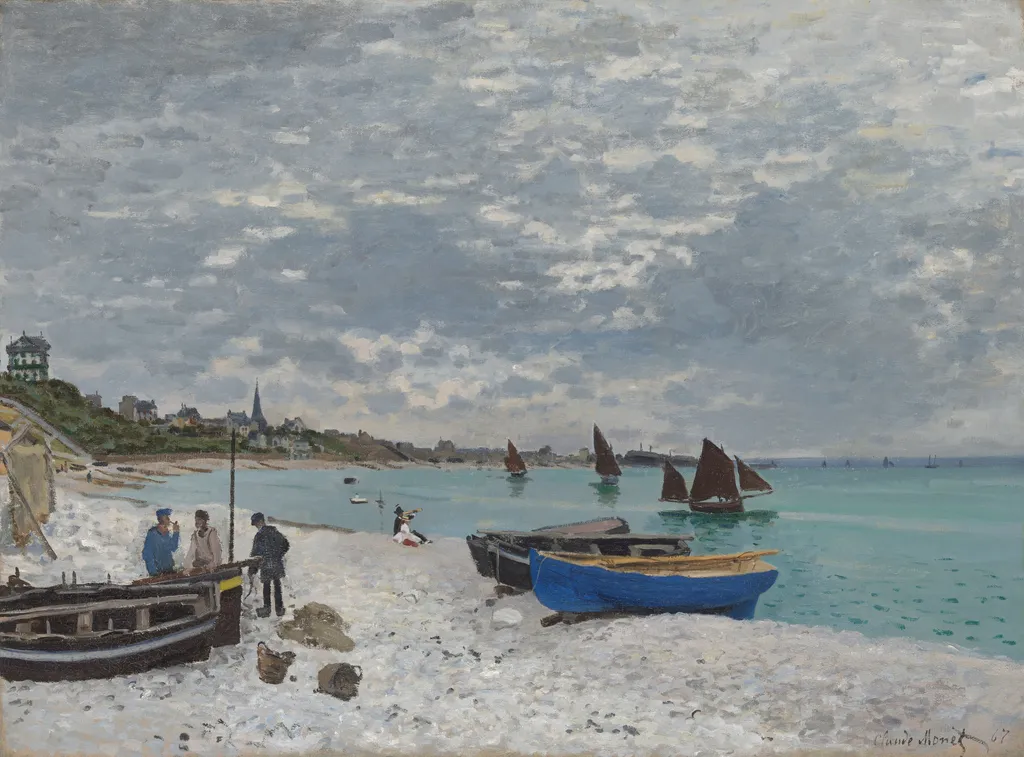
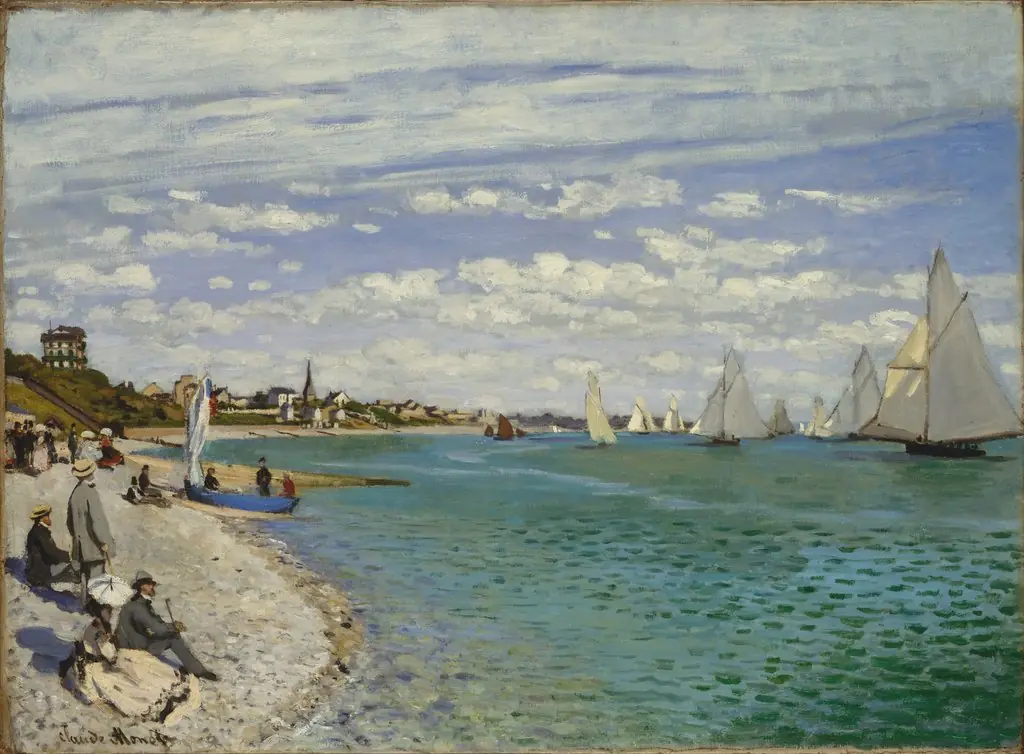
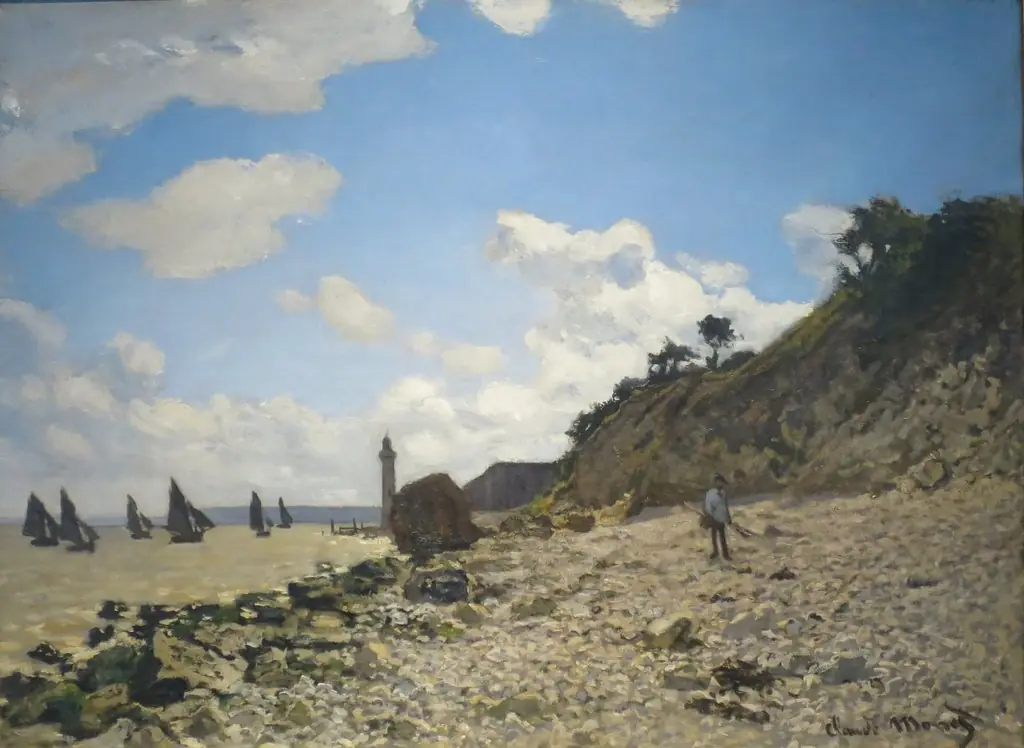
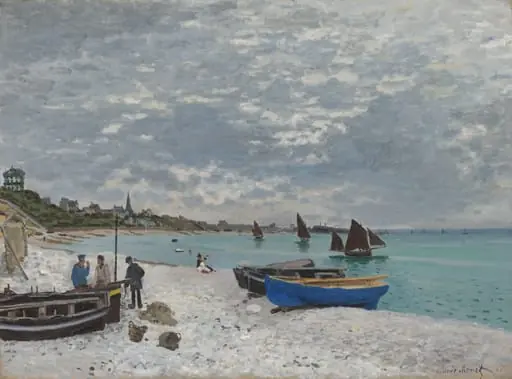
The Beach at Sainte-Adresse is an oil painting by the Impressionist artist Claude Monet. It dates from 1867 and is held in the collection of the Art Institute of Chicago.
About this work
Subject & Meaning
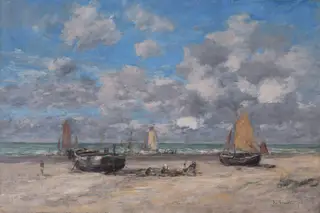
The Beach at Sainte-Adresse depicts a working-class shoreline scene featuring fishermen, a modest beachside village, and a bourgeois couple in the background, reflecting everyday life along the Normandy coast near Le Havre in the summer of 1867. Monet painted the work during a financially strained visit to his aunt and father in Sainte-Adresse, where he stayed while his pregnant partner remained in Paris. The painting juxtaposes laborers at low tide with a leisurely couple, capturing a transitional moment in the region's history as former fishing villages like Sainte-Adresse were being transformed into fashionable seaside resorts for Parisian elites.
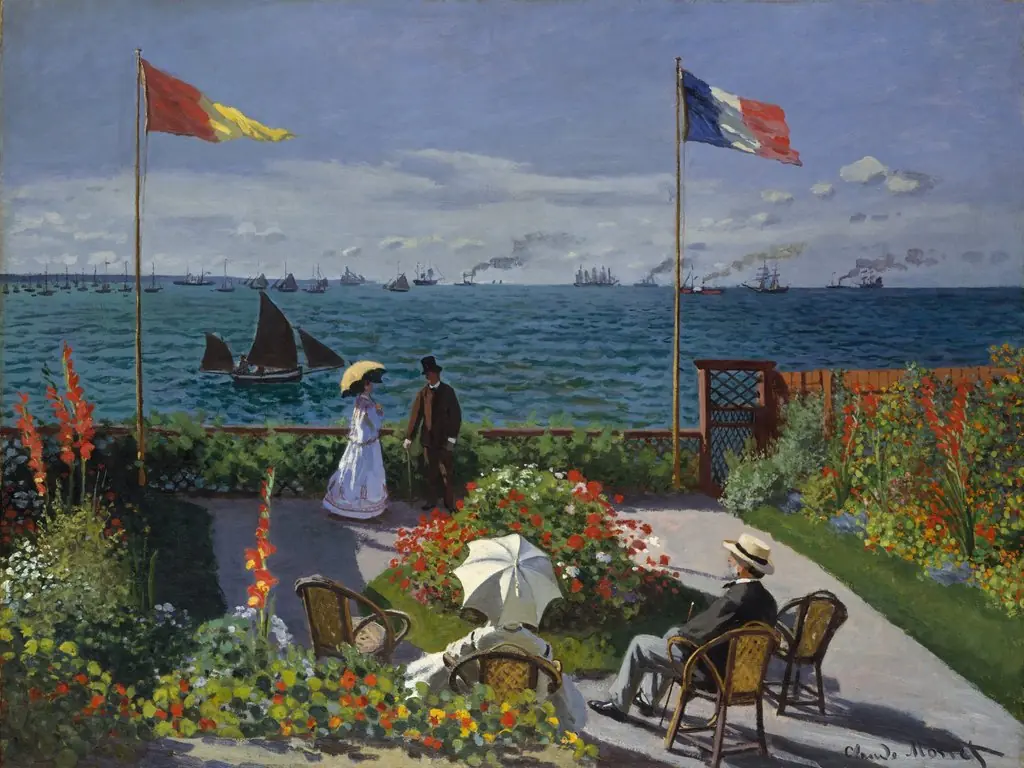
This duality is rendered through identical compositional viewpoints shared with Monet's Regatta at Sainte-Adresse, painted nearby, emphasizing variations in light and atmospheric conditions rather than explicit social commentary. The work was created shortly after Monet's submissions were rejected for the 1867 Exposition universelle, a period marked by personal and financial pressures that influenced his focus on coastal scenes as both subject and artistic experiment.
Technique & Style
Executed in the Impressionist style, the work depicts a low-tide scene under a grey sky, contrasting with a companion piece painted nearby that shows high tide.
Created in 1867, The Beach at Sainte-Adresse is an oil painting on canvas measuring 75.8 cm by 102.5 cm. Executed in the Impressionist style, the work depicts a low-tide scene under a grey sky, contrasting with a companion piece painted nearby that shows high tide. The handling of paint demonstrates a deliberate disparity in detail: the cloud formations are rendered with meticulous care, creating a vast, textured canopy, while the human figures and fishermen are depicted with a more summary, economical approach. Although the weather appears overcast, the surface conveys a vivid and intense quality of light.
Technical investigations using infrared and X-ray imaging revealed that Monet initially included tourists and pleasure yachts in the composition, which were later painted over to feature fishermen and beached boats, altering the social character of the scene.
History & Provenance
Claude Monet painted The Beach at Sainte-Adresse in the summer of 1867 while staying with family in Normandy, a visit necessitated by financial difficulties and family tensions regarding his partner Camille Doncieux. Working near the location of his companion piece Regatta at Sainte-Adresse, Monet initially depicted tourists and pleasure yachts but later altered the composition to show fishermen at low tide under a grey sky.
Monet sold the finished work to the dealer Paul Durand-Ruel on 28 February 1873. It was acquired by the baritone and collector Jean-Baptiste Faure in 1876, then returned to Durand-Ruel on 9 January 1893 for 7,000 francs, and days later sold to Henri Véver in Paris. On 1–2 February 1897 it passed to Gustave Kahn for 9,000 francs.
By 1920 it was held jointly by Durand-Ruel and Bernheim-Jeune, and in 1923 it entered Annie Swan Coburn's possession in Chicago. She bequeathed it to the Art Institute of Chicago upon her death in 1933, as part of the Mr. and Mrs. Lewis Larned Coburn Memorial Collection.
The work was first publicly exhibited at the 2nd Impressionist Exhibition in 1876. It has since appeared in roughly thirty exhibitions devoted to Monet and Impressionism in the United States, France, the United Kingdom, Spain, Germany, Switzerland, and Russia.
Context
Painted in 1867 during a period of financial strain and family separation, the work reflects Monet's focus on light variations rather than social commentary. Critics have long identified it as a pendant to Regatta at Sainte-Adresse; while the companion piece depicts bourgeois leisure at high tide, this canvas portrays fishermen at low tide under a grey sky. Despite their near-identical format and viewpoint, the pair was never exhibited together.
The painting received favorable reactions upon its debut at the second Impressionist exhibition in 1876. Scholars note that technical analysis reveals Monet originally painted tourists and pleasure yachts before overpainting them with the current figures of laborers, adding a social layer to his study of atmospheric conditions. The work remains a significant example of his early Impressionist development and his practice of capturing the same landscape under differing circumstances.
Legacy
First exhibited in 1876, the painting initially garnered favorable critical reactions. Art historians regard it as a deliberate pendant to Monet's Regatta at Sainte-Adresse, noting how the pair explores variations of light and social class through nearly identical viewpoints. While the companion piece depicts bourgeois leisure at high tide, this work focuses on fishermen at low tide under a grey sky, illustrating Monet's interest in capturing atmospheric changes rather than issuing a social manifesto.
The work's reputation grew through extensive exhibition history, appearing in approximately thirty shows dedicated to Impressionism across the United States, Europe, and Russia. Its legacy was solidified in 1933 when Annie Swan Coburn bequeathed the canvas to the Art Institute of Chicago, ensuring its permanent place within a major public collection.
Overview
Claude Monet created The Beach at Sainte-Adresse in 1867, employing oil on canvas to capture a coastal scene near the Normandy town of Sainte‑Adresse. The composition presents a tranquil shoreline populated by fishermen, a distant bourgeois couple, and a modest fleet of sailboats beneath a cloud‑filled sky.
Own this work as a print
Artist & collection

Artist
Oscar-Claude Monet was a French painter and founder of Impressionism who is seen as a key precursor to modernism, especially in his attempts to paint nature as he perceived it.