Artwork
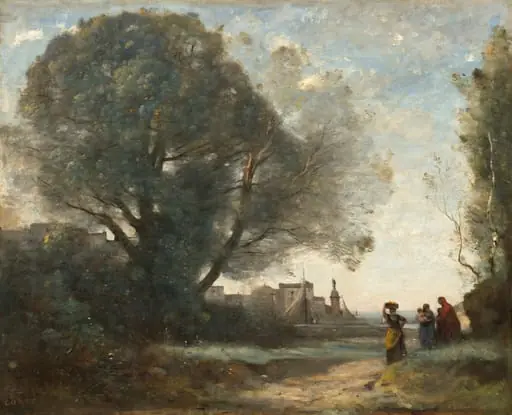
The Moored Boatman: Souvenir of an Italian Lake
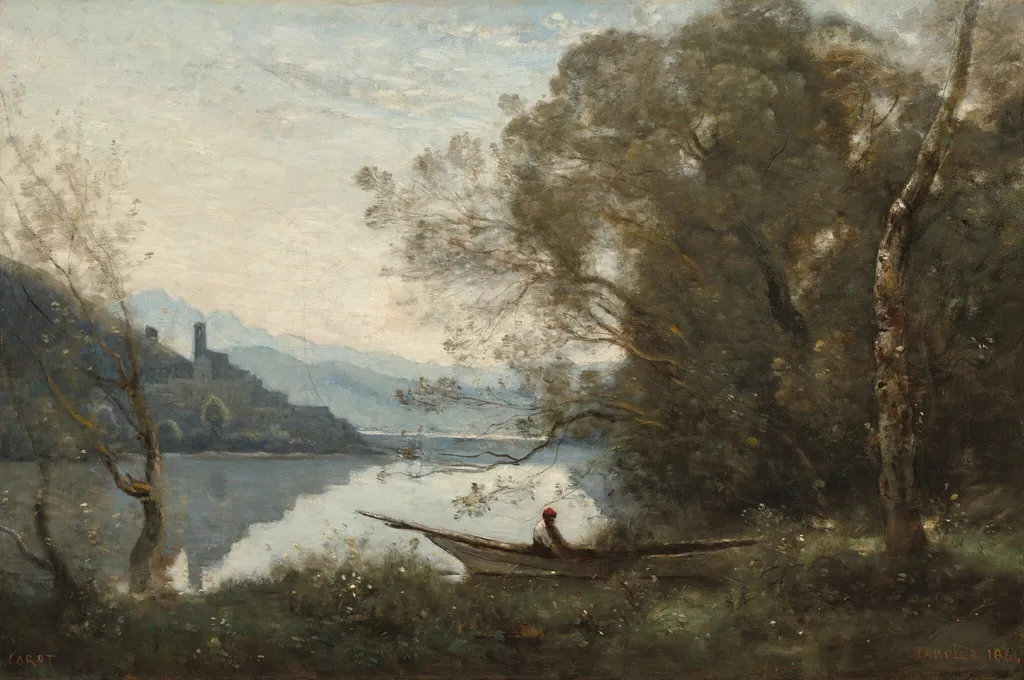
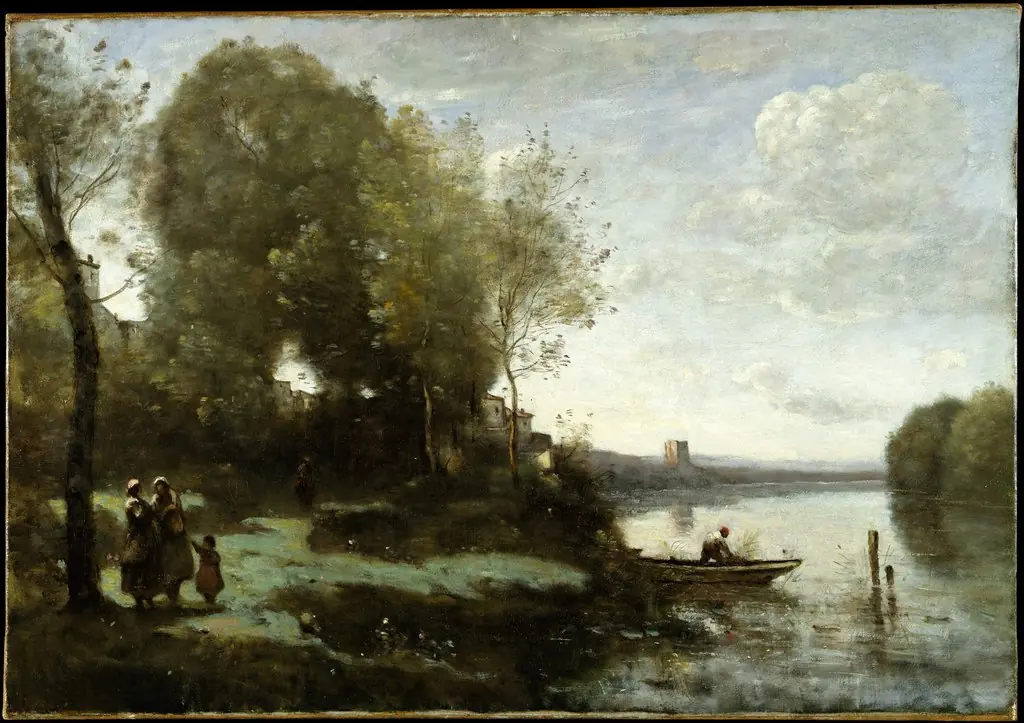
The Moored Boatman: Souvenir of an Italian Lake is an oil painting by the Barbizon school artist Jean Baptiste Camille Corot. It dates from 1861 and is held in the collection of the National Gallery of Art.
- Inscription
- Inscribed:lower left: COROT; lower right, the "n" backwards: Janvier 1861
About this work
Subject & Meaning
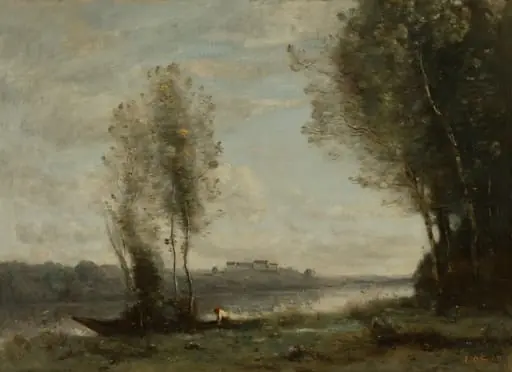
The painting shows a solitary boatman anchored on an Italian lake, a motif that evokes the contemplative stillness of nature and the fleeting passage of time.
The painting shows a solitary boatman anchored on an Italian lake, a motif that evokes the contemplative stillness of nature and the fleeting passage of time. Corot’s rendering emphasizes atmospheric light and the quiet dialogue between human labor and water, suggesting a symbolic meditation on transience and serenity. The work’s subject therefore embodies the Romantic ideal of nature as a reflective sanctuary rather than a literal landscape.
Technique & Style
Executed in 1861, the work is an oil painting on canvas measuring approximately 61 × 90 cm. The handling is characteristic of Corot’s late Italianate style: broad, luminous skies are contrasted with carefully observed foliage and reflective water rendered through translucent glazes and delicate scumbles. The composition balances repoussoir framing on the left with open expanse on the right, while the muted palette, soft greens, silvery blues, and warm earth tones, evokes a tranquil lakeside atmosphere. Brushwork varies from smooth passages in the distant hills to more textured strokes in the foreground foliage, indicating a deliberate modulation of finish associated with Corot’s plein-air synthesis.
History & Provenance
The painting was created by Jean-Baptiste-Camille Corot in 1861 as an oil on canvas landscape titled The Moored Boatman: Souvenir of an Italian Lake. It entered the ownership of Albert, vicomte de Curel, who held it until his death, after which it was sold by his estate at Galerie Georges Petit in Paris on 25 November 1918 as Le Lac de Terni. The work was subsequently acquired jointly by Arnold & Tripp and M. Knoedler & Co., and purchased in April 1919 by William Andrews Clark, who added it to his collection under the title Le Lac de Terni.
Clark later bequeathed the painting to the Corcoran Gallery of Art in 1926, where it remained in the collection until its acquisition by the National Gallery of Art in 2015.
The work is held by the National Gallery of Art in Washington, D.C., where it was acquired in 2015 after being bequeathed to the Corcoran Gallery of Art in 1926. Its accession number is 2015.160.1. The painting entered the collection through a series of transactions beginning with its purchase by William Andrews Clark in 1919, following its sale at the Galerie Georges Petit auction in 1918.
Prior to this, it was owned by Albert, vicomte de Curel, and earlier by the Parisian dealer Georges Petit. The painting has been included in exhibitions such as 'Corot 1796-1875'
Overview
Jean-Baptiste-Camille Corot’s oil on canvas titled The Moored Boatman: Souvenir of an Italian Lake presents a tranquil waterside view. A muted blue sky stretches above a placid lake, bordered by olive‑toned trees and low hills that recede into the distance. The composition is dominated by a single boat occupied by a lone figure, creating a quiet, contemplative atmosphere.
Context
Created during Corot’s Italian period, the painting reflects the artist’s fascination with the country’s lakes and rural scenery. While the work does not directly reference a specific location, it embodies the idealized vision of the Italian landscape that attracted many 19th‑century painters. The piece remains part of Corot’s broader exploration of light, atmosphere, and the quiet moments of everyday life.
Own this work as a print
Artist & collection
Artist
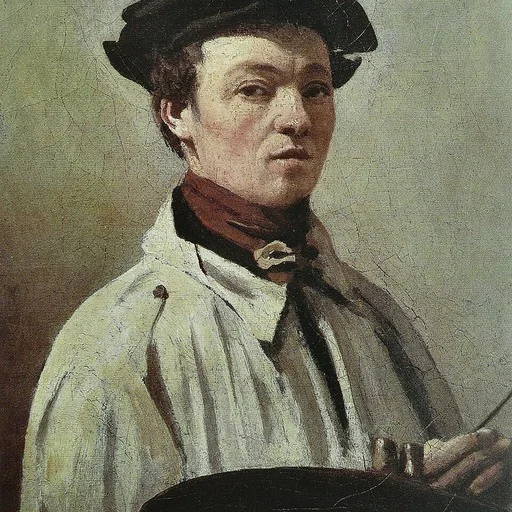
Jean-Baptiste-Camille Corot (UK: KORR-oh, US: kə-ROH, kor-OH; French:; 16 July 1796 – 22 February 1875), or simply Camille Corot, was a French landscape and portrait painter as well as a printmaker in etching.