Artwork
Little Fortune
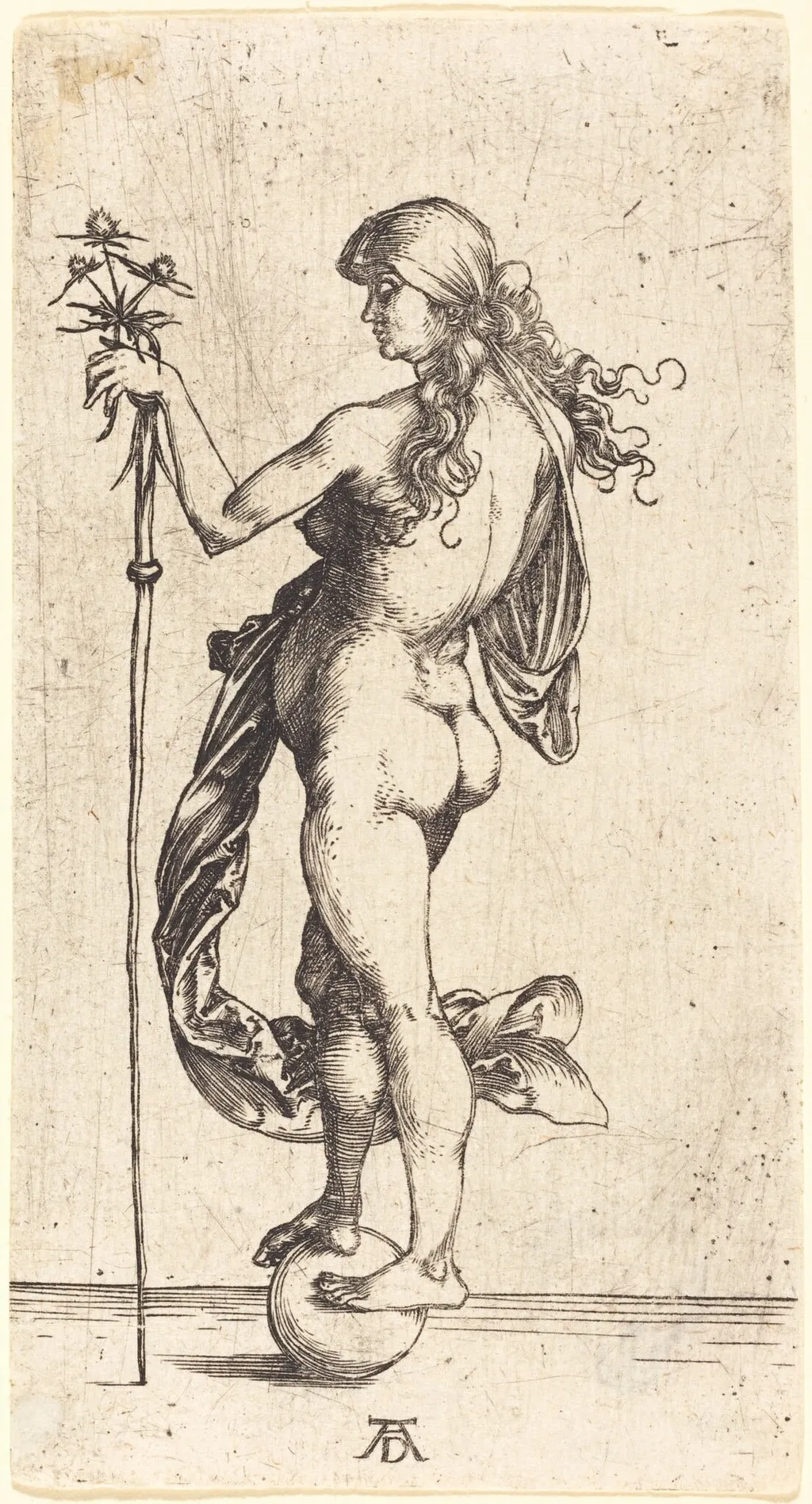
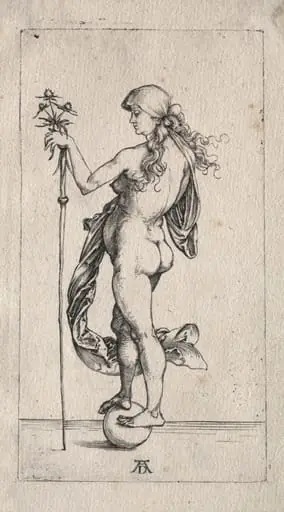
Little Fortune is an ink print by the Northern Renaissance artist Albrecht Dürer. It dates from 1496 and is held in the collection of the British Museum.
- Inscription
- Inscribed:in plate, bottom center: AD [artist's monogram]; verso, lower right, in graphite by a later hand: B78; verso, lower left, in graphite by a later hand: 28 [upside down]; verso, lower center, in graphite by a later hand: L4 [?]; verso, lower center, in graphite by a later hand: H.831; verso, lower right, in graphite by a later hand: (78) [?]; verso, lower right, in graphite by a later hand: 69; verso, bottom right, in graphite by a later hand: 248
About this work
Subject & Meaning
The print depicts the Roman goddess Fortuna, identified by the sphere she balances on and the eryngium flower symbolizing amorous fortune, representing both the power and fragility of love. Dürer breaks from medieval Fortune iconography by showing her without a wheel or blindfold, drawing inspiration from Andrea Mantegna's Parnassus and a philosophical dialogue attributed to Socrates' student Cebes, as noted in French and Spanish Wikipedia entries and corroborated by the National Gallery of Art provenance records. The work, titled Little Fortune, is recognized as Dürer's first female nude engraving, created around 1495-1496 in Nuremberg, and influenced later artists such as Lucas van Leyden.
Technique & Style
The composition breaks from late medieval iconography by showing Fortuna without blindfold or a turning wheel, emphasizing both the power and fragility of luck.
Little Fortune is an engraving on laid paper created around 1495-1496 by Albrecht Dürer. Executed in the German Renaissance style, it measures 12.3 cm in height by 6.5 cm in width and depicts the goddess Fortuna standing on a sphere, holding an eryngium flower and a thistle. The composition breaks from late medieval iconography by showing Fortuna without blindfold or a turning wheel, emphasizing both the power and fragility of luck. Dürer drew on classical sources such as the Greek dialogue attributed to a disciple of Socrates, as rendered by his friend Willibald Pirckheimer, and on visual models including the dancing Muses in Andrea Mantegna’s Parnassus. The print was made in Nuremberg and is housed in several major collections, including the National Gallery of Art in Washington, D.C., where it was acquired as part of the Rosenwald gift in 1943.
History & Provenance
Albrecht Dürer produced the engraving around 1495-1496 in Nuremberg, according to the French and Spanish Wikipedia entries, which both date the work to that period. The internal corpus record, however, lists the date as 1490, while Wikidata gives multiple possible inception dates spanning 1490, 1496, and 1497. The documented ownership chain begins with a sale at Hollstein & Puppel in Berlin on May 6-8, 1929 (lot 248). Lessing J. Rosenwald of Jenkintown, Pennsylvania acquired the impression at that sale, as recorded by his collector's marks (Lugt 1760b and 1932d). The print subsequently passed to the Nationalmuseum in Stockholm, identified by marks Lugt 1934 and 1982. Rosenwald later gave the impression to the National Gallery of Art in Washington, D.C., in 1943, where it entered the Prints collection of the Rosenwald Collection. Little Fortune is held in the National Gallery of Art, Washington, D.C., where it is catalogued under the inventory number 1943.10.16. The work entered the collection through a gift from Lessing J. Rosenwald in 1943 after his purchase at the Hollstein & Puppel auction in Berlin on May 6-8, 1929 (sale number 248). Earlier provenance includes ownership recorded in Lugt 1934 and Lugt 1982, and it was previously in the possession of the Nationalmuseum in Stockholm. Exhibition history is documented through its inclusion in the National Gallery of Art’s Rosenwald Collection and its appearance in various exhibitions of Dürer’s prints, though specific exhibition titles are not detailed in the sources. The print is also listed in the National Gallery of Art’s Rosenwald Collection and has been featured in catalogues and scholarly discussions of Dürer’s oeuvre, including entries in the Germanisches Nationalmuseum and the Cleveland Museum of Art holdings.
Context
The work known in English as Little Fortune is a 1490 engraving by Albrecht Dürer depicting the allegorical figure of Fortuna, the goddess of luck. It is recognized as Dürer’s first fully nude female engraving, created during a period in which he produced multiple studies of the female form, including a standing female nude (1495, Louvre) and the Bath of Women (1496, Kunsthalle Bremen). Scholars note its iconographic innovation: a sphere symbolizing Fortuna’s balance, an eryngium flower denoting erotic fortune, and a thistle representing success in love, all of which break from medieval depictions of Fortuna on a wheel with blindfolded eyes. Dürer likely drew on philosophical sources, including the ancient dialogue attributed to a disciple of Socrates, as rendered in German by his friend Willibald Pirckheimer. The print was widely copied and influential during Dürer’s lifetime, inspiring artists such as Lucas van Leyden. It is held in major collections including the National Gallery of Art, the Cleveland Museum of Art, and the Rijksmuseum.
Legacy
The legacy of Little Fortune rests on its pioneering role as the first female nude engraving by Albrecht Dürer, a work that introduced a new iconography of Fortuna as a lover rather than the traditional wheel-bearing, blind figure. Its influence is evident in contemporary reproductions and later borrowings, such as Lucas van Leyden’s 'Woman and the Stag' inspired by Dürer’s composition. The piece reshaped how Renaissance artists approached personifications of chance and desire, linking Dürer’s technical innovation with humanist ideas transmitted through Willibald Pirckheimer’s translation of 'The Table of Cebes'.
Artist & collection
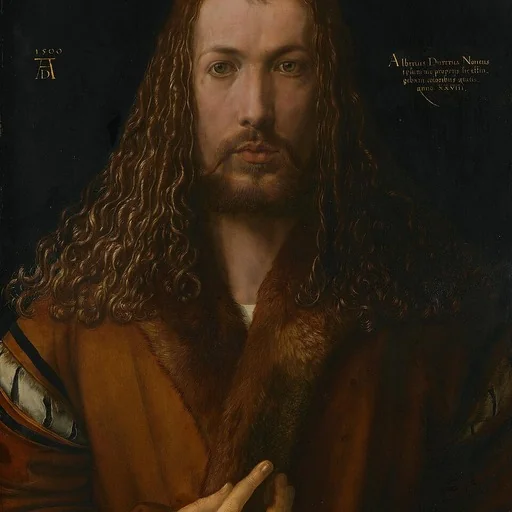
Artist
Albrecht Dürer spent his life in Nuremberg, a busy German city where artists traded prints like currency.

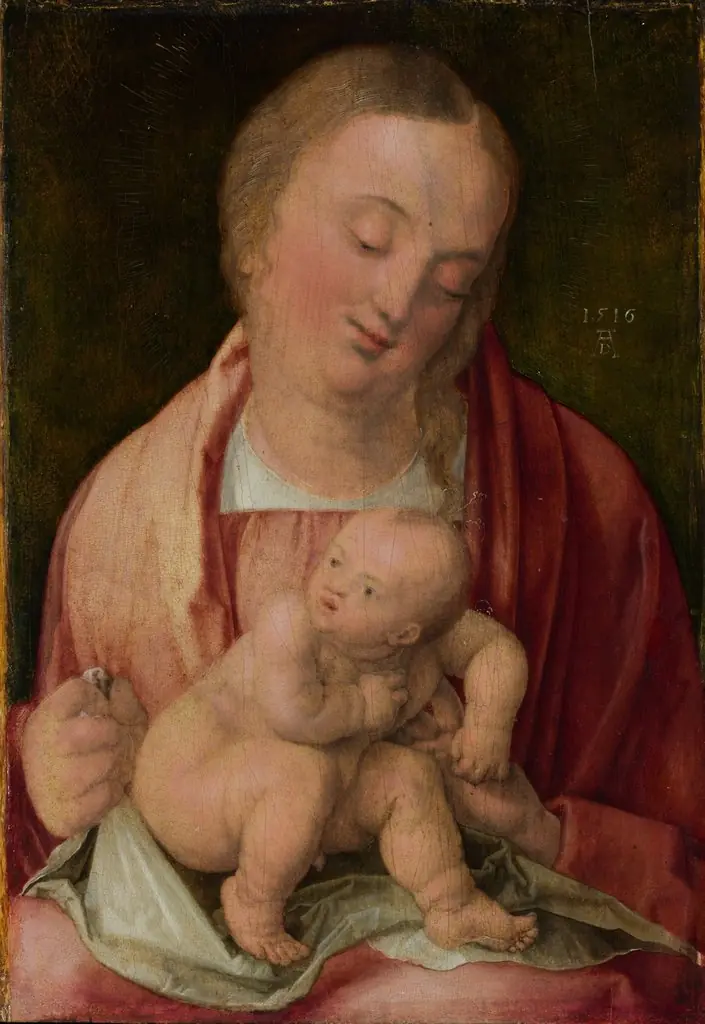
![Madonna and Child [obverse], by Albrecht Dürer](https://artifactworldgallery.com/img/albrecht-durer--madonna-and-child-obverse--d7b8ebf05d22ebe5-w320.webp)
![Lot and His Daughters [reverse], by Albrecht Dürer](https://artifactworldgallery.com/img/albrecht-durer--lot-and-his-daughters-reverse--b4ebf9b282faa17a-w320.webp)