Artwork
Nemesis (The Great Fortune)
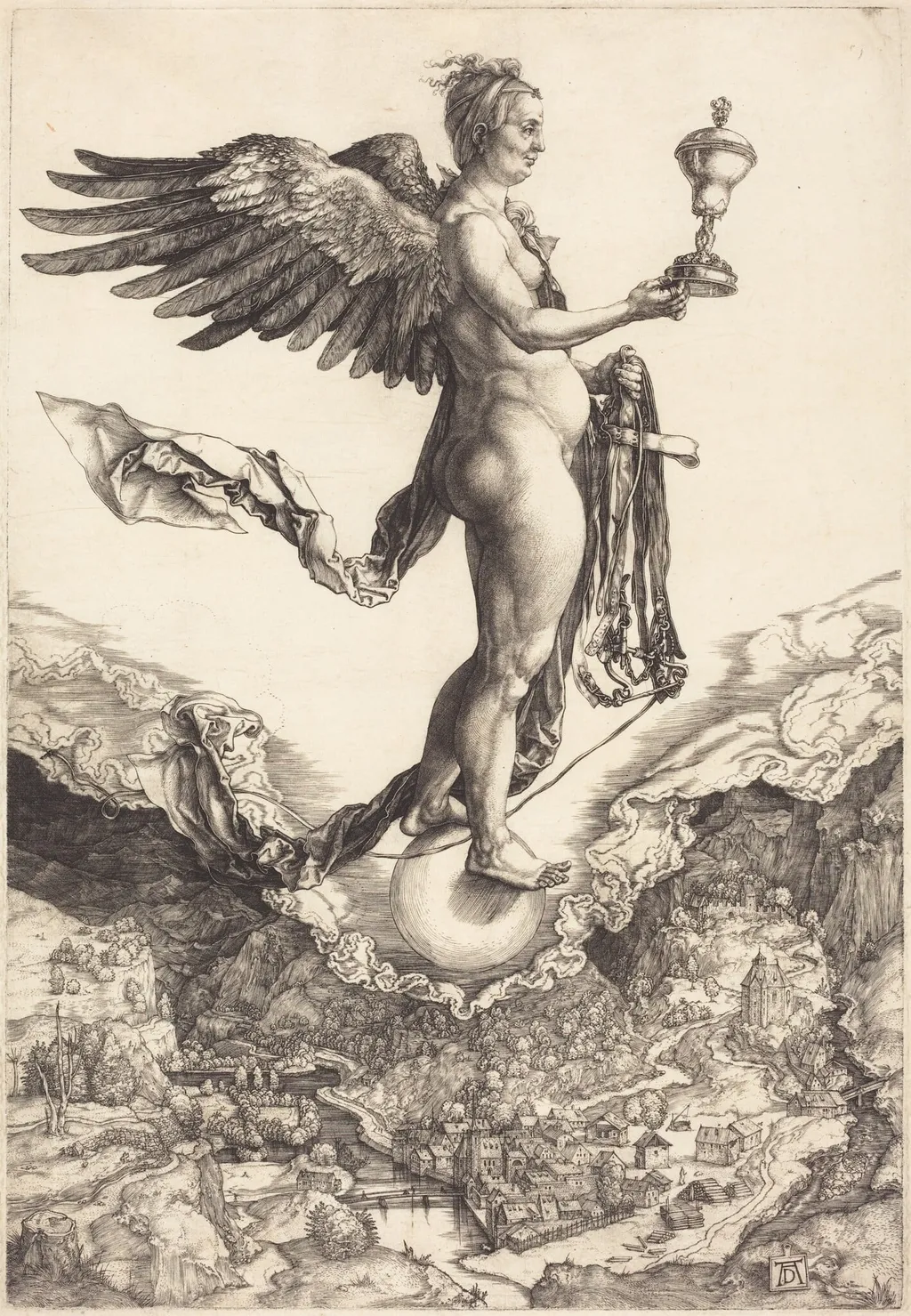
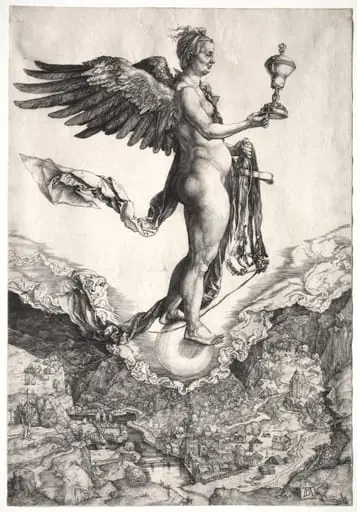
Nemesis (The Great Fortune) is an ink print by the Northern Renaissance artist Albrecht Dürer. It dates from 1502 and is held in the collection of the National Gallery of Victoria.
- Inscription
- Inscribed:in plate, bottom right, on tablet: AD [artist's monogram]; verso, lower left, in graphite by a later hand: stopp [?] [underlined]; verso, bottom left, in graphite by a later hand: 312 [?] [obscured by hinge]
About this work
Subject & Meaning
In her hands, she holds contrasting symbols of fate: an ornate goblet representing reward and a set of bridle reins signifying punishment.
The engraving depicts Nemesis, the Greek goddess of divine retribution, synthesized with the Roman concept of Fortuna. Dürer portrays her as a powerful, winged female figure standing atop a floating sphere, hovering above a vast valley landscape often identified as Chiusa in the South Tyrol. Her iconography draws from humanist sources, specifically Angelo Poliziano's poem Manto and Giulio Pomponio Leto's Manual of Roman History, merging the ideas of victory and vengeance.
In her hands, she holds contrasting symbols of fate: an ornate goblet representing reward and a set of bridle reins signifying punishment. The goddess is rendered with a corpulent, non-idealized nudity, a deliberate stylistic choice by the artist to reflect the heavy, fatalistic weight of her dominion. This physical mass is so pronounced that the clouds beneath her feet appear to sag under her burden, emphasizing the gravity of her role as the dispenser of justice.
Technique & Style
The print is an engraving executed on laid paper, measuring 33.2 cm by 23.2 cm (source 2). Dürer’s technique combines precise line work with careful shading to render a winged female figure standing on a sphere, holding a gold cup as a symbol of reward and reins as a symbol of punishment (source 3). The composition displays unusual proportions that reflect Dürer’s study of Vitruvian canon and the influence of Jacopo de’ Barbari, emphasizing a heavy, non‑idealized body that weighs down the surrounding clouds (source 3). Fine details such as the texture of the feathers are balanced against a broad, bird’s‑eye landscape that recedes into shadow, creating a dramatic contrast (source 3).
History & Provenance
The work Nemesis (The Great Fortune) was created by Albrecht Dürer in 1501 as an engraving on laid paper. It was first recorded in the collection of Oskar Stössel in Vienna and later acquired by Lessing J. Rosenwald in Jenkintown, Pennsylvania, before being gifted to the National Gallery of Art in 1943. The print is documented in multiple institutional collections, including the National Gallery of Art, Cleveland Museum of Art, and Staatliche Kunsthalle Karlsruhe. Its dimensions are 33.2 cm in height and 23.2 cm in width, and it was produced in Nuremberg. The iconography draws from the Latin poem Manto by Angelo Poliziano and Giulio Pomponio Leto’s Roman history manual, blending the Greek deity Nemesis with the Roman Fortuna. Dürer’s composition features a winged, nude female figure standing on a sphere, holding symbols of reward and punishment, rendered with unconventional proportions reflecting Vitruvian and Jacopo de’ Barbari influences.
Nemesis (The Great Fortune) is held in the National Gallery of Art, Washington, D.C., where it is part of the Rosenwald Collection (inventory/accession number not specified in sources). It has been exhibited as part of the Rosenwald Collection holdings and is also held in the Staatliche Kunsthalle Karlsruhe, Germany, and the Villa Pisani Dossi museum in Corbetta, Italy, according to multiple sources. Exhibition history is limited to its inclusion in the Rosenwald Collection display at the National Gallery of Art, with no further exhibition details provided in the sources.
Context
Critical reception of Nemesis (The Great Fortune) has been shaped by its allegorical complexity and technical innovation within the German Renaissance. Scholarship identifies the work as a pivotal exploration of fortune and justice, drawing on Poliziano's Manto and Pomponio Leto's Roman history manual to fuse Fortuna and Nemesis into a winged, nude figure holding symbols of reward and punishment. The engraving's composition, featuring a floating sphere, wind-swept drapery, and a panoramic landscape possibly referencing Chiusa in the Isarco Valley, reflects Dürer's synthesis of Vitruvian proportion and Jacopo de' Barbari's influence, as noted in French and Italian art historical sources. The work's reception underscores its role in art history as an early example of mathematically precise engraving using compas and ruler, with its unconventional heavy female form and detailed wing textures conveying the 'fatidic gravity' of its subject. This piece is part of Dürer's broader engagement with allegory and humanist thought, situated within his wider practice of blending classical mythology with Northern Renaissance naturalism, as documented in museum collections and cited scholarship across institutions like the National Gallery of Art and Staatliche Kunsthalle Karlsruhe.
Own this work as a print
Artist & collection
Artist
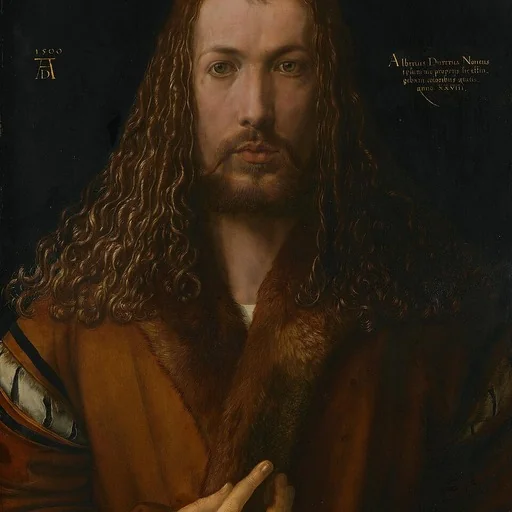
Albrecht Dürer spent his life in Nuremberg, a busy German city where artists traded prints like currency.

![Madonna and Child [obverse], by Albrecht Dürer](https://artifactworldgallery.com/img/albrecht-durer--madonna-and-child-obverse--d7b8ebf05d22ebe5-w320.webp)
![Lot and His Daughters [reverse], by Albrecht Dürer](https://artifactworldgallery.com/img/albrecht-durer--lot-and-his-daughters-reverse--b4ebf9b282faa17a-w320.webp)