Artwork
The Beast with Two Horns like a Lamb
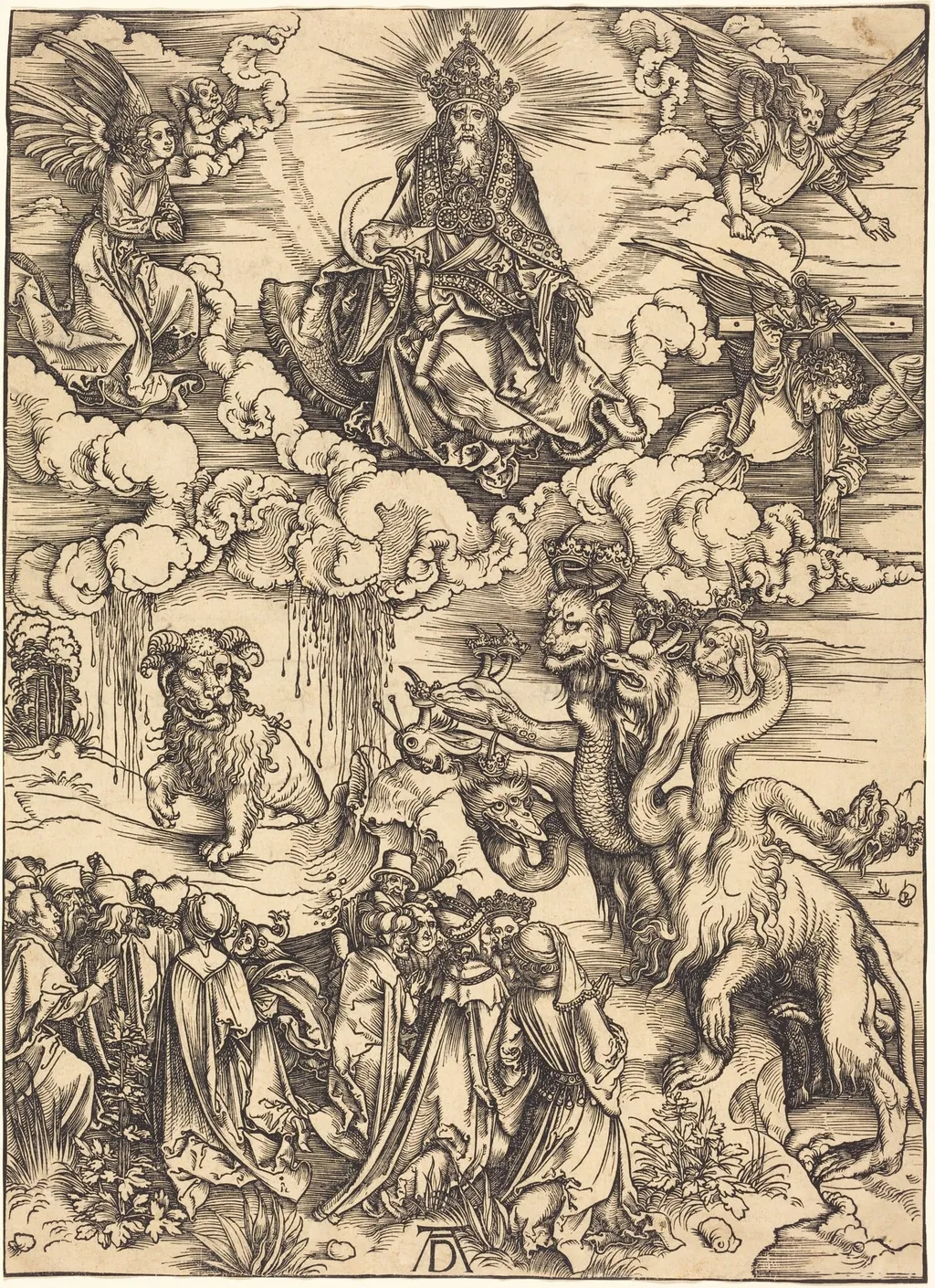
The Beast with Two Horns like a Lamb is an ink print by the Northern Renaissance artist Albrecht Dürer. It dates from 1497 and is held in the collection of the Metropolitan Museum of Art.
About this work
Subject & Meaning
The print portrays a hybrid figure described in Revelation 13 and 14, combining lamb-like horns with beastly characteristics to symbolize false prophecy and satanic deception within Christian eschatology. Dürer’s woodcut visualizes the apocalyptic warning against deceptive miracles that mimic divine authority, aligning with the broader German Renaissance interest in theological narrative and print as a medium for religious instruction.
Technique & Style
The composition draws its subject from the Book of Revelation, specifically chapters 13 and 14, and depicts God in Christianity.
The Beast with Two Horns like a Lamb is a woodcut produced by Albrecht Dürer in 1496, classified as a print within the religious genre and associated with the German Renaissance movement. The work is executed on laid paper, a support characteristic of late fifteenth-century printmaking. Recorded dimensions indicate the sheet measures approximately 38.8–39.2 cm in height and 28.1–28.2 cm in width.
The composition draws its subject from the Book of Revelation, specifically chapters 13 and 14, and depicts God in Christianity.
Dürer's woodcut technique involved carving a design into a wooden block, inking the raised surfaces, and transferring the image to paper under pressure, a method that allowed for the wide dissemination of his Apocalypse series imagery. The print belongs to the broader Apocalypse series, of which impressions are held by numerous institutions including the National Gallery of Art in Washington, D.C., and the Cleveland Museum of Art.
History & Provenance
Albrecht Dürer produced The Beast with Two Horns like a Lamb as a woodcut in 1496 while working in Nuremberg. The print belongs to the Apocalypse series and portrays a divine figure from Revelation 13 and 14. It is held in several major institutions, including the National Gallery of Art in Washington, D.C., and the Cleveland Museum of Art. The work was created on laid paper and measures approximately 38.8 cm by 28.1 cm.
Albrecht Dürer's woodcut The Beast with Two Horns like a Lamb is held in multiple public institutions, including the National Gallery of Art in Washington, D.C., and the Cleveland Museum of Art. The National Gallery of Art houses a version from the Rosenwald Collection, while other known impressions reside in the collections of the Städel Museum, Staatliche Kunsthalle Karlsruhe, Museum of Fine Arts in Houston, Metropolitan Museum of Art, Davison Art Center, Kupferstichkabinett Berlin, and Kupferstich-Kabinett Dresden. These prints, created on laid paper as part of Dürer's Apocalypse series, are cataloged within the inventory systems of these major repositories.
The provided sources list the holding institutions but do not specify individual accession numbers or detail a history of specific exhibitions for this work.
Legacy
The print has been referenced in scholarship on early modern apocalyptic imagery and cited as a visual precursor to later depictions of prophetic figures in the 16th century. Its formal composition was reproduced in several 19th-century engravings that circulated among academic circles interested in Reformation-era iconography. The work is held in the permanent collections of the National Gallery of Art and the Cleveland Museum of Art, where it is frequently included in exhibitions on German Renaissance prints.
Overview
Albrecht Dürer’s woodcut, titled The Beast with Two Horns like a Lamb, was produced around 1497. Executed as a single‑block print, the image presents a hybrid creature, its head resembling a lamb, its body goat‑like, and two prominent horns, set against a dark background where a shadowy demonic face can be discerned. The work belongs to Dürer’s early religious series and reflects the apocalyptic tone of the biblical Book of Revelation.
Context
The woodcut emerges from a period when the Reformation’s precursors stirred interest in scriptural interpretation and apocalyptic expectation. Dürer, working in Nuremberg, responded to a growing demand for visual aids that could convey complex theological ideas to a largely illiterate audience, using the accessible medium of print to disseminate biblical narratives.
Own this work as a print
Artist & collection
Artist
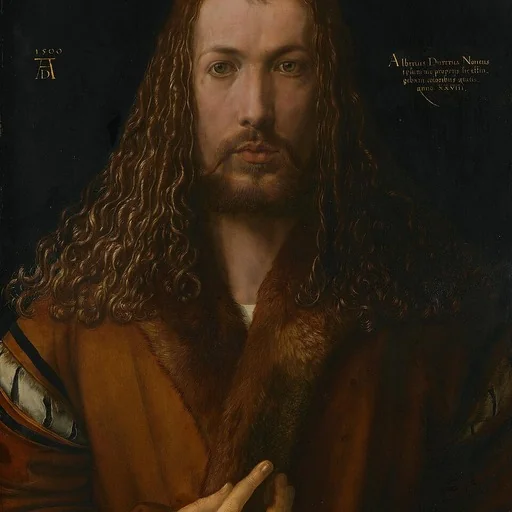
Albrecht Dürer spent his life in Nuremberg, a busy German city where artists traded prints like currency.

![Madonna and Child [obverse], by Albrecht Dürer](https://artifactworldgallery.com/img/albrecht-durer--madonna-and-child-obverse--d7b8ebf05d22ebe5-w320.webp)
![Lot and His Daughters [reverse], by Albrecht Dürer](https://artifactworldgallery.com/img/albrecht-durer--lot-and-his-daughters-reverse--b4ebf9b282faa17a-w320.webp)
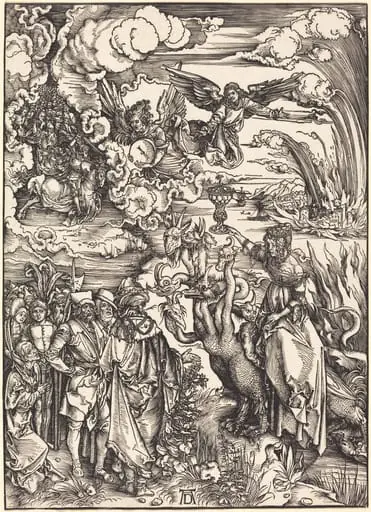 The Babylonian Whore
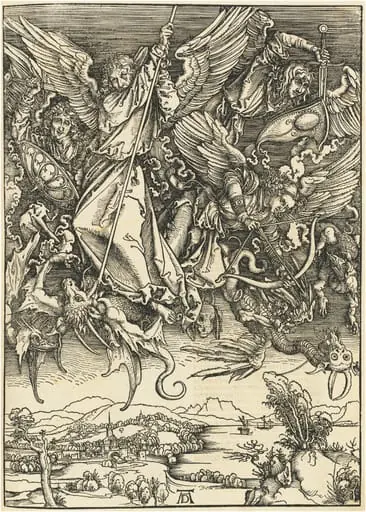 Saint Michael Fighting the Dragon
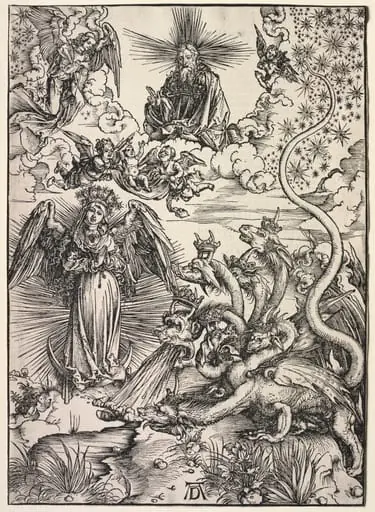 Revelation of St. John: The Woman Clothed with the Sun
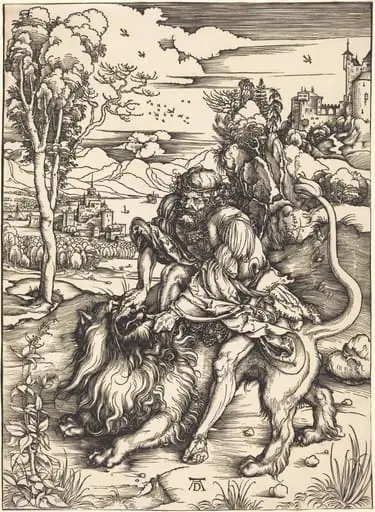 Samson Fighting with the Lion
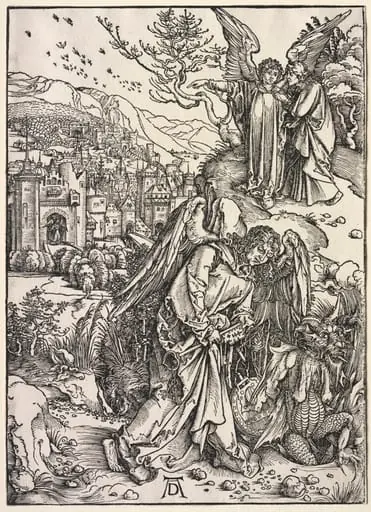 Revelation of St. John: Angel with the Key of the Bottomless Pit
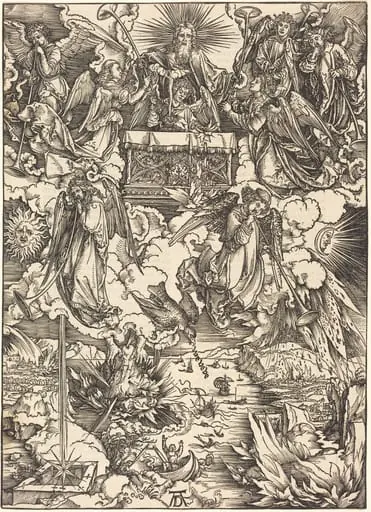 The Seven Angels with the Trumpets
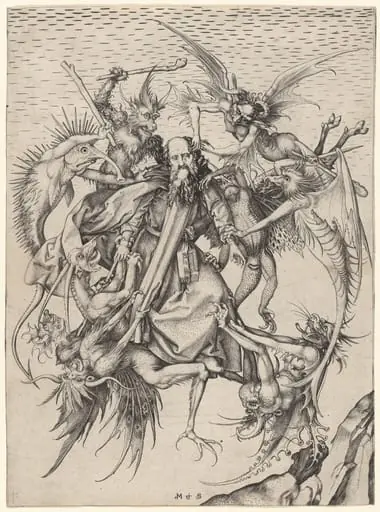 The Tribulations of Saint Anthony
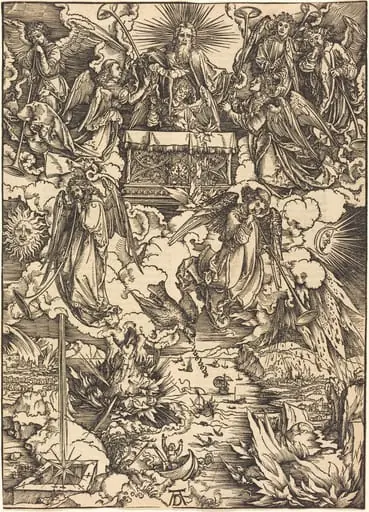 The Seven Angels with the Trumpets
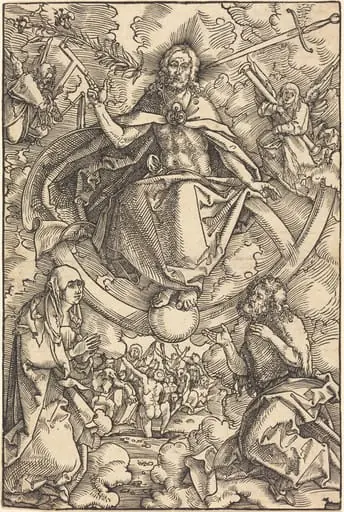 The Last Judgment