Artwork
The Betrayal of Christ
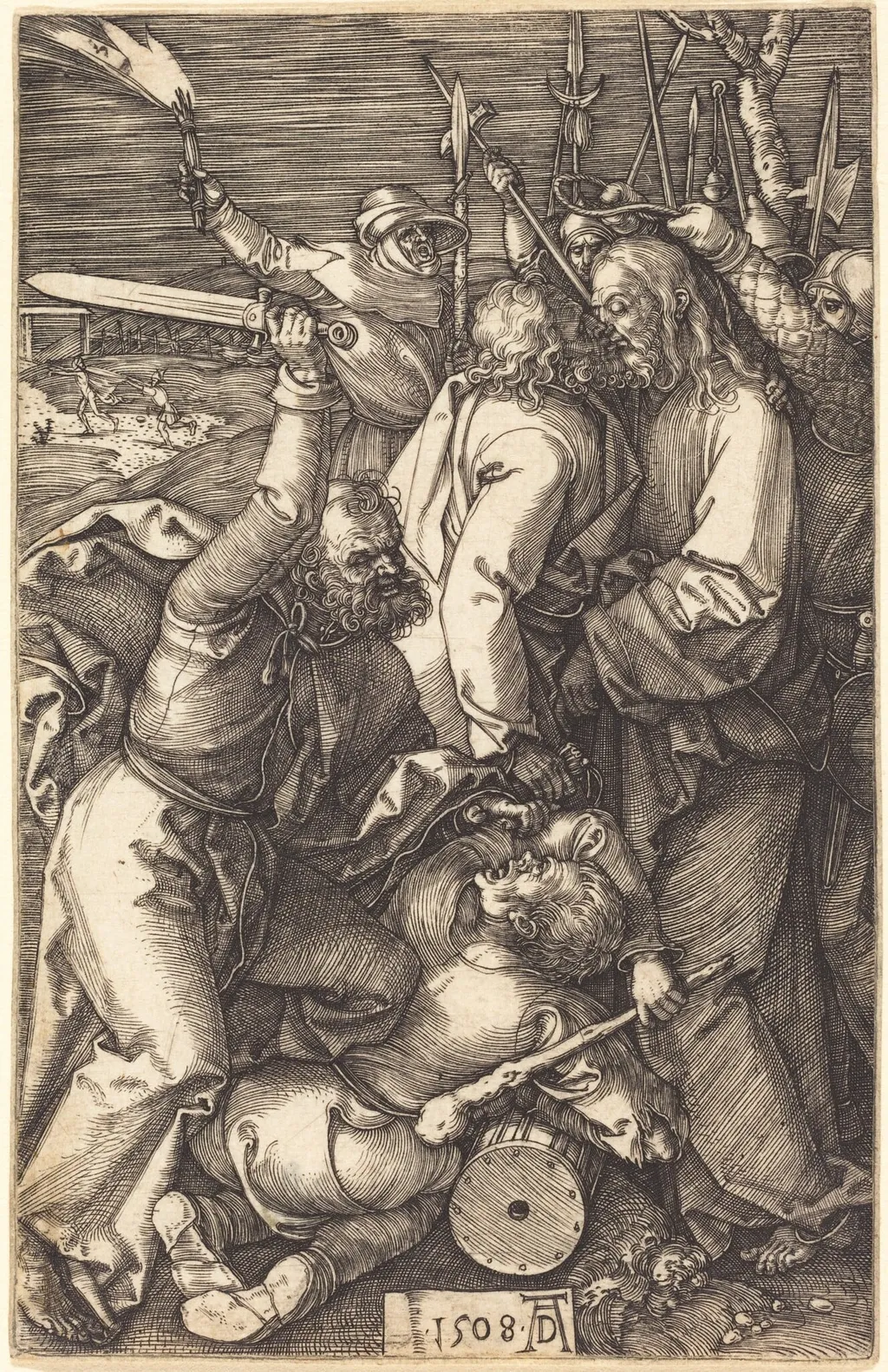
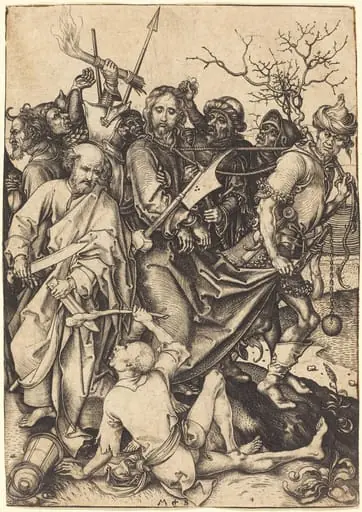
The Betrayal of Christ is an ink print by the Northern Renaissance artist Albrecht Dürer. It dates from 1508 and is held in the collection of the Metropolitan Museum of Art.
- Inscription
- Inscribed:in plate at bottom center: 1508 AD [artist's monogram]; verso, lower center, in graphite by a later hand: 19 [upside down]; verso, bottom center, in graphite by a later hand: B. 5; verso, bottom center, in graphite by a later hand: NR [?] 25146
- Markings
- Marked:none
About this work
Subject & Meaning
Albrecht Dürer's 1508 engraving illustrates the biblical moment known as the Kiss of Judas, an event drawn from the New Testament narratives of the Passion.
Albrecht Dürer's 1508 engraving illustrates the biblical moment known as the Kiss of Judas, an event drawn from the New Testament narratives of the Passion. The composition focuses on the interaction between Jesus Christ and Judas Iscariot, capturing the specific act of betrayal where the disciple identifies the Messiah to arresting soldiers through a deceptive gesture of affection. As a work of German Renaissance religious art, the piece serves as a visual meditation on treachery and the fulfillment of prophetic suffering.
The iconography relies on the stark contrast between the calm acceptance of Christ and the duplicity of his follower, emphasizing the theological weight of this pivotal instant in Christian doctrine.
Technique & Style
The Betrayal of Christ is an engraving executed on laid paper, characteristic of Albrecht Dürer's German Renaissance style. The work measures 118 cm in height and 75 cm in width, depicting the kiss of Judas as described in the New Testament. It is part of Dürer's Passion series and was created in 1508.
The print has passed through several collections, including the Brentano-Birckenstock Collection in Vienna and Frankfurt, Arthur Friederich Theodor Bohnenberger in Stuttgart, and Arthur Friederich Theodor Bohnenberger, before being acquired by Lessing J. Rosenwald in 1928 and gifted to the National Gallery of Art in 1943.
History & Provenance
Albrecht Dürer created this engraving in 1508 as part of his Passion series. The work's documented ownership begins with the Brentano-Birckenstock Collection, which held items in both Vienna and Frankfurt. It subsequently entered the collection of Arthur Friederich Theodor Bohnenberger in Stuttgart.
In 1928, Lessing J. Rosenwald of Jenkintown, Pennsylvania, purchased the print. Rosenwald later donated the work to the National Gallery of Art in Washington, D.C., in 1943, where it remains part of the institution's holdings.
The engraving is held by the National Gallery of Art, Washington, D.C., as part of the Rosenwald Collection, accessioned in 1943 following its donation by Lessing J. Rosenwald.
Its exhibition history includes display in the collection of the Cleveland Museum of Art, as documented in the museum’s holdings of Dürer’s Passion series.
Legacy
The Betrayal of Christ has shaped religious printmaking through its stark emotional intensity and compositional clarity, serving as a visual reference for later depictions of the Kiss of Judas. Its prominence in major museum collections, including the National Gallery of Art and Cleveland Museum of Art, has reinforced its status as a cornerstone of German Renaissance print culture.
Overview
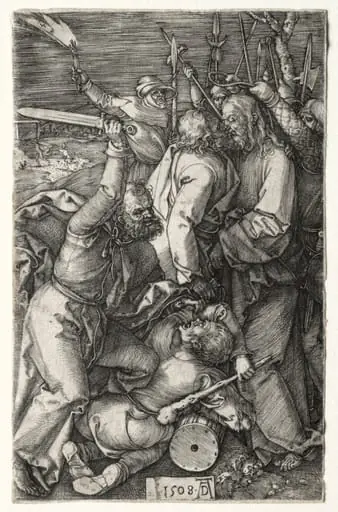
Albrecht Dürer’s 1508 engraving titled The Betrayal of Christ presents a pivotal moment from the New Testament narrative. Executed on laid paper, the print captures the instant when Judas identifies Jesus to the arresting soldiers, emphasizing the tension and drama inherent in the scene.
Own this work as a print
Artist & collection
Artist
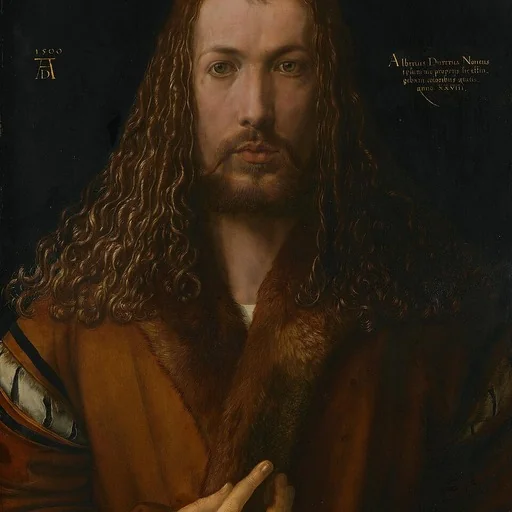
Albrecht Dürer spent his life in Nuremberg, a busy German city where artists traded prints like currency.

![Madonna and Child [obverse], by Albrecht Dürer](https://artifactworldgallery.com/img/albrecht-durer--madonna-and-child-obverse--d7b8ebf05d22ebe5-w320.webp)
![Lot and His Daughters [reverse], by Albrecht Dürer](https://artifactworldgallery.com/img/albrecht-durer--lot-and-his-daughters-reverse--b4ebf9b282faa17a-w320.webp)


- The Betrayal of Christ by Judas
 The Betrayal and Capture of Christ
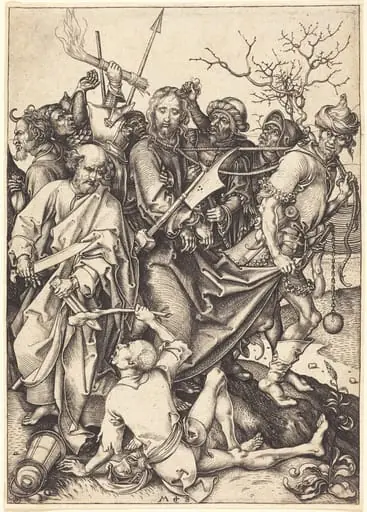 The Betrayal and Capture of Christ
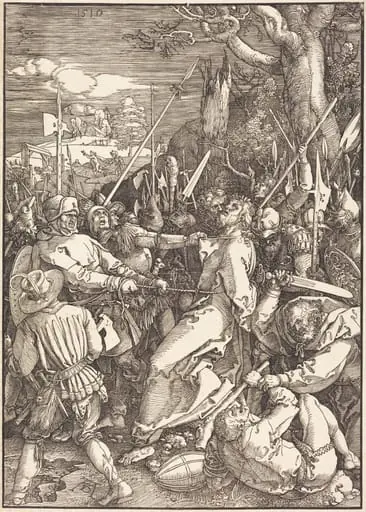 The Betrayal of Christ
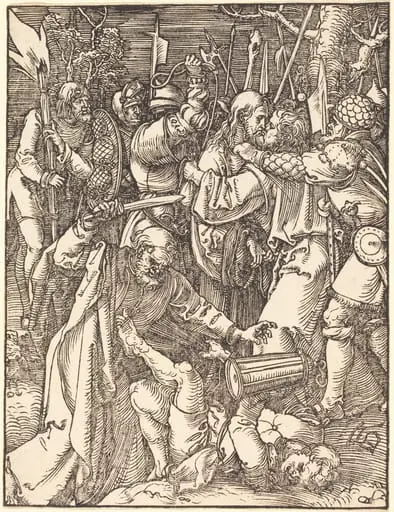 The Betrayal of Christ
 The Passion: The Betrayal of Christ
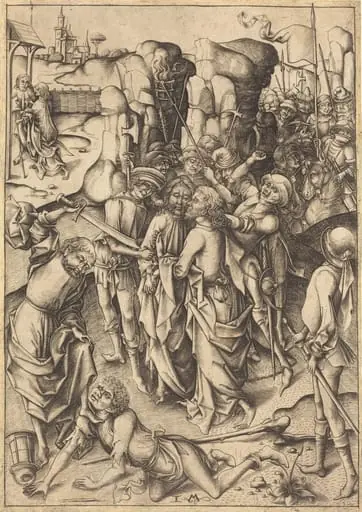 The Betrayal
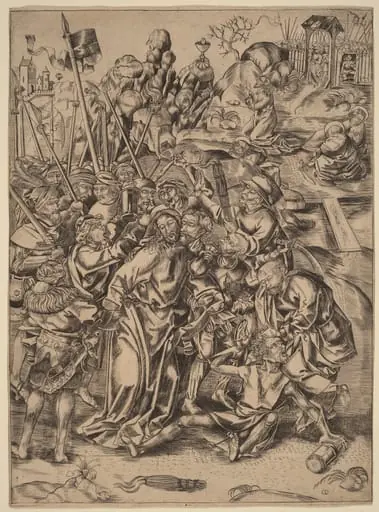 The Betrayal
 The Passion: The Betrayal of Christ
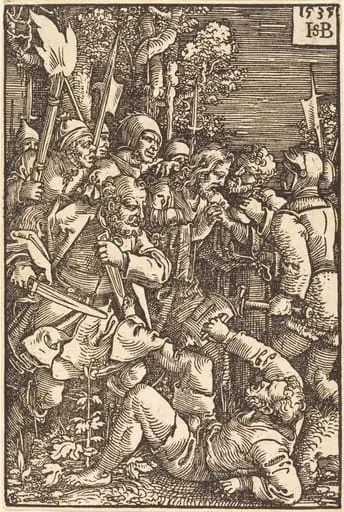 The Betrayal of Christ
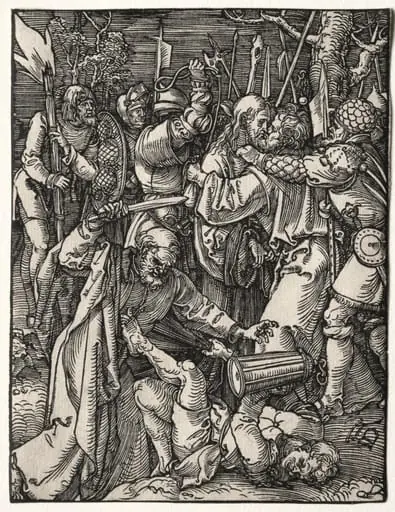 The Small Passion: The Betrayal of Christ