Artwork
The Resurrection
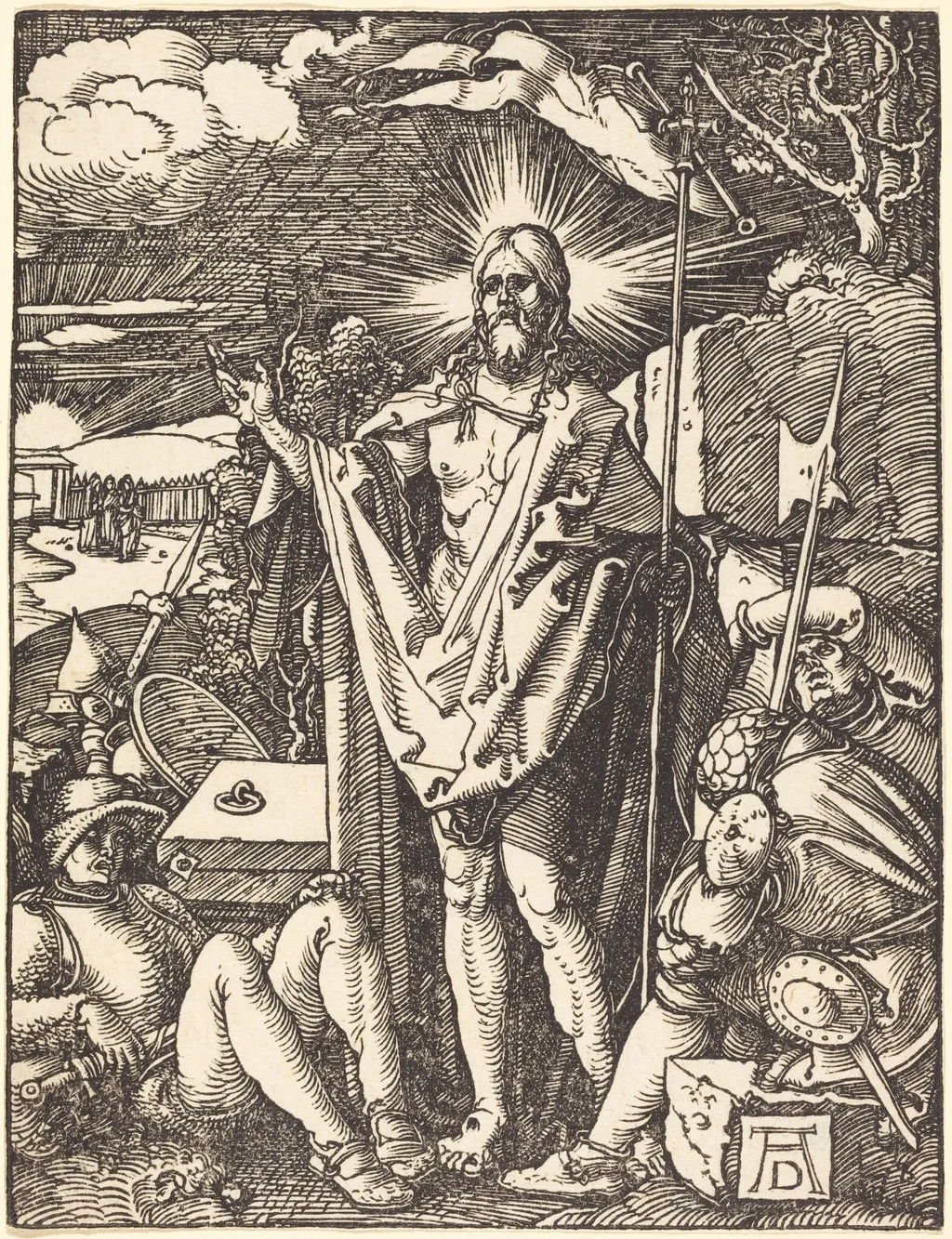
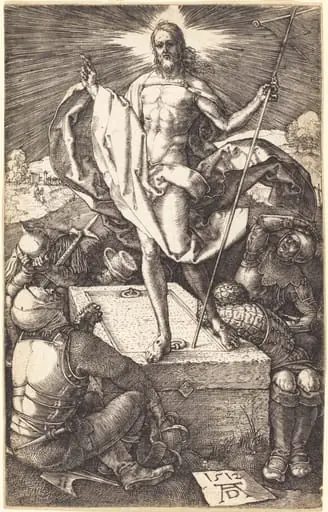
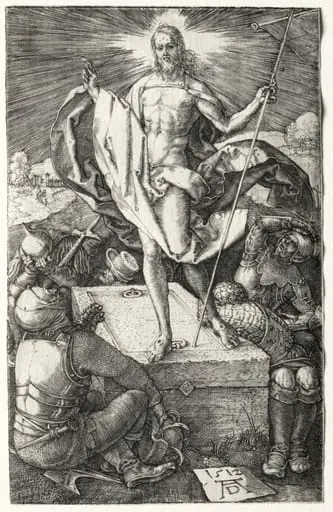
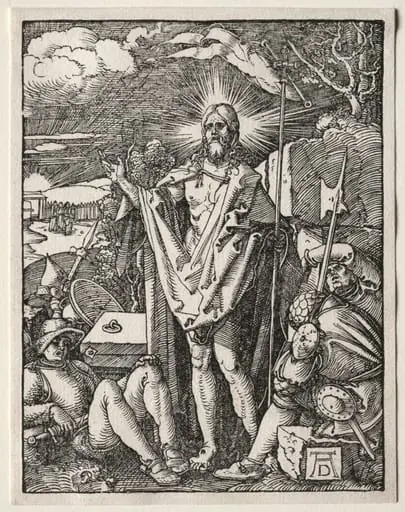
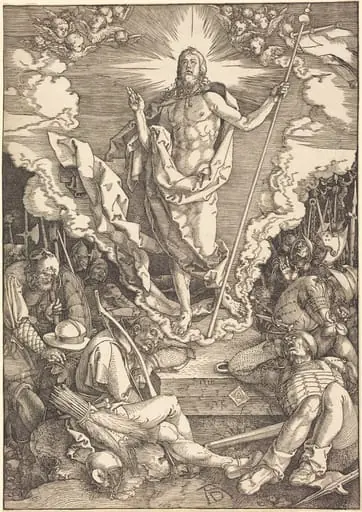
The Resurrection is an ink print by the Northern Renaissance artist Albrecht Dürer. It dates from 1510 and is held in the collection of the British Museum.
- Inscription
- Inscribed:in block, bottom right, on stone: AD [artist's monogram]; verso, lower center, in graphite by a later hand: 627; verso, bottom left, in graphite by a later hand: B 45; verso, bottom center, in graphite by a later hand: 30
About this work
Subject & Meaning
By focusing exclusively on the figure of Jesus, the composition emphasizes the singular importance of this miraculous occurrence in Christian doctrine.
Albrecht Dürer's 1509 woodcut depicts the Resurrection of Jesus Christ, a central event in Christian theology derived from the New Testament. As part of the artist's Little Passion series, the print illustrates the moment Christ rises from the dead, serving as a visual meditation on redemption and divine victory over mortality. The work functions within the genre of religious art, utilizing the woodcut medium to disseminate this biblical narrative to a broader audience during the German Renaissance.
By focusing exclusively on the figure of Jesus, the composition emphasizes the singular importance of this miraculous occurrence in Christian doctrine.
Technique & Style
The Resurrection is a woodcut executed on paper, printed in black ink and hand-colored with watercolor washes. The sheet measures 12.7 cm in height and 9.8 cm in width, and the image is printed on a laid paper support. The formal composition emphasizes the risen Christ, rendered with stark chiaroscuro and precise line work that conveys both physical emergence and spiritual triumph.
Stylistically, the work belongs to the German Renaissance, employing a naturalistic yet symbolic approach to drapery and anatomy. The handling of the medium, combining the linear economy of woodcut with delicate washes, creates a subtle tonal depth that anticipates later chiaroscuro engravings. Condition notes indicate the paper remains stable with only minor foxing along the edges, preserving the integrity of the image.
History & Provenance
Albrecht Dürer created The Resurrection in 1509 as a woodcut on laid paper. Its early ownership passed from Joseph Daniel Böhm in Vienna to Robert Scholtz in Budapest, later moving to William Schab in New York. In 1940, Lessing J. Rosenwald acquired the print and gifted it to the National Gallery of Art in 1943.
The work is part of Dürer’s Little Passion series, depicting the Resurrection of Jesus based on New Testament narratives.
This 1509 woodcut by Albrecht Dürer entered the collection of the National Gallery of Art in Washington, D.C., in 1943 as a gift from Lessing J. Rosenwald. Rosenwald had purchased the specific impression in 1940 from the dealer William Schab in New York. Prior to Rosenwald's ownership, the print belonged to Robert Scholtz of Budapest and Joseph Daniel Böhm of Vienna.
While this specific provenance traces one impression to Washington, other impressions of the work are held in major institutions including the Metropolitan Museum of Art, the British Museum, the Cleveland Museum of Art, and within the Rosenwald Collection.
Context
Albrecht Dürer's 1509 woodcut The Resurrection, part of his Little Passion series, depicts the risen Christ emerging from the tomb, drawing on New Testament narratives and exemplifying the German Renaissance's blend of devotional intensity and technical precision. The print entered the Rosenwald Collection in 1940 and was gifted to the National Gallery of Art in 1943, where it remains in the Prints and Drawings department. Its subject aligns with religious art traditions of the period, reflecting both Dürer's mastery of printmaking and the broader cultural context of Reformation-era biblical illustration.
Legacy
The Resurrection has been recognized as a pivotal image in the history of printmaking and as an emblem of the German Renaissance. Its depiction of the risen Christ has shaped devotional imagery across centuries and is frequently cited in surveys of early modern religious art. The work's inclusion in major collections such as the National Gallery of Art and the Cleveland Museum of Art underscores its enduring scholarly and curatorial interest.
Overview
The Resurrection is a woodcut print by Albrecht Dürer, created around 1510. It is executed on laid paper.
Own this work as a print
Artist & collection
Artist
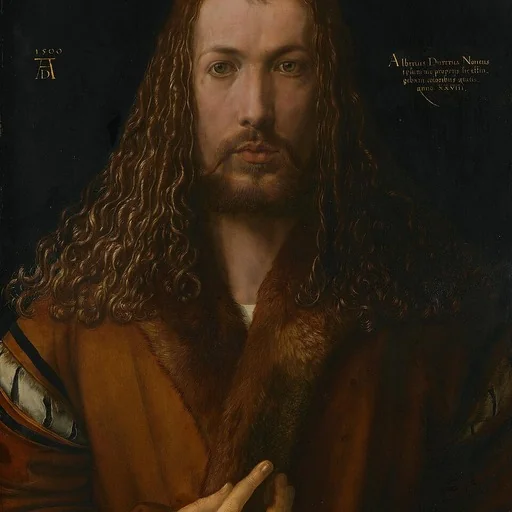
Albrecht Dürer spent his life in Nuremberg, a busy German city where artists traded prints like currency.

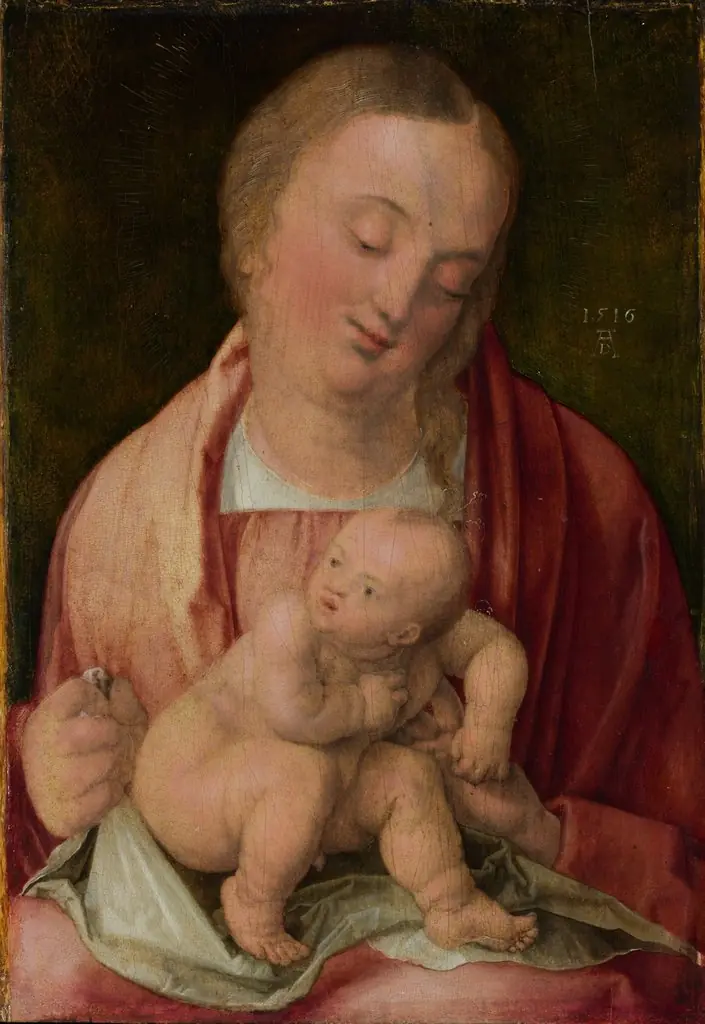
![Madonna and Child [obverse], by Albrecht Dürer](https://artifactworldgallery.com/img/albrecht-durer--madonna-and-child-obverse--d7b8ebf05d22ebe5-w320.webp)
![Lot and His Daughters [reverse], by Albrecht Dürer](https://artifactworldgallery.com/img/albrecht-durer--lot-and-his-daughters-reverse--b4ebf9b282faa17a-w320.webp)