Artwork
The Resurrection
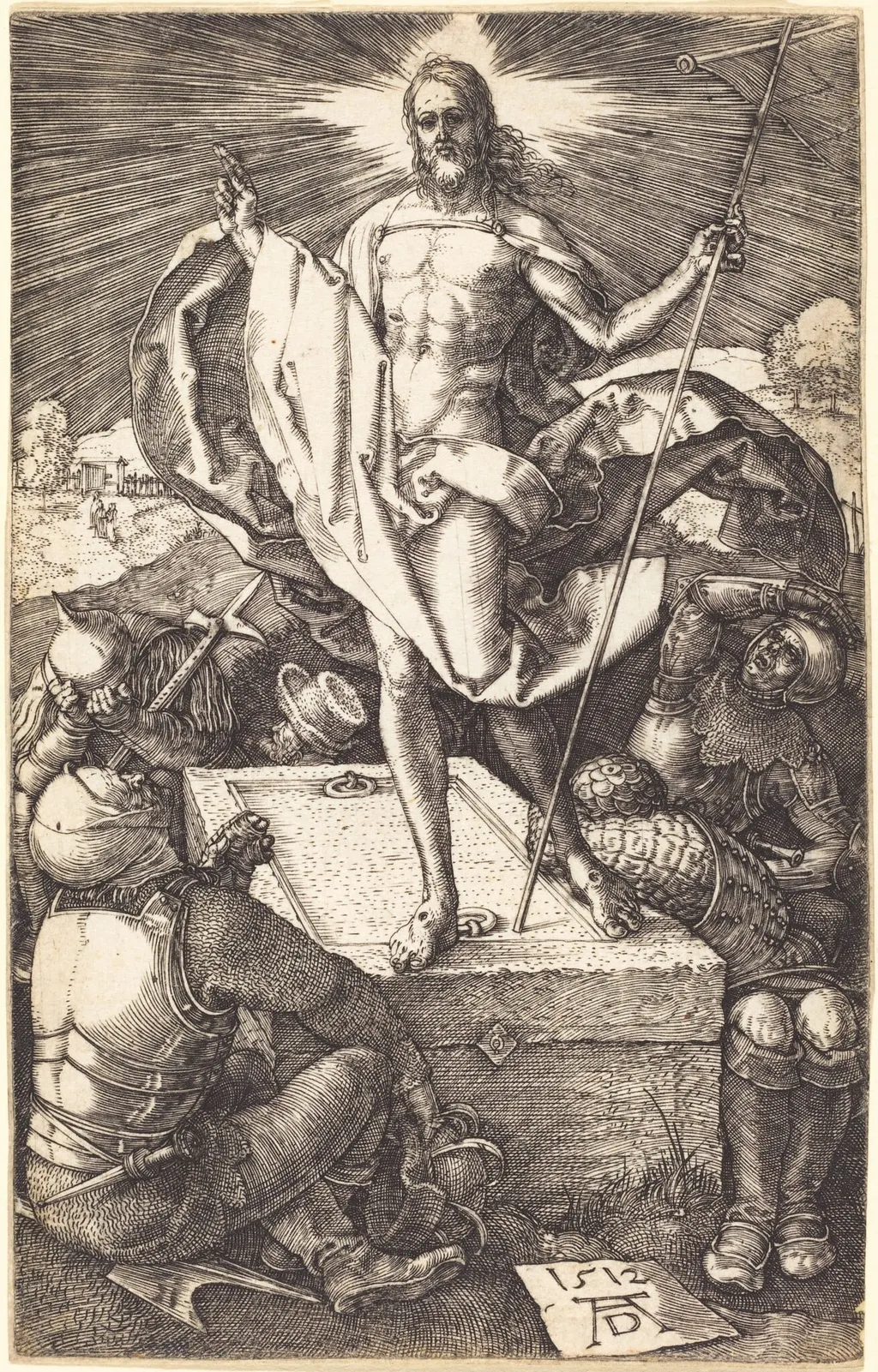
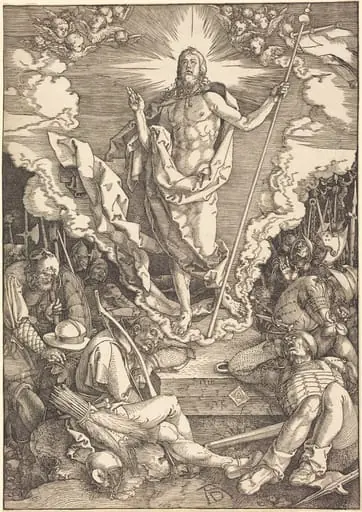
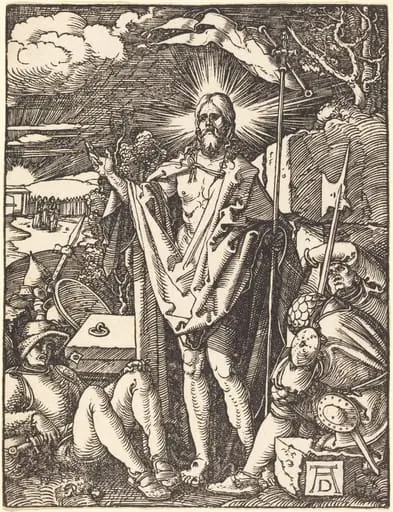
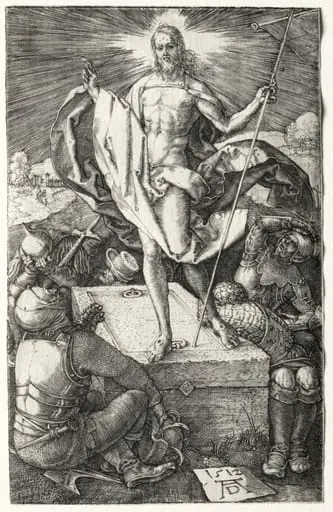
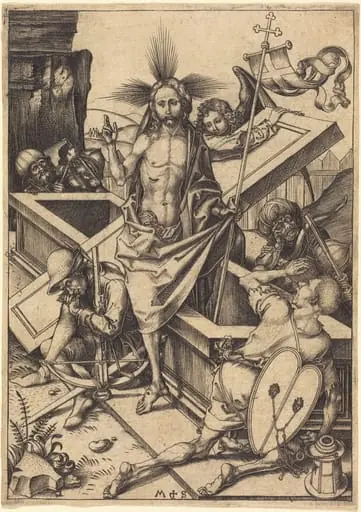
The Resurrection is an ink print by the Northern Renaissance artist Albrecht Dürer. It dates from 1512 and is held in the collection of the Metropolitan Museum of Art.
- Inscription
- Inscribed:in plate, bottom right: 1512 / AD [artist's monogram]; verso, lower right, in graphite by a later hand: 7 [upside down]; verso, bottom left, in graphite by a later hand: NR [?] 25146; verso, bottom center, in graphite by a later hand: B.17
- Markings
- Marked:none
About this work
Subject & Meaning
The composition emphasizes the moment of spiritual renewal and the promise of salvation, central themes in Christian iconography.
The Resurrection depicts Jesus Christ rising from the tomb, a scene drawn from the New Testament narrative of the Resurrection. Dürer presents the figure of Christ in a dynamic, upward-reaching pose with arms outstretched, surrounded by radiant light that symbolizes divine triumph over death. The composition emphasizes the moment of spiritual renewal and the promise of salvation, central themes in Christian iconography.
This print is part of Dürer's broader Passion series, yet it stands apart as a focused meditation on the moment of Christ's victory, reflecting the theological emphasis of the German Renaissance on both suffering and ultimate resurrection.
Technique & Style
The Resurrection is an engraving on laid paper, executed in 1512 as part of Albrecht Dürer's printmaking practice within the German Renaissance. The matrix measures approximately 117 by 75 millimeters, a modest scale consistent with Dürer's small-format Passion engravings, and the impression is classified as a print of religious subject matter.
Dürer's handling of the engraving is marked by dense, controlled linework and finely hatched modeling that produces dramatic tonal contrasts across the composition. The technique exploits the precision of the burin on laid paper to render sharply defined contours and layered cross-hatching, lending sculptural volume to the figures and atmospheric depth to the surrounding space. Stylistically, the work reflects the disciplined draftsmanship and idealized figural treatment characteristic of Dürer's mature graphic style, conveying both narrative clarity and devotional intensity through purely linear means.
History & Provenance
Albrecht Dürer's engraving The Resurrection was created in 1512 as part of his Passion series. The work is an engraving on laid paper, classified as a religious print depicting the Resurrection of Jesus.
The documented provenance of the impression held by the National Gallery of Art traces back to the Brentano-Birckenstock Collection in Vienna and Frankfurt, identified by the collector's mark Lugt 345. It subsequently passed to Arthur Friederich Theodor Bohnenberger (1826–1893) of Stuttgart, whose mark is Lugt 68. Lessing J. Rosenwald (1891–1979) of Jenkintown, Pennsylvania, acquired the print in 1928, bearing the marks Lugt 1760b and Lugt 1932d. Rosenwald later donated it to the National Gallery of Art in 1943.
The engraving is held by the National Gallery of Art, Washington, as part of the Rosenwald Collection, accessioned in 1943 following its gift by Lessing J. Rosenwald.
It has been exhibited at the National Gallery of Art in Washington, D.C.
Overview
The Resurrection is a religious engraving by Albrecht Dürer, dated to 1512. Executed on laid paper, it portrays a pivotal moment in Christian theology.
Context
The Resurrection reflects the religious themes prevalent in Northern European art during the early 16th century, showcasing Dürer's contribution to the period's devotional imagery.
Legacy
While specific influences of The Resurrection are not outlined in the sources, Dürer's engraving techniques and religious subjects broadly impacted subsequent European printmaking and religious art.
Own this work as a print
Artist & collection
Artist
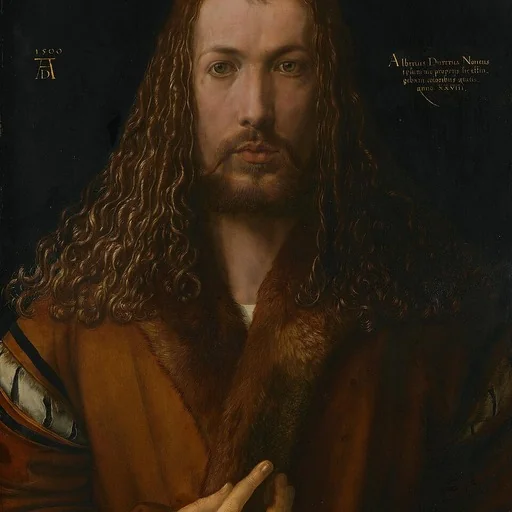
Albrecht Dürer spent his life in Nuremberg, a busy German city where artists traded prints like currency.

![Madonna and Child [obverse], by Albrecht Dürer](https://artifactworldgallery.com/img/albrecht-durer--madonna-and-child-obverse--d7b8ebf05d22ebe5-w320.webp)
![Lot and His Daughters [reverse], by Albrecht Dürer](https://artifactworldgallery.com/img/albrecht-durer--lot-and-his-daughters-reverse--b4ebf9b282faa17a-w320.webp)