Artwork
Sunset (Soleil couchant)
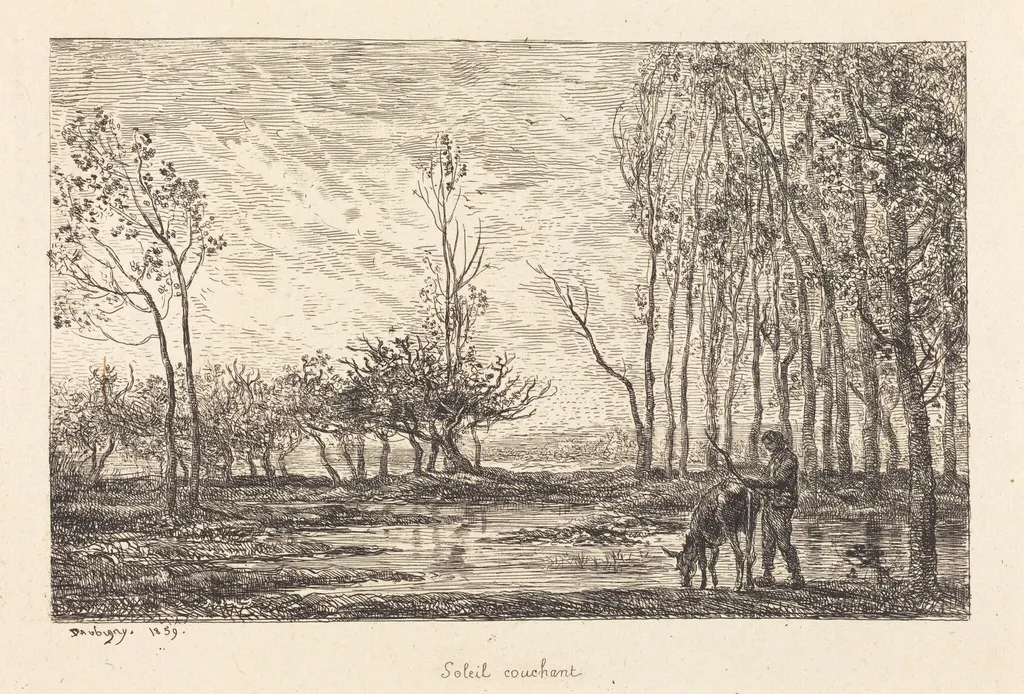
Sunset (Soleil couchant) is an ink print by the Impressionist artist Charles François Daubigny. It dates from 1859 and is held in the collection of the National Gallery of Art.
About this work
Overview
Daubigny, linked to the Barbizon school, used etching to explore transient natural effects, favoring intimate landscapes over grand narratives.
Charles-François Daubigny produced Sunset (Soleil couchant) in 1859 as an etching, part of his broader engagement with printmaking. Unlike his oil paintings, this work captures the quietude of twilight through fine, incised lines. Daubigny, linked to the Barbizon school, used etching to explore transient natural effects, favoring intimate landscapes over grand narratives. The piece exemplifies his interest in the subtle interplay of light and form outside the studio.
Subject & Meaning
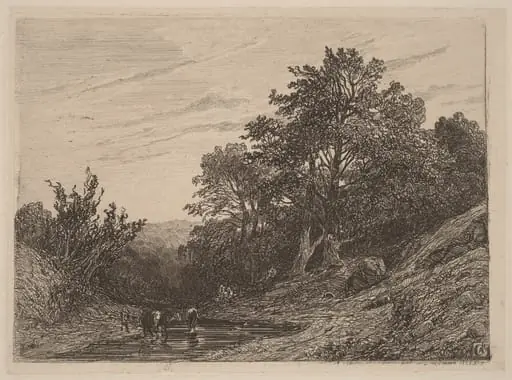
The scene depicts a secluded forest path at dusk, flanked by slender, leafless trees and a still pool reflecting the fading sky. A solitary horse, head bowed, stands near the water’s edge, suggesting stillness and solitude. No human figures are present, reinforcing a sense of quiet withdrawal from the world. The composition evokes contemplation rather than drama, aligning with Daubigny’s preference for unembellished, observed moments in nature.
Technique & Style
Daubigny employed etching to render delicate tonal gradations, using fine, controlled lines to suggest texture and depth. The trees are defined by vertical strokes, while the water’s surface is suggested by horizontal hatching that mirrors the sky’s soft descent. Subtle shading creates volume without heavy contrast, and the fading light is implied through the gradual lightening of the paper’s tone from left to right, enhancing the scene’s atmospheric mood.
History & Provenance
Created in 1859, Sunset emerged during a period when Daubigny was increasingly focused on printmaking as a means to study light and landscape directly. Though not widely exhibited at the time, the etching entered private collections in France and later found its way into institutional holdings. Its survival reflects its role as a personal study rather than a commercial product, valued for its quiet observation over public acclaim.
Context
In mid-19th century France, artists like Daubigny moved away from idealized historical scenes toward direct engagement with rural environments. Etching offered a flexible medium for capturing fleeting effects of light, aligning with emerging interests in realism and naturalism. Daubigny’s prints, though less known than his paintings, contributed to a broader shift toward intimate, observational art that later influenced Impressionist practices.
Legacy
Though not widely reproduced in his lifetime, Sunset exemplifies Daubigny’s role in bridging Barbizon realism and the Impressionist focus on transient light. His etchings, including this work, demonstrated that printmaking could convey nuanced atmospheric effects without color. Later artists recognized his prints as vital studies in perception, influencing how light and mood were rendered in graphic media.
Own this work as a print
Artist & collection
Artist
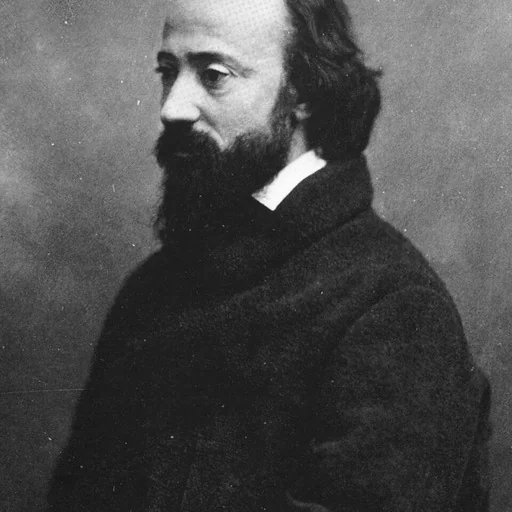
Charles-François Daubigny ( DOH-bin-yee, US: DOH-been-YEE, doh-BEEN-yee, French:; 15 February 1817 – 19 February 1878) was a French painter, one of the members of the Barbizon school, and is considered an important precursor of…

- Donkey at a Watering Place (L'Ane a l'abreuvoir)
 Herd in a Stream
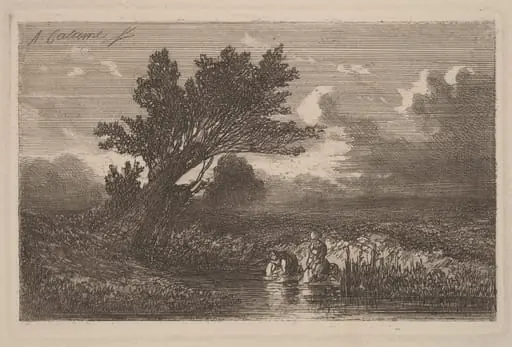 Laundresses
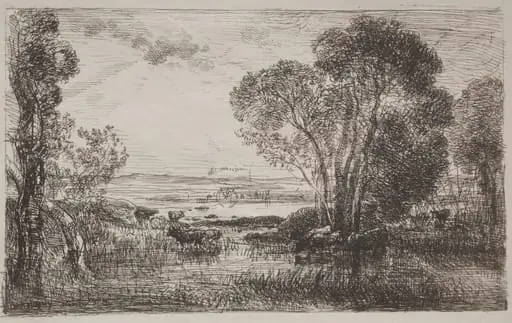 The Hydraulic Machine
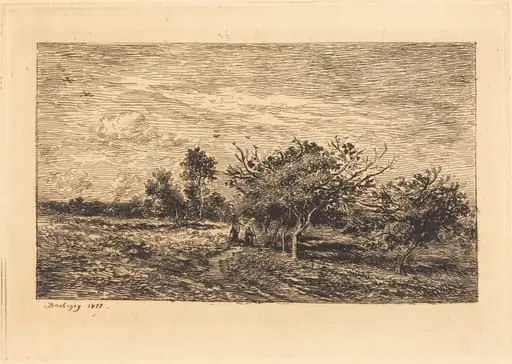 Apple Trees in Auvers (Pommiers a Auvers)
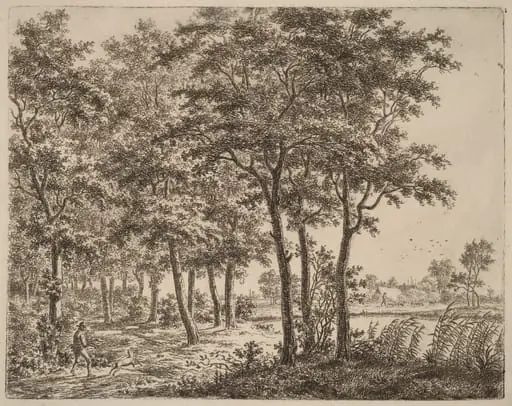 Landscape with a Peasant Carrying Firewood
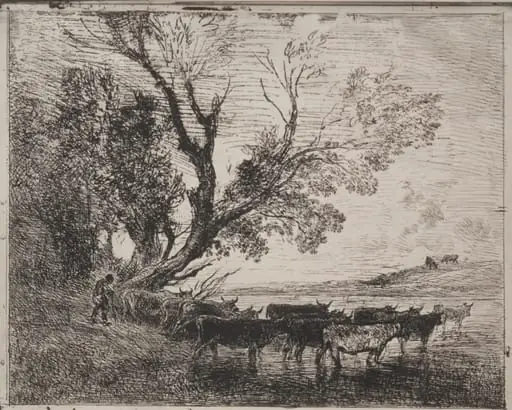 The Ford
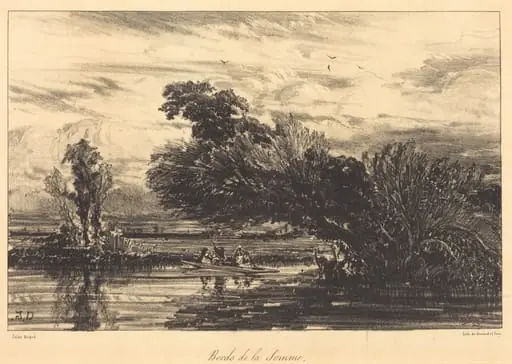 Bank of the Somme (Bords de la Somme)
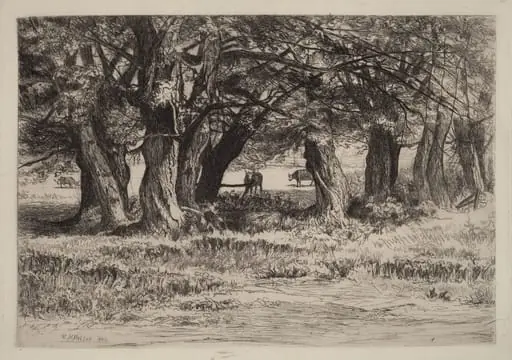 A Group of Willows
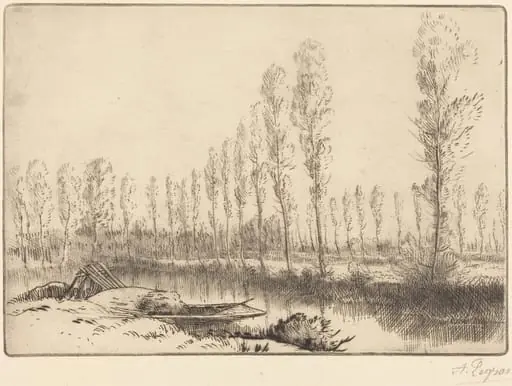 Poplars near Amiens (Pres d'Amiens, les tourbieres)
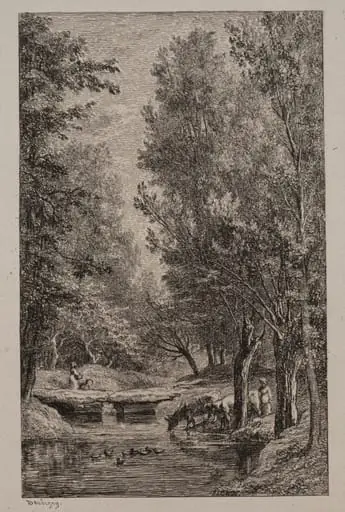 Brook in the Val Mondois
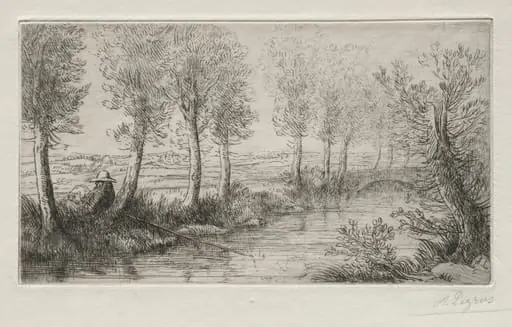 Near the Mill