Artwork
De L'or (J. -Ant. -Adrien Delort)
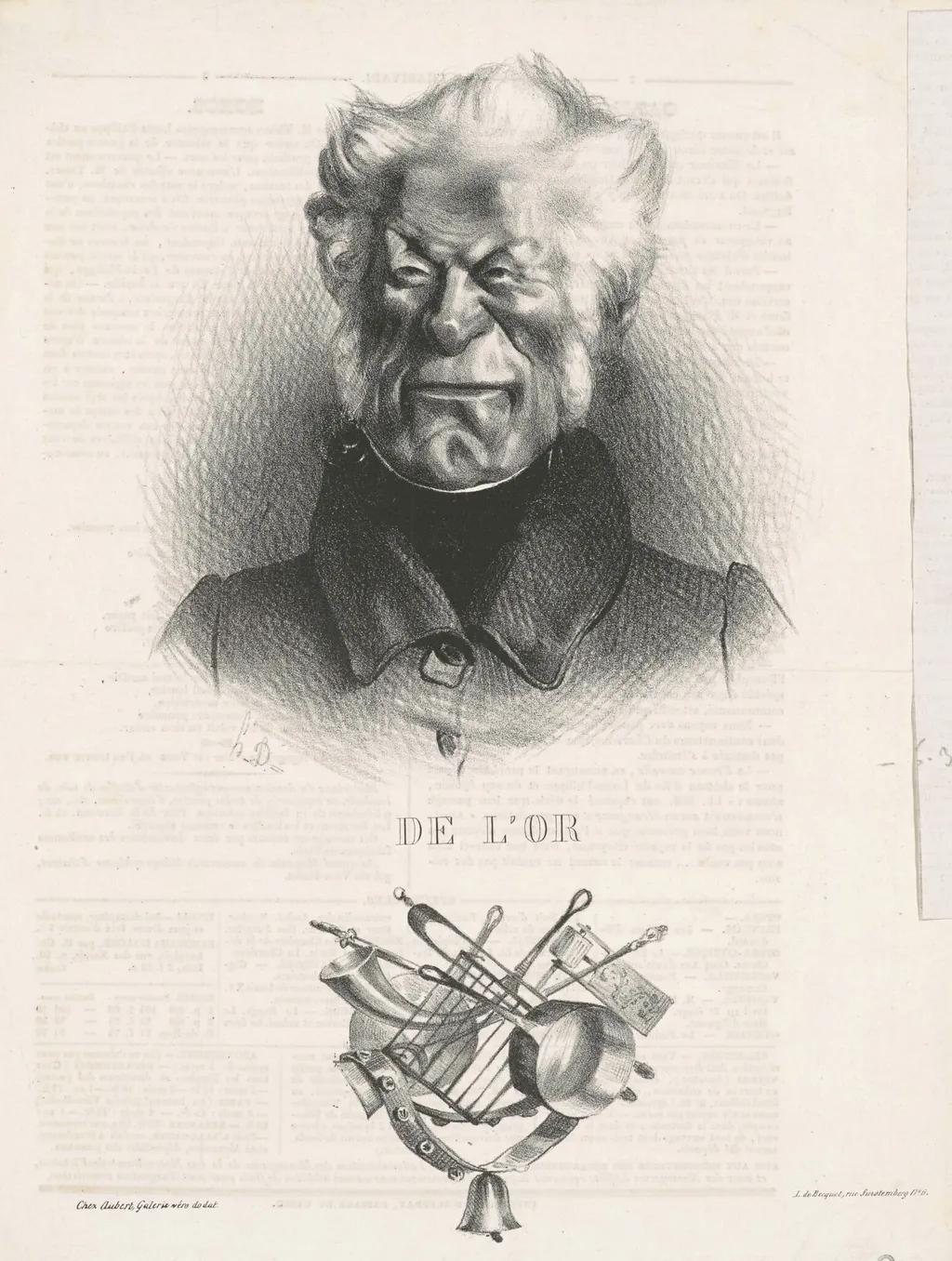
De L'or (J. -Ant. -Adrien Delort) is an ink print by the Romanticist artist Honoré Daumier. It dates from 1833 and is held in the collection of the National Gallery of Art. De L’or, a lithographic print dated 1833, presents a solitary male figure rendered with a pronounced grin and stark facial features.
About this work
Overview
De L’or, a lithographic print dated 1833, presents a solitary male figure rendered with a pronounced grin and stark facial features. He is dressed in a dark coat, standing before a background composed of overlapping printed text that adds a tactile, patterned quality to the composition.
Subject & Meaning
The central figure’s smirking expression and the surrounding accoutrements, a collection of metallic tools and a horn, suggest a commentary on labor, craftsmanship, or perhaps a satirical take on societal roles. The juxtaposition of the human portrait with utilitarian objects invites viewers to consider the relationship between identity and occupation.
Technique & Style
Executed in lithography, the work exploits the medium’s capacity for fine line work and tonal variation. The artist employs a contrast between the sharply defined facial details and the more loosely rendered textual background, creating a layered visual effect that blurs the line between image and printed matter.
History & Provenance
Created in the early 1830s, the print emerged during a period when lithography was gaining popularity for both artistic and commercial purposes. While specific ownership records are scarce, the work is attributed to J.‑Ant.‑Adrien Delort, an artist active in the French printmaking scene of the era.
Context
The early nineteenth‑century French print market was characterized by a proliferation of satirical and genre images that often combined portraiture with symbolic objects. De L’or reflects this trend, employing visual humor and allegorical elements typical of contemporary social commentary.
Legacy
Although not as widely reproduced as other lithographs of the period, De L’or exemplifies the experimental merging of textual and pictorial elements that influenced later graphic artists. Its nuanced interplay of portraiture and material symbols continues to be studied for insights into early lithographic practices.
Own this work as a print
Artist & collection
Artist
Honoré-Victorin Daumier (French: ; 26 February 1808 – 10 or 11 February 1879) was a French painter, sculptor, and printmaker, whose many works offer commentary on the social and political life in France, from the…