Artwork
Dis donc amour! Crois-tu que ce sera un garçon. -Tu sais bien Clothilde que je te l'ai promis . . . Et j'ai un tact . . . Qui ne me trompe jamais!
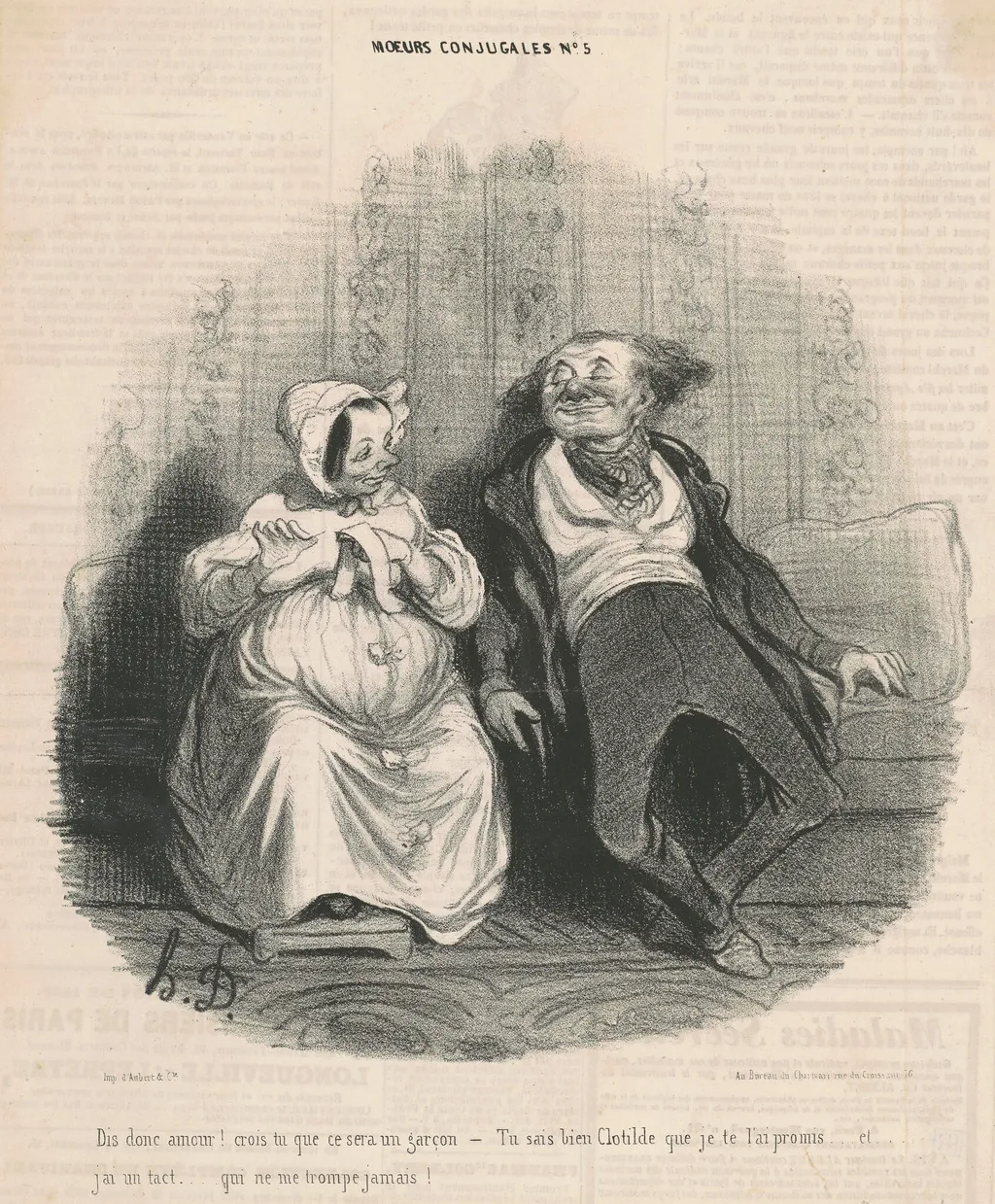
Dis donc amour! Crois-tu que ce sera un garçon. -Tu sais bien Clothilde que je te l'ai promis . . . Et j'ai un tact . . . Qui ne me trompe jamais! is an ink print by the Romanticist artist Honoré Daumier. It dates from 16 and is held in the collection of the National Gallery of Art.
About this work
Overview
Daumier captures a fleeting moment of personal anticipation, rendered with subtle emotional nuance rather than theatricality.
This lithograph by Honoré Daumier depicts a private exchange between a man and woman seated side by side on a padded bench. The scene is quiet, intimate, and grounded in domestic realism. Daumier captures a fleeting moment of personal anticipation, rendered with subtle emotional nuance rather than theatricality.
The work belongs to a series of prints that observe everyday life in mid-19th-century France with observational precision.
Subject & Meaning
The couple engages in a whispered conversation about the gender of an expected child, their dialogue drawn from colloquial French speech. The man’s confident tone contrasts with the woman’s quiet receptiveness, suggesting familiar dynamics of reassurance and trust. The subject reflects broader societal preoccupations with family, gender, and domestic expectation, presented without judgment, merely as a moment of ordinary human connection.
Technique & Style
Executed in lithography, the image relies on fluid ink lines and tonal gradations to suggest form and texture. Daumier’s hand is economical: facial expressions are suggested through minimal strokes, while clothing and furnishings are rendered with suggestive detail rather than elaborate finish. The medium’s capacity for rapid reproduction allowed Daumier to disseminate these intimate scenes widely, aligning his art with journalistic observation.
History & Provenance
Created in the 1860s, this print emerged during Daumier’s prolific period of social commentary through graphic art. It was likely published in a periodical or as part of a portfolio aimed at middle-class audiences. Though its exact publication history is undocumented, its survival in museum collections attests to its recognition as a representative example of Daumier’s humanist approach to printmaking.
Context
In 19th-century France, domestic life became an increasing focus of artistic interest as urbanization reshaped family structures. Daumier’s work responds to this shift, portraying private moments with dignity rather than satire. Unlike caricatures of public figures, this piece elevates the quiet rituals of marriage and parenthood, reflecting a broader cultural turn toward sentimental realism in visual culture.
Legacy
Daumier’s lithographs, including this one, helped redefine printmaking as a vehicle for empathetic social observation. His ability to convey emotional depth through simple forms influenced later generations of illustrators and realist artists. Though not widely exhibited in his lifetime as fine art, these works are now valued for their unembellished humanity and their quiet documentation of ordinary life.
Own this work as a print
Artist & collection
Artist
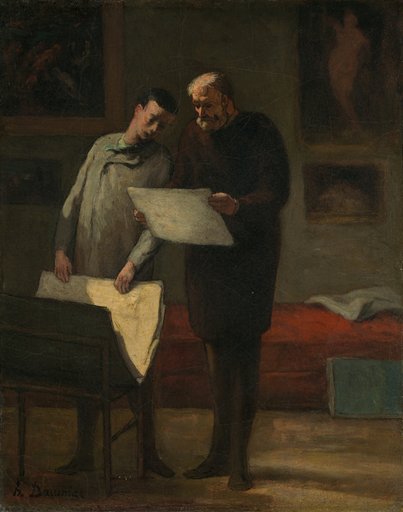
Honoré-Victorin Daumier (French: ; 26 February 1808 – 10 or 11 February 1879) was a French painter, sculptor, and printmaker, whose many works offer commentary on the social and political life in France, from the…