Artwork
Suffrage universel (Universal Suffrage)
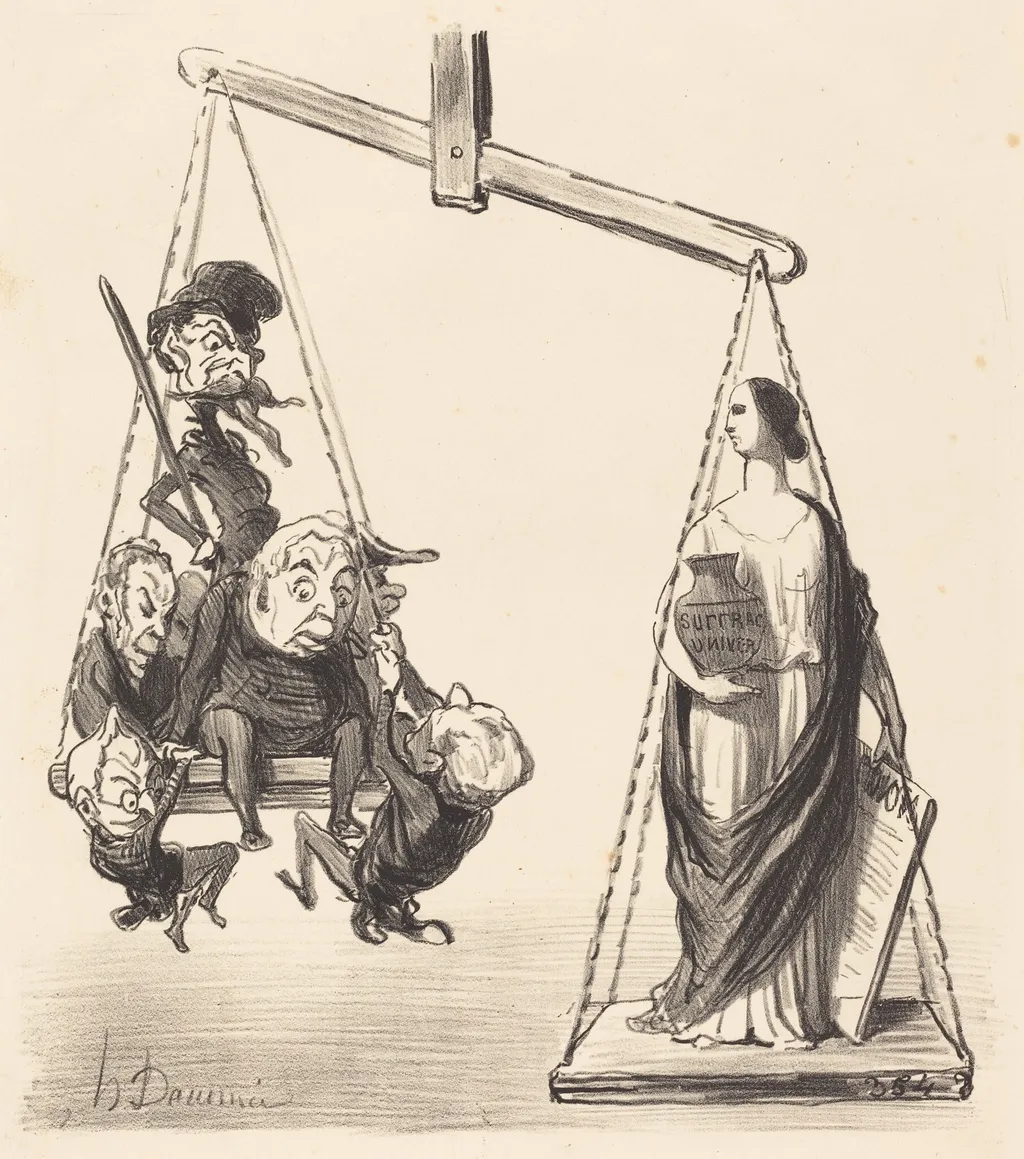
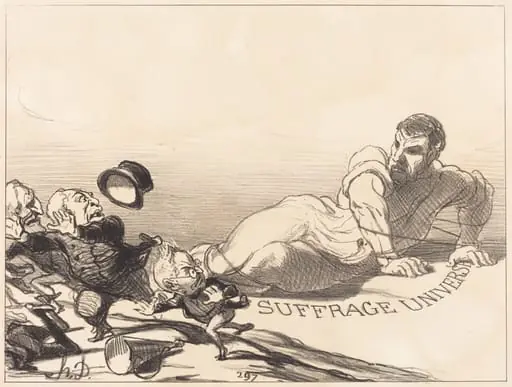
Suffrage universel (Universal Suffrage) is an ink print by the Impressionist artist Honoré Daumier. It dates from 1850 and is held in the collection of the National Gallery of Art.
- Inscription
- Inscribed:recto: in stone, at lower left: h Daumier; at top right in graphite in later hand: D 2000 / I; at bottom left in graphite in later hand: Le Suffrage universel (Seule epreuve connu?); at bottom right in graphite in later hand: (HH450); verso: at lower right in graphite in later hand: 5743 [underlined]
- Markings
- Marked:recto: none; verso: National Gallery of Art (Lugt 1932d)
About this work
Overview
Honoré Daumier’s lithograph Suffrage universel, created around 1850, presents a satirical tableau that comments on the political climate of mid‑nineteenth‑century France. Executed on wove paper, the print uses the familiar device of a balance scale to juxtapose opposing forces within the public sphere, reflecting the artist’s ongoing engagement with questions of representation and power.
Subject & Meaning
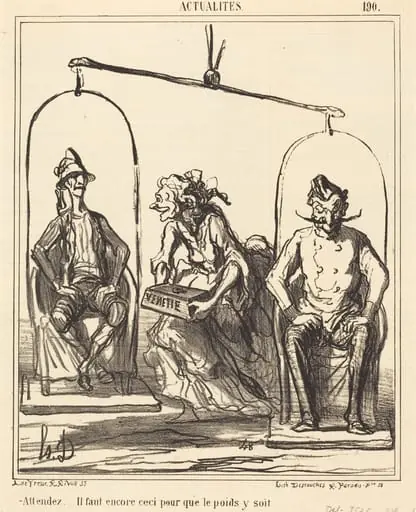
At the centre of the composition a woman draped in a flowing robe steadies a jug marked “Suffrage Universel” on one pan of the scale, while a cluster of men in dark clothing teeters on the opposite side, some slipping off. The calm demeanor of the female figure contrasts with the disorder of the men, suggesting a critique of the male‑dominated political establishment and an ironic assertion that universal suffrage could restore equilibrium.
Technique & Style
Daumier employed lithography, a medium that allowed rapid reproduction for the satirical journals of his day. The print’s bold line work and stark chiaroscuro are characteristic of his realist approach, emphasizing everyday figures and social commentary over idealized forms. The crisp contrasts and exaggerated postures enhance the humorous yet pointed tone of the scene.
Context
The image was produced during a period of frequent regime change in France, from the July Monarchy through the Second Republic to the Second Empire.
The image was produced during a period of frequent regime change in France, from the July Monarchy through the Second Republic to the Second Empire. As a self‑identified republican, Daumier regularly contributed caricatures to publications such as La Caricature and Le Charivari, targeting the monarchy, aristocracy, and clergy. The lithograph reflects contemporary debates over who should participate in governance, at a time when the franchise remained highly restricted.
Legacy
Suffrage universel exemplifies Daumier’s capacity to fuse political satire with realist visual language, influencing later generations of social commentators in print media. The work remains a reference point for scholars examining the visual culture of French republicanism and the role of humor in critiquing institutional power.
Own this work as a print
Artist & collection
Artist
Honoré-Victorin Daumier (French: ; 26 February 1808 – 10 or 11 February 1879) was a French painter, sculptor, and printmaker, whose many works offer commentary on the social and political life in France, from the…









 Ils prétendent qu'ils la soutiennent
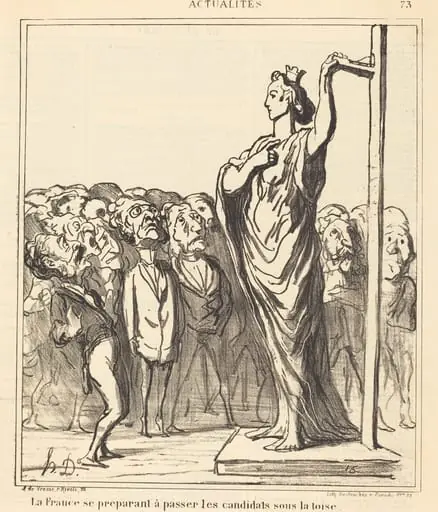 La France se préparant a passer...
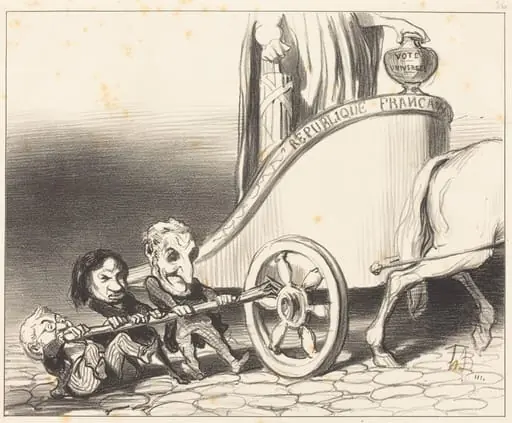 Ce char marchera toujours...
 Encore perdu en Cour Royale... et il se lamente...
 Une Panique de Lilliputiens...
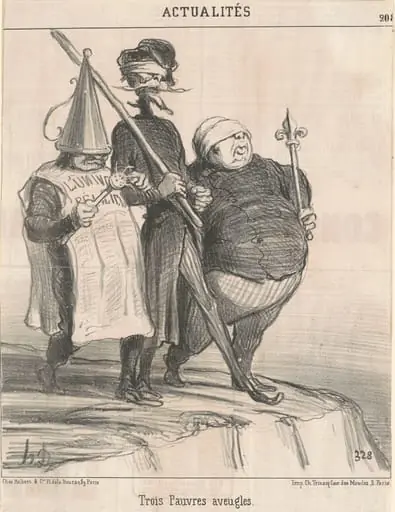 Trois Pauvres aveugles
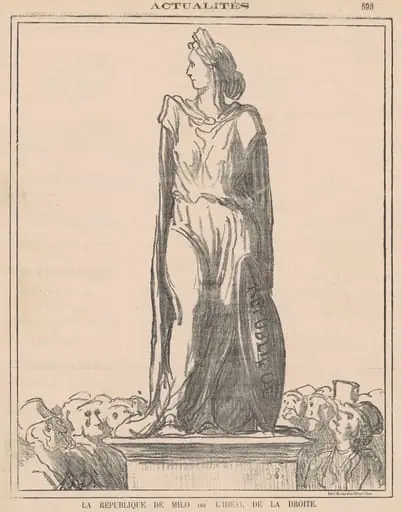 La république de Milo...
 La république de Milo...
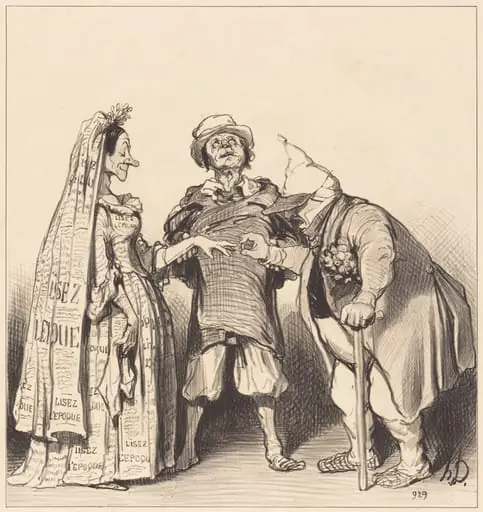 Mariage de l'Époque et du Constitutionnel
 Attendez... il faut encore ceci...
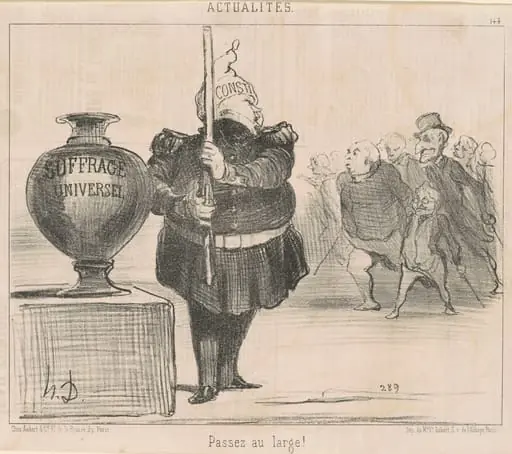
- Passez au large!
 La paix a tout prix