Artwork
Une Descente en parachute
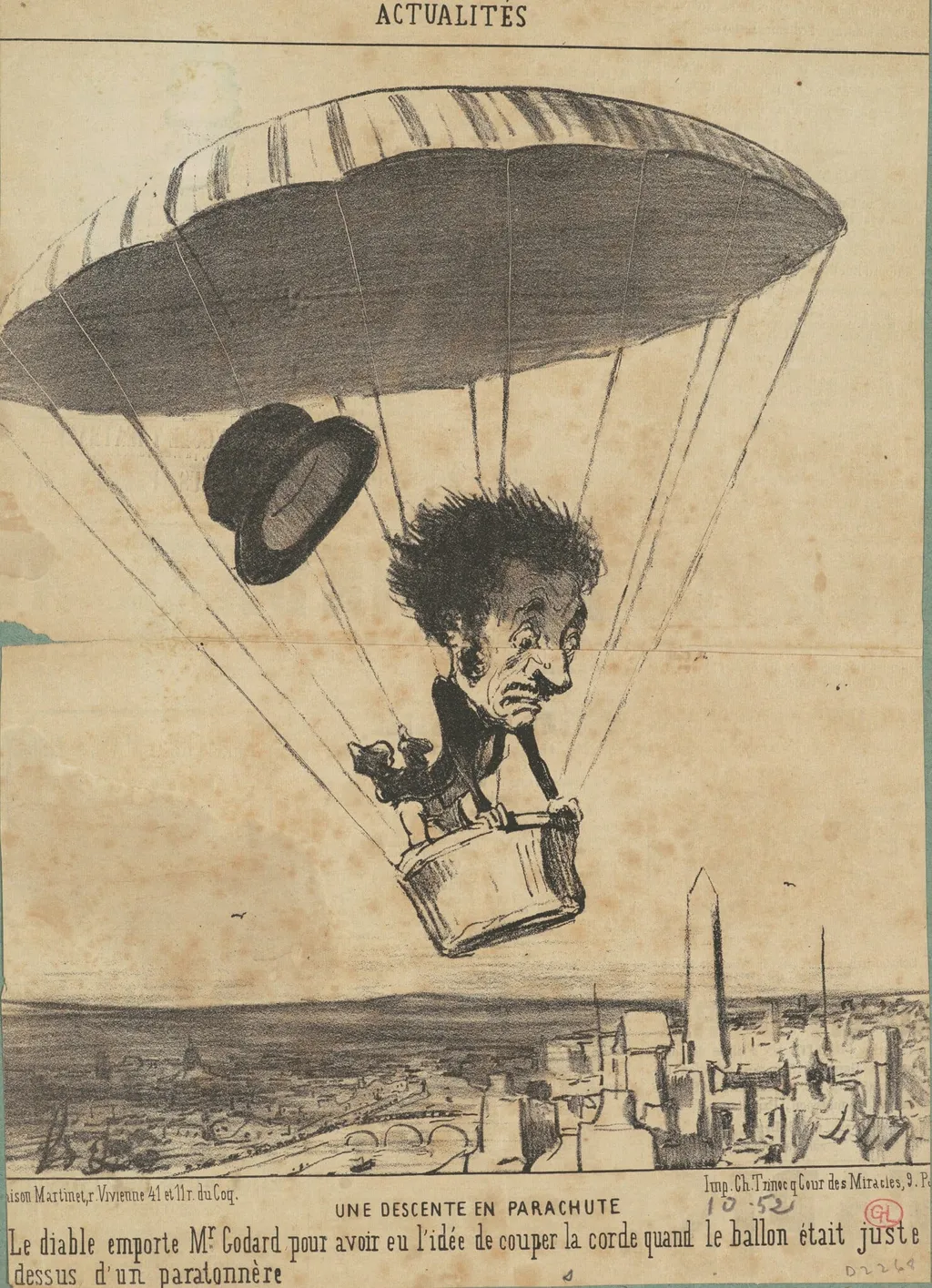
Une Descente en parachute is an ink print by the Impressionist artist Honoré Daumier. It dates from 1852 and is held in the collection of the National Gallery of Art.
About this work
Overview
Created in 1852, 'Une Descente en parachute' is a lithograph by Honoré Daumier that captures a comical descent through the skies of Paris.
Created in 1852, 'Une Descente en parachute' is a lithograph by Honoré Daumier that captures a comical descent through the skies of Paris. The image portrays a man in a wicker basket, suspended beneath a misshapen parachute, as he gazes downward with alarm. Rendered in monochrome, the print uses sharp contrasts and precise linework to emphasize absurdity rather than danger, aligning with Daumier’s tradition of satirical observation.
Subject & Meaning
The figure, dressed in dark, formal attire, embodies a bourgeois observer caught in an absurd technological experiment. His wide-eyed expression and rigid posture contrast with the chaotic, uncontrolled descent, mocking the overconfidence in early aviation devices. Daumier critiques the era’s fascination with novelty, suggesting that progress often outpaces safety and common sense, particularly among those who embrace it without skepticism.
Technique & Style
Daumier employed lithography to achieve fine tonal gradations and crisp outlines, allowing detailed rendering of Parisian architecture while keeping the central figure starkly defined. The exaggerated proportions of the parachute and the minuscule scale of bystanders below heighten the visual irony. His use of shadow and texture grounds the fantasy in recognizable urban reality, reinforcing the satire through plausible detail.
History & Provenance
Produced during Daumier’s prolific period for satirical journals, this print likely appeared in a periodical such as Le Charivari, where his caricatures reached a broad public. It was part of a series targeting contemporary fads and inventions, reflecting the press’s role in shaping public opinion. The work remained in circulation among collectors and institutions, preserving its status as a document of mid-19th-century social critique.
Context
In the 1850s, parachute experiments were public spectacles, often performed by showmen or amateur inventors with little regard for safety. Daumier’s image responds to these events, which were widely reported and ridiculed in the press. His depiction reflects a broader cultural skepticism toward technological showmanship, particularly when it involved the lives of ordinary people placed at risk for entertainment or prestige.
Legacy
The lithograph endures as a clear example of Daumier’s ability to merge social observation with visual wit. It influenced later satirical illustrators and cartoonists who used similar techniques to critique modernity. While not widely exhibited today, it remains a reference point in studies of 19th-century print culture and the intersection of art, journalism, and public humor.
Own this work as a print
Artist & collection
Artist
Honoré-Victorin Daumier (French: ; 26 February 1808 – 10 or 11 February 1879) was a French painter, sculptor, and printmaker, whose many works offer commentary on the social and political life in France, from the…