Artwork
A Shoemaker's Workshop
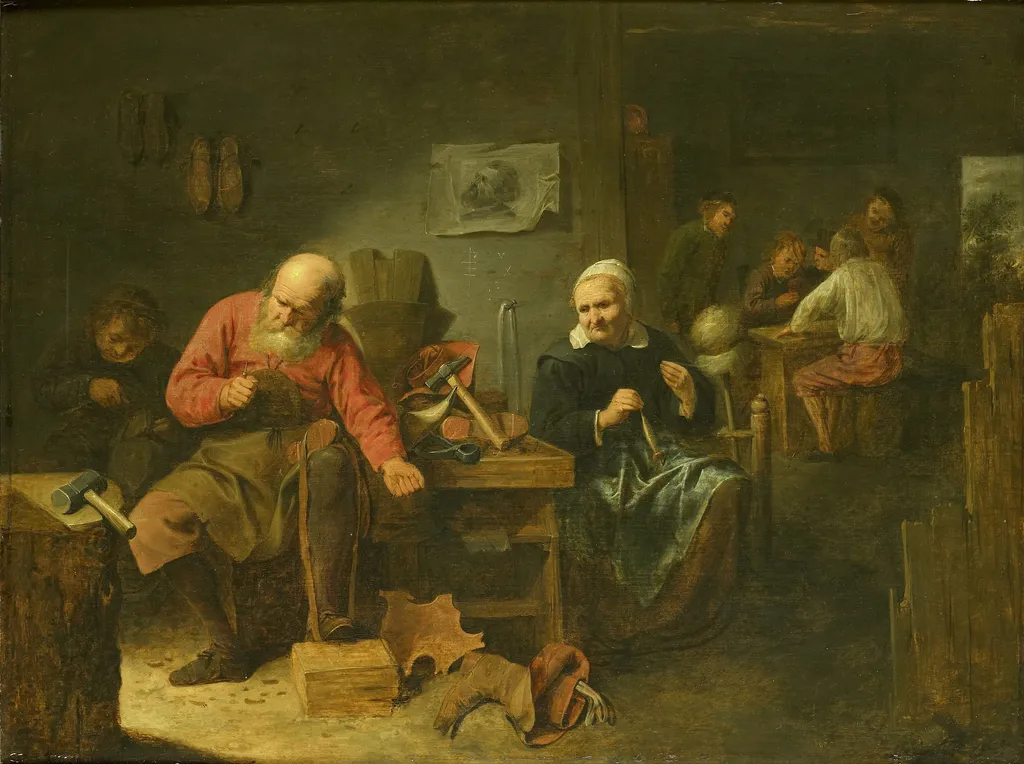
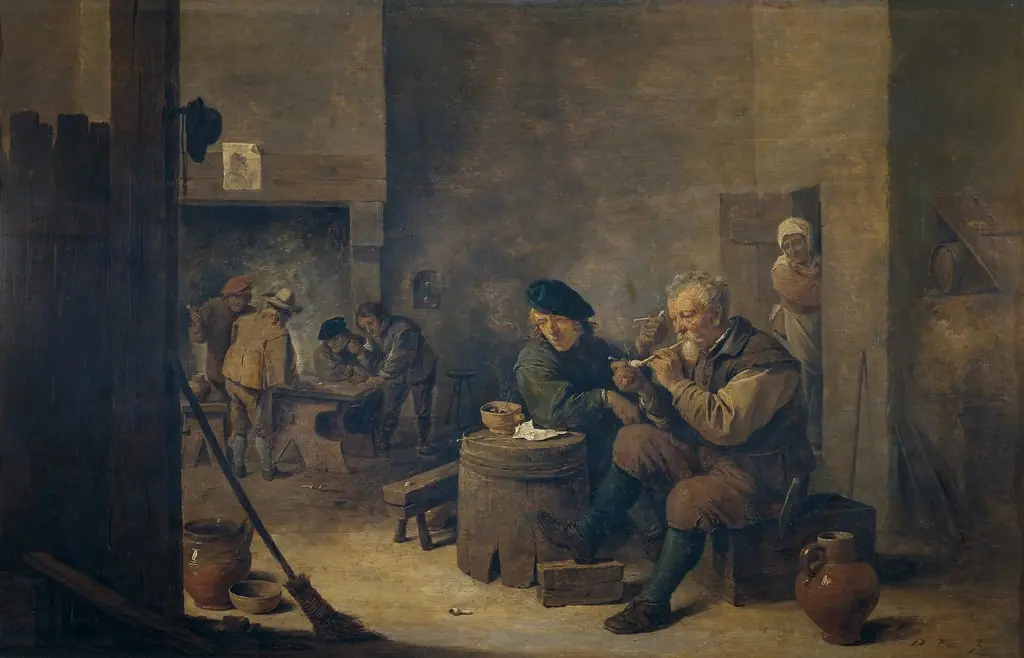
A Shoemaker's Workshop is an oil painting by the Flemish Baroque painting artist David Ryckaert III. It dates from 1650 and is held in the collection of the Rijksmuseum. Created circa 1650, this oil painting presents the interior of a shoemaker’s workshop.
About this work
Subject & Meaning
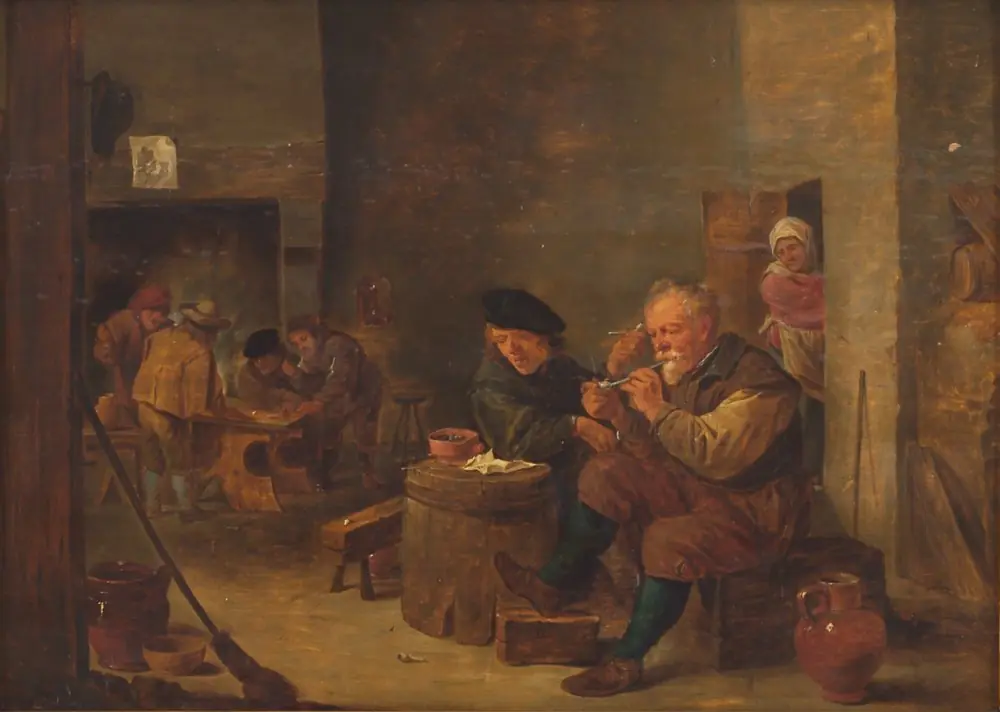
David Ryckaert III's 1650 painting depicts a shoemaker actively sewing a sole to an upper, with the footwear secured to his knee by a leather strap.
David Ryckaert III's 1650 painting depicts a shoemaker actively sewing a sole to an upper, with the footwear secured to his knee by a leather strap. The scene includes his wife spinning yarn beside him and an apprentice working to the left, illustrating the collaborative nature of the trade. The background features two pairs of shoemaker's lasts hanging on the wall and a print of a bearded man.
Further to the right, several men are seated at a table playing cards. This composition presents a detailed genre scene of daily labor and domestic life within a 17th-century workshop setting.
The image captures the specific mechanics of shoemaking alongside the social atmosphere of the workspace, blending focused craftsmanship with leisure activities in the background.
Technique & Style
Executed in oil on a wooden panel, the composition employs a restrained palette dominated by earth tones and subtle chiaroscuro to model the figures and tools within the shoemaker’s cramped interior. Ryckaert’s handling emphasizes fine, linear detail in the stitching and leather, while broader, softer brushwork defines the background figures and interior space. The scene’s shallow depth and centralized focus draw attention to the artisan’s concentrated labor, with the kneeling shoemaker’s taut posture and the rhythmic, parallel threads of the stitching underscoring the methodical nature of the craft.
The work’s formal qualities reflect the Antwerp tradition of genre painting: carefully observed gestures and props convey narrative clarity, while the inclusion of secondary activities, the woman spinning yarn and the card-playing men, adds anecdotal richness without disrupting the central action.
History & Provenance
Created in 1650 in Antwerp, A Shoemaker's Workshop is an oil painting on panel by David Ryckaert III. The work entered the collection of the National Art Gallery in The Hague, the predecessor to the Rijksmuseum, on February 28, 1803. It was acquired for 700 guilders from the art dealer P.C. Huybrechts, who sold it alongside a painting by Lieve Verschuier.
At the time of this 1803 purchase, the piece was attributed to Adriaen Brouwer. The attribution was subsequently corrected in 1809, when the work was reassigned to Ryckaert, a classification that remains current.
A Shoemaker's Workshop is held in the collection of the Rijksmuseum in Amsterdam. The museum acquired the painting on February 28, 1803, purchasing it from the art dealer P.C. Huybrechts for 700 guilders. At the time of this acquisition by the National Art Gallery in The Hague, the predecessor to the Rijksmuseum, the work was attributed to Adriaen Brouwer. The attribution was corrected to David Ryckaert III starting in 1809.
The painting has been featured in the exhibition "Going south: South-Netherlandish painting (1470-1670) from the Rijksmuseum Amsterdam."
Context
Critical reception and scholarship on A Shoemaker's Workshop have long recognized its genre scene character and its role in documenting 17th-century Antwerp workshop life. The painting entered the collection of the Nationale Konst-Gallerij in Den Haag in 1803 at a price of 700 gulden, initially attributed to Adriaen Brouwer before later scholarship reassigned it to David Ryckaert III, a attribution solidified by 1809. Contemporary descriptions note its depiction of a shoemaker binding a shoe to his knee while his wife spins nearby, with a pupil working and decorative elements like leesters and a bearded man's print on the wall, situating it within the broader tradition of Dutch and Flemish genre painting.
Its inclusion in the Rijksmuseum's exhibition 'Going south: South-Netherlandish painting (1470-1670)' further underscores its significance within the artist's wider context and Dutch Golden Age art history.
Overview
Created circa 1650, this oil painting presents the interior of a shoemaker’s workshop. A man in a red shirt and brown apron sits on a bench, while a woman in a black dress and white headscarf works from a chair, both engaged in the craft of leatherworking. The composition is confined to a modest space, emphasizing the quiet labor of everyday artisans.
Own this work as a print
Artist & collection
Artist
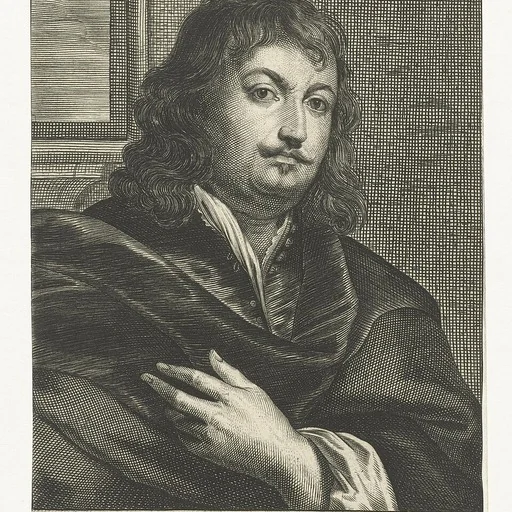
David Ryckaert III, David Rijckaert III or David Rijckaert the Younger (2 December 1612, Antwerp – 11 November 1661, Antwerp) was a Flemish painter known for his contribution to genre painting, in particular through his scenes of merry…