Artwork
The Dance Lesson
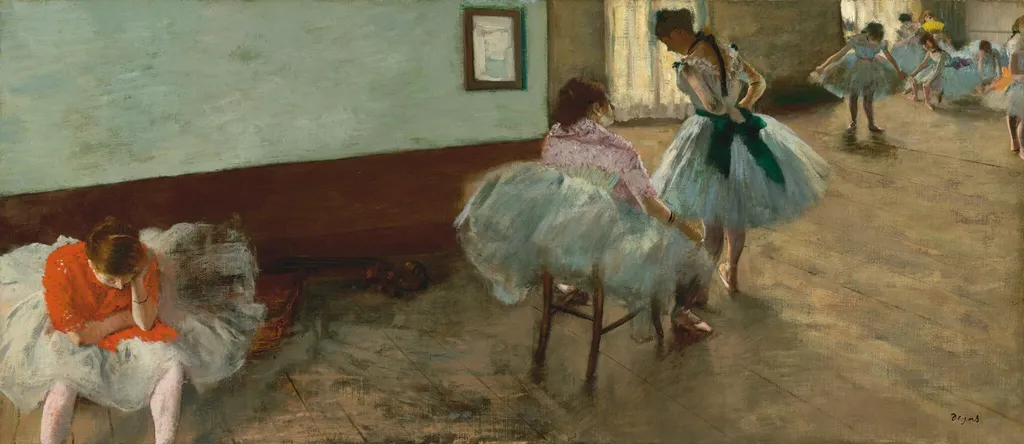
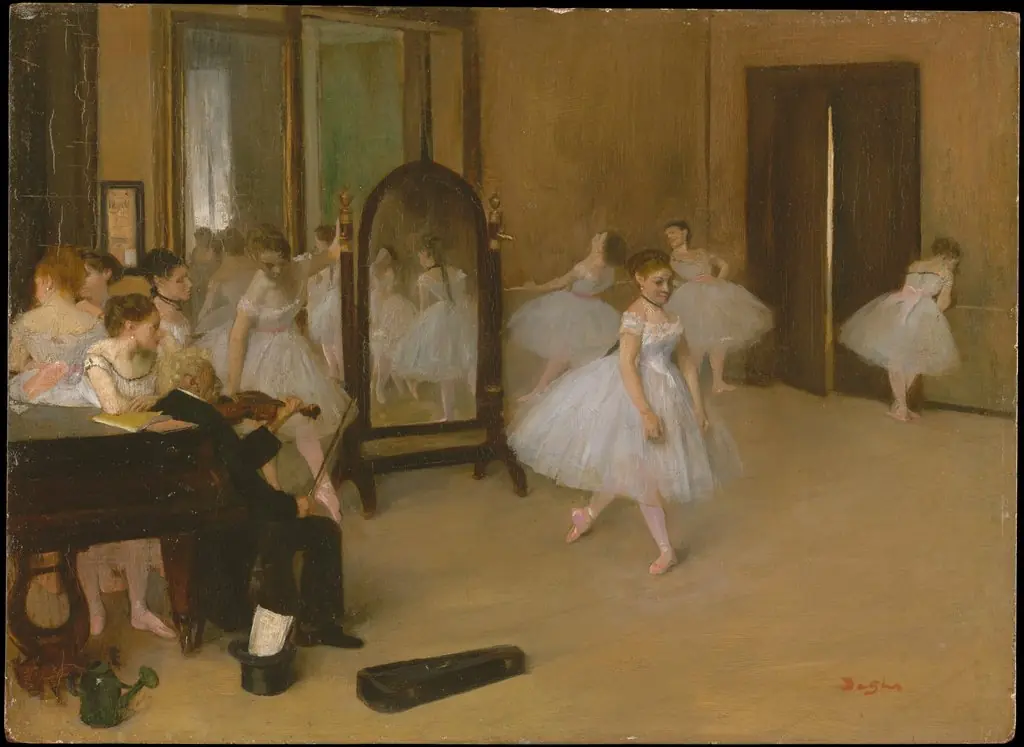
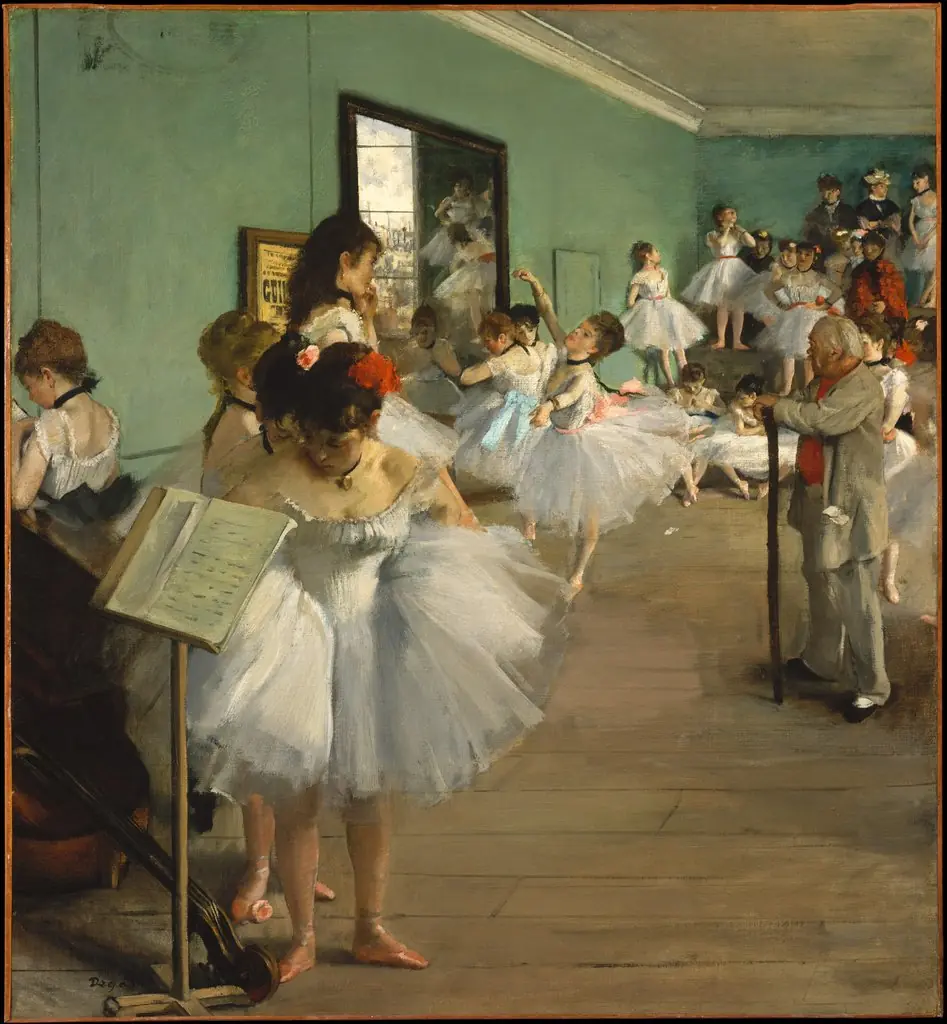
The Dance Lesson is an oil painting by the Impressionist artist Edgar Degas. It dates from 1879 and is held in the collection of the National Gallery of Art.
- Inscription
- Inscribed:lower right: Degas
About this work
Subject & Meaning
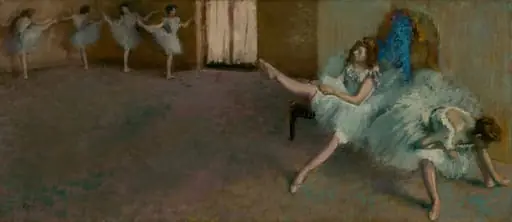
To the left, an exhausted dancer in a bright orange shawl rests on a double bass, while a violin case, though painted out, remains faintly visible nearby.
The painting depicts a scene from a ballet rehearsal, focusing on the informal interactions of dancers rather than a staged performance. To the left, an exhausted dancer in a bright orange shawl rests on a double bass, while a violin case, though painted out, remains faintly visible nearby. The central figures include a seated dancer in pink being attended to by a standing peer adjusting her sash, with a group practicing in the background near a large window.
This composition reflects Degas's interest in the 'intervals between figures and space' as a basis for ornamentation, utilizing a horizontal, frieze-like format inspired by Japanese prints. The work captures the fatigue and routine of the studio, deliberately placing figures off-center or cutting them off at unexpected angles to emphasize the candid nature of the moment.
Technique & Style
The Dance Lesson is an oil on canvas painting created around 1879. It measures 38 by 88 centimetres and is executed in oil paint on canvas, reflecting Degas’s characteristic use of flat planes and off‑centre composition influenced by Japanese prints. The work belongs to a series of approximately 40 frieze‑like pieces that explore spatial intervals and figure placement.
Its current location is the National Gallery of Art in Washington, D.C., where it has been part of the collection since 1995 after being acquired by Paul Mellon in 1957.
History & Provenance
Painted in 1879, The Dance Lesson entered the art trade with Durand-Ruel in Paris before being sold the same year to G. G. Keansward Jr. in Boston. By 1927 it was on loan to the Museum of Fine Arts, Boston, in the care of the Rev. George S. Fiske; after his death it passed to his daughter, Mrs. Esther Fiske Hammond, who lent it to the 1937 Degas exhibition in Paris. By 1952 the work belonged to Mrs. Alfred Chester Beatty (Edith Dunn Stone) in London, from whom Paul Rosenberg & Co. acquired it and sold it in November 1957 to Paul Mellon. Mellon later donated the painting to the National Gallery of Art, Washington, in 1995.
The painting is currently held by the National Gallery of Art in Washington, D.C., where it was accessioned in 1995 as a gift from Paul Mellon. Prior to this donation, the work belonged to Mellon's private collection in Upperville, Virginia, having been purchased by him in November 1957 from Paul Rosenberg & Co. Before entering the Mellon collection, the painting passed through the hands of Mrs. Alfred Chester Beatty and the Fiske family in Boston.
The work has a documented exhibition and loan history, including a loan to the Boston Museum of Fine Arts by 1927 and a loan to a 1937 Degas exhibition in Paris by Mrs. Fiske Hammond. While the National Gallery of Art received the work in 1995, some records indicate the museum's association with the piece began earlier, though the definitive transfer occurred upon Mellon's gift.
Context
The Dance Lesson (1879) emerged within Degas' exploration of ballet rehearsal spaces, reflecting his broader interest in capturing the physicality and discipline of dance while challenging conventional compositional norms. The work belongs to a series of approximately forty paintings depicting rehearsal environments, characterized by off-center figures, cropped perspectives, and flattened spatial depth influenced by Japanese prints. This approach aligns with Degas' contribution to Impressionism and his focus on transient, unidealized moments in contemporary life.
The painting's provenance traces from Durand-Ruel in Paris to G.G. Keansward Jr. in Boston, then to multiple private collectors before Paul Mellon acquired it in 1957, with its donation to the National Gallery of Art in 1995 ensuring its preservation in a public collection.
Overview
The Dance Lesson, painted by Edgar Degas in 1879, depicts an intimate moment within a Parisian dance studio. The composition centers on a young ballerina in a pink tutu practicing at the barre, her arms extended as an instructor stands behind her, hands placed on the student's shoulders to correct her posture. Degas employs his characteristic asymmetrical framing and elevated viewpoint, cropping the scene to suggest a candid glimpse rather than a staged tableau.
The palette is dominated by soft pinks, creams, and muted grays, with light filtering from an unseen window to illuminate the figures against the plain walls. Executed in oil on canvas, the work showcases Degas's mastery of capturing movement and the rigorous discipline of ballet training. Created during the height of his fascination with the subject, this painting reflects his shift from grand narrative scenes to studies of modern life and the private labor behind public performance.
It stands as a significant example of his ability to blend Impressionist light and color with a structured, almost photographic observation of human form and interaction.
Artist & collection

Artist
Born Hilaire-Germain-Edgar De Gas on 19 July 1834 in Paris, Edgar Degas came from an affluent banking family with aristocratic roots and spent his childhood among the cultivated circles of the French capital.