Artwork
Kitchen Scene with the Supper in Emmaus
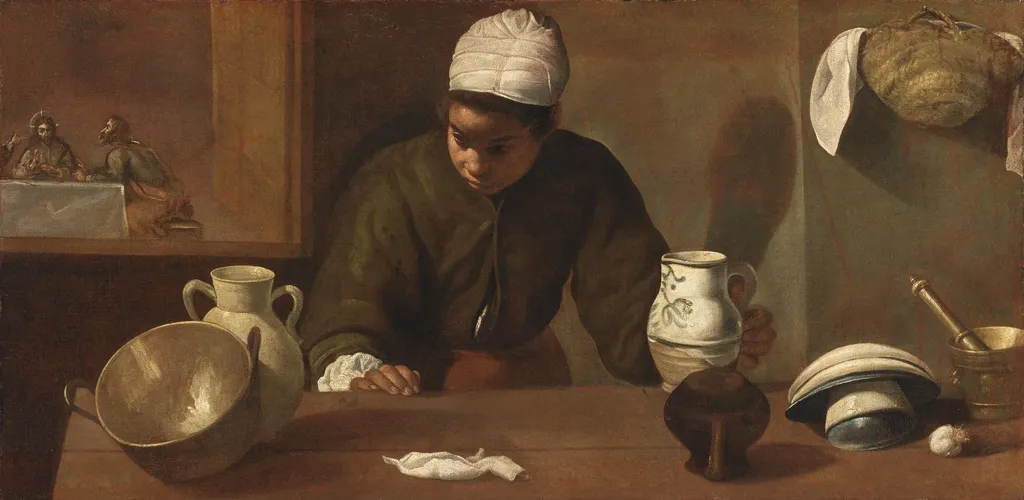
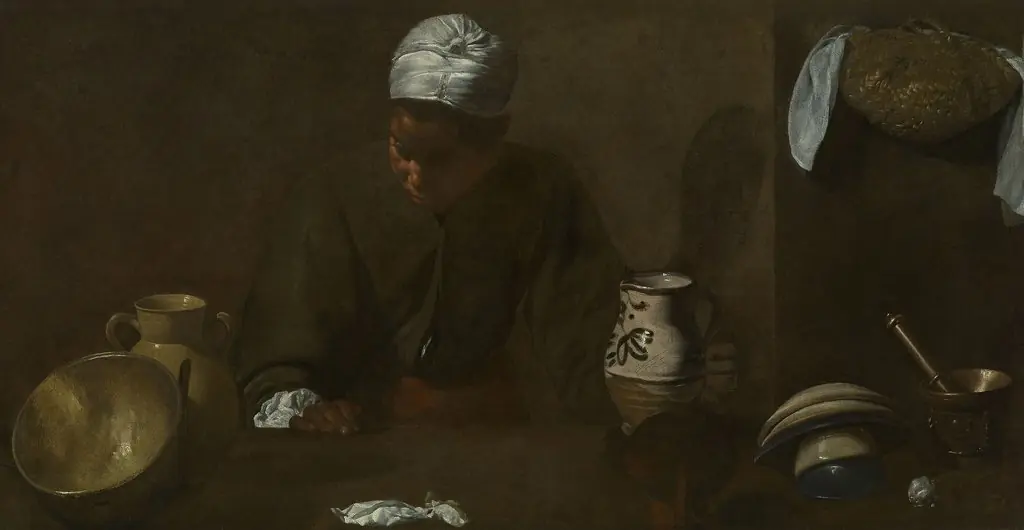
Kitchen Scene with the Supper in Emmaus is an oil painting by the Early Baroque Italian artist Diego Velázquez. It dates from 1618 and is held in the collection of the National Gallery of Ireland.
About this work
Subject & Meaning
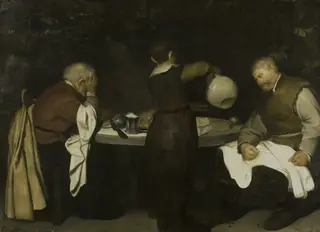
The painting depicts a young woman with dark skin and a white cap standing behind a kitchen table that cuts her figure in half.
The painting depicts a young woman with dark skin and a white cap standing behind a kitchen table that cuts her figure in half. She holds a glazed ceramic jug while other vessels, a mortar and pestle, and a head of garlic rest on the table. Behind her, a wicker basket hangs from a hook with a white cloth draped over its edge.
Originally concealed beneath overpaint, a window in the background was revealed in 1933 showing Christ blessing bread and a bearded man, with only a second disciple’s hand remaining due to later trimming; this window frames the Emmaus supper from Luke 24:13–35.
The composition inverts the traditional still-life hierarchy by placing a humble domestic interior in the foreground and the sacred scene in the background, transforming a kitchen bodegón into a "bodegón a lo divino." The arrangement elevates the servant’s dignity, aligning with the theological idea that the risen Christ appears to the lowly, expressed in Teresa of Ávila’s dictum: "God also walks among the pots."
Technique & Style
Executed in oil on canvas, the work measures 55 cm in height and 118 cm in width. The composition features a foreground still life of kitchen objects, including glazed ceramic jugs, bronze vessels, a mortar and pestle, and garlic, arranged on a table before a dark-skinned maid. A defining stylistic element is the "painting within a painting" technique, where a small window in the background wall reveals the biblical Supper at Emmaus, creating an inverted still life that elevates the mundane setting.
This spatial device, similar to that in Christ in the House of Martha and Mary, functions as an opening into a separate room rather than a mirror. The canvas underwent significant alteration; a 1933 cleaning removed overpaint to reveal the sacred window scene, which had been obscured, while evidence suggests the left side of the original support was trimmed, removing a second disciple.
History & Provenance
Kitchen Scene with the Supper in Emmaus was painted by Diego Velázquez in 1618, likely during his early Sevillian period before 1623. The work, executed in oil on canvas, measures 55 cm by 118 cm and depicts a kitchen interior with a young woman serving a meal associated with the biblical scene of the Supper at Emmaus. It entered the National Gallery of Ireland in Dublin in 1987 through a bequest from Alfred Beit, joining other works from his collection at Russborough House.
The painting was first publicly identified as an original Velázquez work by Aureliano Beruete in 1913, following its display at the Grafton Galleries exhibition where it was initially attributed to the artist. Subsequent scholarly debate, including views by August Mayer and José López-Rey, affirmed its authenticity after the 1933 cleaning revealed a hidden window depicting the risen Christ, confirming its narrative connection to the Emmaus story. The work remains part of the National Gallery of Ireland's permanent collection, documented in exhibition catalogues from 1990 and 1999.
The painting has been held at the National Gallery of Ireland in Dublin since 1987, when it entered the collection through a bequest from Alfred Beit, alongside sixteen other important works from Russborough House. Earlier in its provenance, it was lent by Otto Beit as "attributed" to Velázquez to the 1913 exhibition of Spanish masters at the Grafton Galleries in London, where critic Aureliano Beruete first published it as an original by the painter.
The work was included in the 1990 exhibition Velázquez at the Museo del Prado in Madrid, and its recorded exhibition history also references a Velázquez show, consistent with the major retrospective context surrounding the artist's oeuvre.
Context
The painting belongs to Velázquez's early Sevillian period, before 1623, and scholars remain divided on its precise date: some place it around 1617–1618, which would make it among the artist's earliest known works, while others favor 1620–1622. Aureliano Beruete was the first to publish it as an autograph Velázquez, after seeing it at the 1913 Grafton Galleries exhibition of Spanish masters, where it was lent by Otto Beit as "attributed." August L. Mayer later argued that the Goudstikker Gallery version (now in Chicago) was the true original, demoting the Beit canvas to a copy, but he reversed this judgment after the 1933 cleaning revealed the Emmaus window, and subsequent critics have largely accepted the Dublin canvas as authentic.
The work is closely linked to Velázquez's bodegón tradition, recalling the "bodegoncillos" Antonio Palomino described among his early output, and it parallels the compositional device of Christ in the House of Martha and Mary. The discovery of the background window transformed the kitchen scene into a so-called "bodegón a lo divino," a subgenre that dignifies humble subject matter by framing it with sacred presence, a concept Julián Gállego summarized with Saint Teresa of Ávila's remark that "God too moves among the pots."
Overview
Diego Velázquez’s oil painting, dated 1618, presents a domestic interior that doubles as a biblical tableau. The canvas, titled Kitchen Scene with the Supper in Emmaus, merges a quotidian kitchen setting with the narrative of the disciples’ meal in Emmaus, and today it belongs to the collection of the National Gallery of Ireland.
Artist & collection
Artist
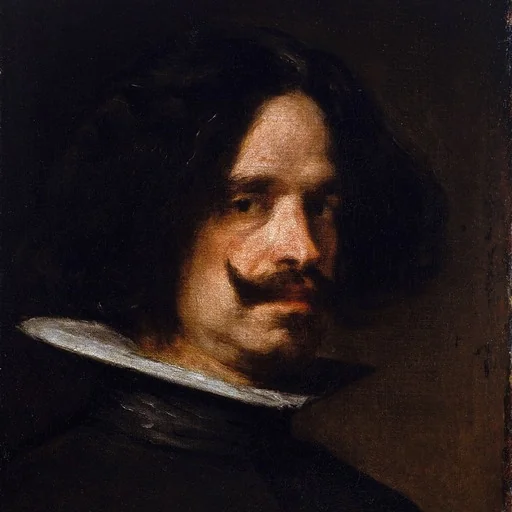
Diego Rodríguez de Silva y Velázquez was a Spanish Baroque painter, the leading artist in the court of King Philip IV of Spain and Portugal, and of the Spanish Golden Age.