Artwork
Three Musicians
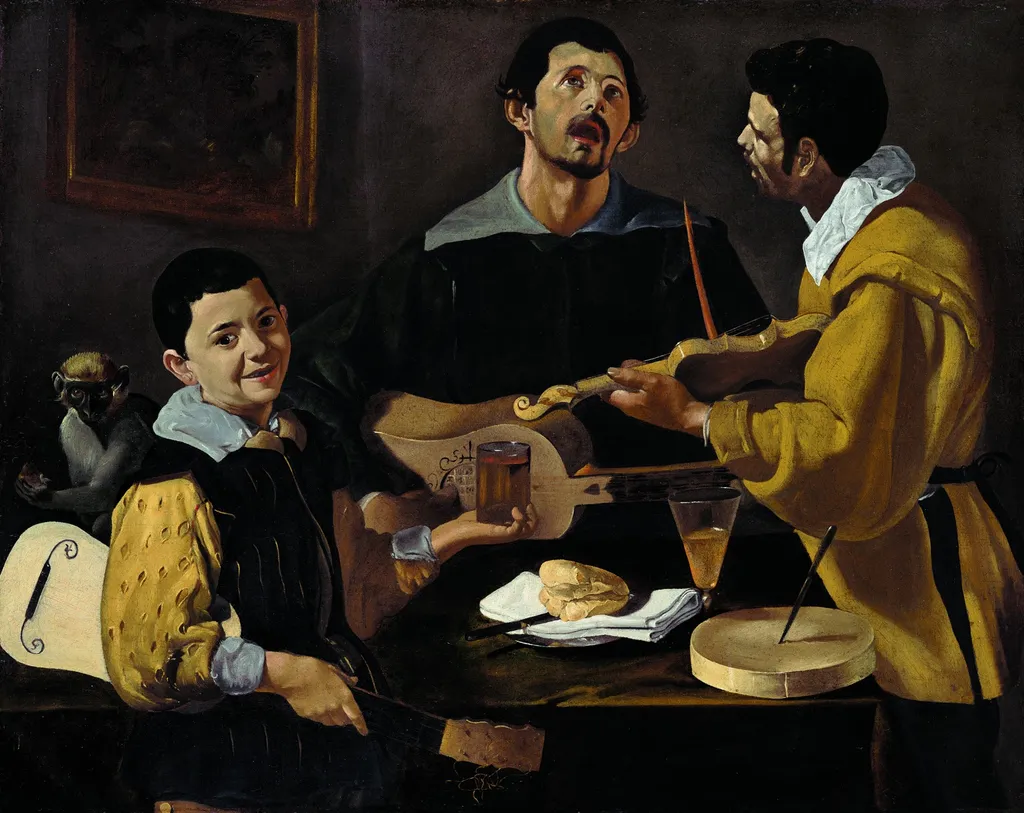
Three Musicians is an oil painting by the Baroque artist Diego Velázquez. It dates from 1618 and is held in the collection of the Gemäldegalerie Berlin.
About this work
Subject & Meaning
Velázquez's Three Musicians depicts three young men in a tavern setting, engaged in singing and playing stringed instruments while surrounded by food and drink.
Velázquez's Three Musicians depicts three young men in a tavern setting, engaged in singing and playing stringed instruments while surrounded by food and drink. The composition features a loaf of bread, cheese with a knife, and a glass of wine, the latter held by the youngest figure who offers it to the viewer with a mocking smile to suggest wine as the source of musical inspiration. A monkey clutching a pear appears in the background, emphasizing the scene's grotesque and ridiculous nature.
While the work functions as a bodegón showcasing varied textures through chiaroscuro lighting, its iconography invites allegorical interpretation. Some scholars associate the monkey with vice, proposing a moralizing reading common in satirical genre painting. However, others argue the image primarily celebrates Bacchic joy and ridicule, intended to amuse upper-class viewers rather than convey a strict ethical lesson.
Technique & Style
Three Musicians is an oil painting on canvas executed by Diego Velázquez in 1618 during his early Seville period. The work exemplifies the bodegón genre through its use of chiaroscuro, employing intense, directional light from the left to create sharp shadows and volumetric highlights. Velázquez applied the paint with a sculptural approach, modeling color masses and reserving delicate white brushstrokes for the most illuminated areas, such as the forehead of the central figure.
Radiographic analysis has revealed significant pentimenti, indicating the central figure's garment was originally painted in muted grays before being repainted entirely in black. The composition features a detailed study of textures, particularly in the depiction of bread, wine, and cheese on a table, alongside grotesque elements like a monkey holding a pear. The handling of light and dark contrasts and the naturalistic rendering of common subjects reflect the artist's engagement with Caravaggesque techniques and Flemish influences.
History & Provenance
Three Musicians is one of Velázquez's earliest surviving works, dating to his Seville period. It was first recorded in the early nineteenth century in the La Touche collection in Ireland, later moving to London, where it was sold at auction in 1906 and acquired by the Kaiser Friedrich Museum in Berlin. The painting has remained in Berlin since, now in the Gemäldegalerie.
Its attribution to Velázquez was established in 1906 by Aureliano de Beruete, who identified the work at the auction and linked it to the artist's early Seville output. It is cataloged in José López-Rey's Velázquez: Catalogue raisonné as an early work, and it has featured in exhibitions such as El Siglo de Oro. The Age of Velázquez.
Context
Added to Velázquez's corpus by Aureliano de Beruete in 1906, Three Musicians is recognized as a seminal work of the artist's early Seville period. Scholars classify it within the bodegón genre, specifically aligning with Francisco Pacheco's category of ridiculous figures intended to provoke laughter. While early criticism often cited Caravaggio as a primary influence regarding subject matter and chiaroscuro, Jonathan Brown argued that direct exposure was unlikely in Seville at the time.
Instead, scholarship suggests Flemish prints and Italian collections, such as that of the Duke of Alcalá, were more probable sources, alongside the work of Luis Tristán. Interpretations of the painting's meaning vary; Peter Cherry noted the monkey could imply a moral allegory on vice, yet he ultimately concluded the scene likely depicts bacchic joy without didactic intent. Radiographic analysis has further informed art historical understanding by revealing compositional changes.
Overview
Diego Velázquez's Three Musicians is an early oil painting by the Spanish Baroque artist. This work portrays three young men gathered around a table, engaged in music-making. It exemplifies Velázquez's developing style as a naturalist, capturing a scene from everyday life with a directness characteristic of his initial period. The painting is currently housed in the collection of the Gemäldegalerie, Berlin.
Own this work as a print
Artist & collection
Artist
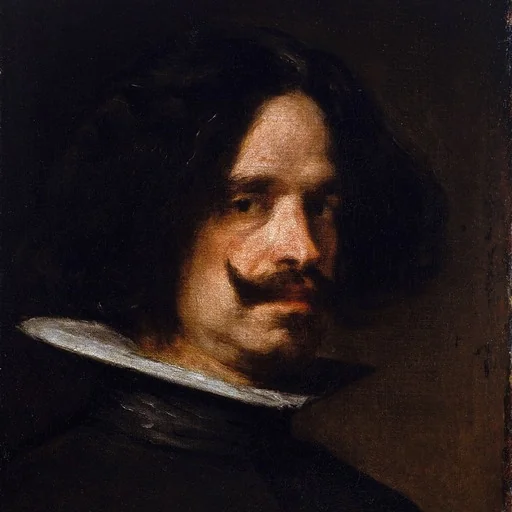
Diego Rodríguez de Silva y Velázquez was a Spanish Baroque painter, the leading artist in the court of King Philip IV of Spain and Portugal, and of the Spanish Golden Age.