Artwork
The Needlewoman
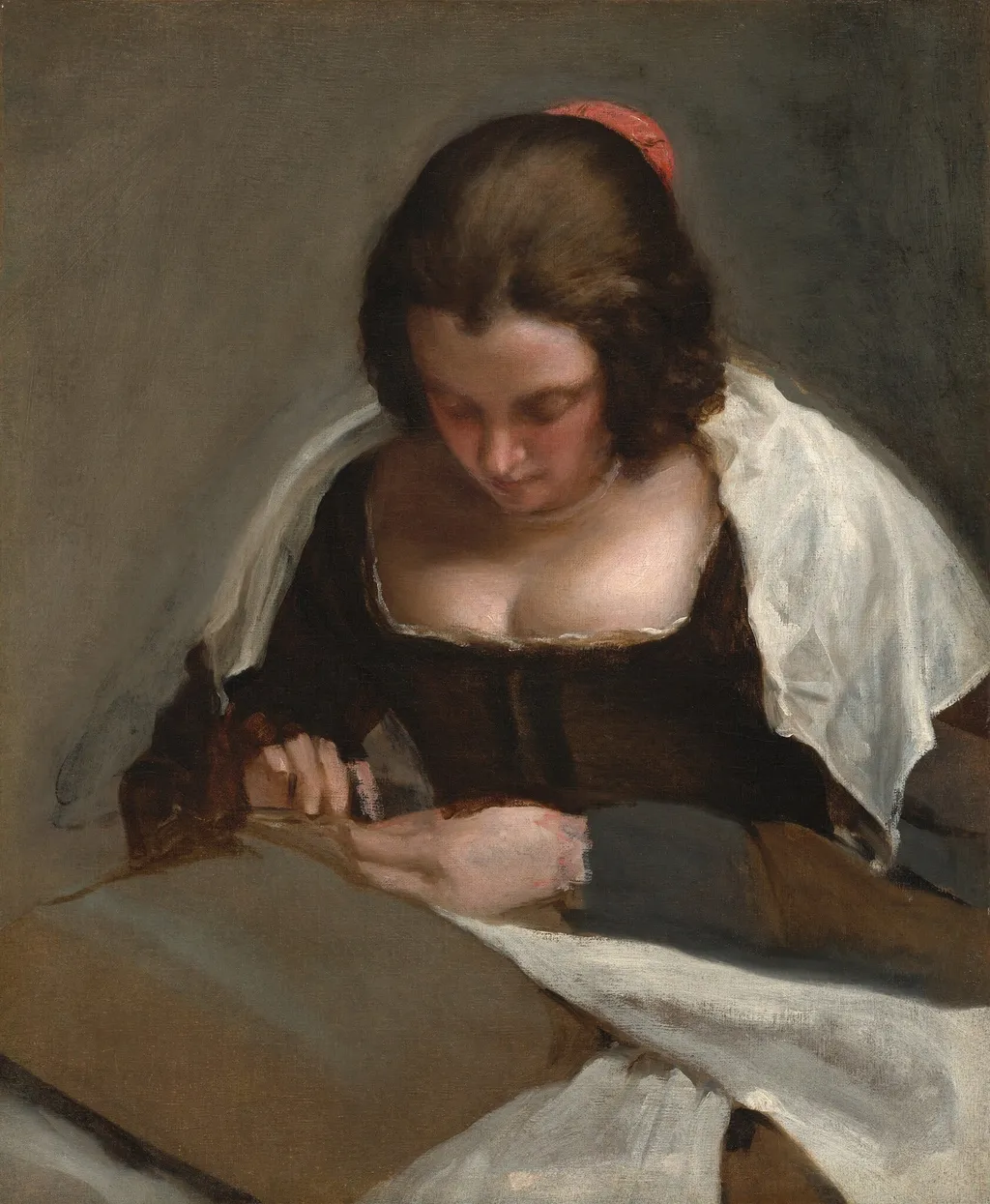
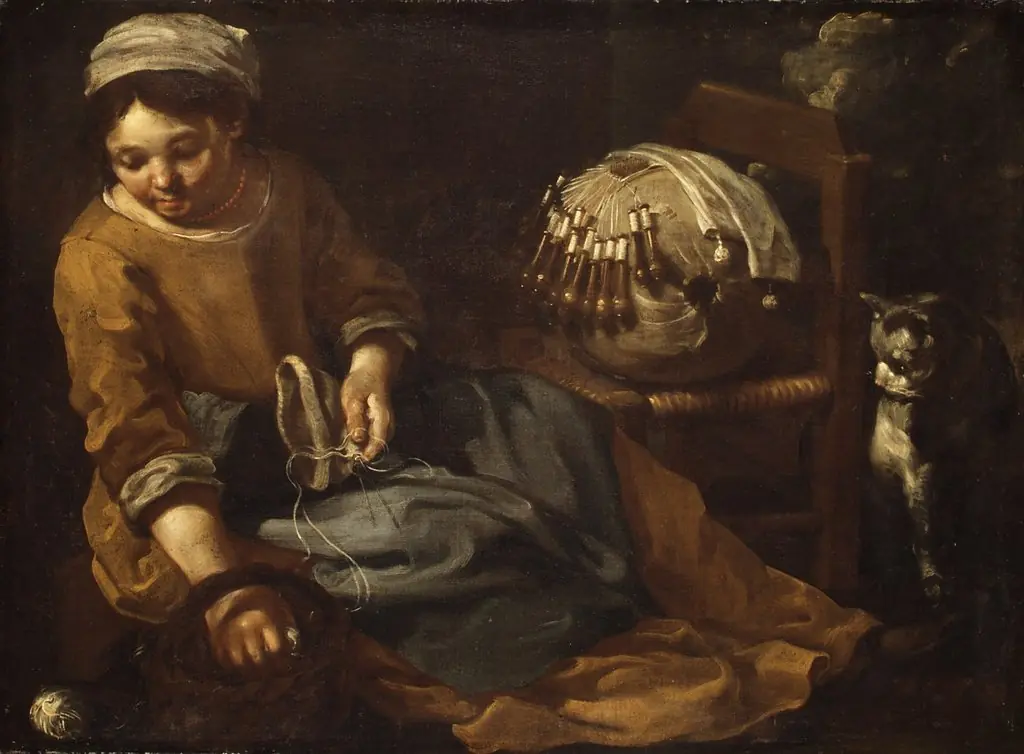
The Needlewoman is an oil painting by the Baroque artist Diego Velázquez. It dates from 1645 and is held in the collection of the National Gallery of Art.
About this work
Subject & Meaning
López-Rey objected that Mazo, who compiled Velázquez's posthumous inventory, would not have catalogued a portrait of his own wife as a mere genre scene.
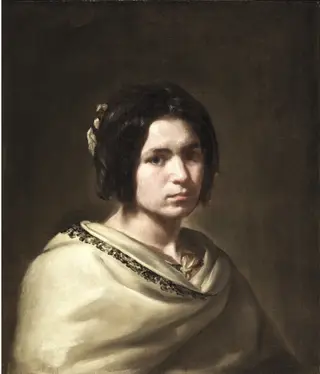
The Needlewoman depicts a young adult woman shown in half-length, her head tilted and absorbed in sewing. She wears a wide décolletage with a white fichu draped over her shoulders, and her reddish hair is gathered in a chignon bound with a red ribbon, which provides the only vivid color against the dominant grey-greens, browns, and whites. White touches around the neck suggest a necklace, implying she is not a laborer but a woman of some social standing.
The subject's identity remains uncertain: José Gudiol proposed the painter's wife Juana Pacheco, while August L. Mayer argued for his daughter Francisca Velázquez del Mazo, married to Juan Bautista Martínez del Mazo. López-Rey objected that Mazo, who compiled Velázquez's posthumous inventory, would not have catalogued a portrait of his own wife as a mere genre scene. Similarities in facial features and brushwork with The Lady with a Fan (dated to around 1635) suggest the same model and an intimate relationship between artist and sitter.
The painting is unfinished, with the head fully modeled in light and shadow while the arms, hands, and contour remain summarily sketched, demonstrating Velázquez's method of suggesting form and atmosphere.
Technique & Style
The Needlewoman is an oil on canvas measuring 74 by 60 cm, executed by Velázquez around 1635. The work is famously unfinished, with the head modeled in light and shadow through layered glazes being the most fully realized passage. The arms and hands are only summarily sketched, while the outer contours of the figure are rapidly blocked in over a greenish ground, establishing the principal zones of color before being abandoned.
Velázquez later revised the shoulder line to sharpen the diagonal pose and adjusted the fingers of the right hand, after which they were left essentially undrawn. The palette is dominated by grayish greens, browns, and whites, with a red ribbon in the sitter's hair providing a single chromatic accent and small white touches around the neck suggesting a necklace. The handling demonstrates the artist's method of constructing the figure economically and allowing the sitter to merge with the surrounding atmosphere.
History & Provenance
The Needlewoman is traditionally dated to c. 1635 on technical and stylistic grounds, aligning with Velázquez’s mature period and the similar handling observed in La dama del abanico, also attributed to 1635. It appears in Velázquez’s posthumous inventory of 1660 as “Another head, of a woman doing needlework,” confirming its execution during his lifetime. The sitter’s identity remains uncertain; hypotheses have included the artist’s daughter Francisca Vélazquez del Mazo and his wife Juana Pacheco, though the unfinished state complicates secure attribution.
After the artist’s death the work descended through private hands, entering the collection of the Marquis de Gouvello de Keriaval by the early nineteenth century. It was sold via Wildenstein & Co. in 1926, consigned to Knoedler, and purchased by Andrew W. Mellon in March 1927; Mellon later conveyed it to The A.W. Mellon Educational and Charitable Trust in 1934, which gifted the painting to the National Gallery of Art, Washington, in 1937.
The Needlewoman is held by the National Gallery of Art in Washington, D.C., as part of the Andrew W. Mellon collection. Andrew W. Mellon acquired the painting on March 9, 1927, through M. Knoedler & Co., which had been consigned the work by Wildenstein and Co. Mellon deeded the painting to The A.W. Mellon Educational and Charitable Trust in December 1934, which subsequently gifted it to the NGA in 1937.
Prior to its entry into the Mellon collection, the painting was likely owned by Hippolyte, Marquis de Gouvello de Keriaval, in Brittany. By 1926, it belonged to Madame Christiane de Polès in Paris, who sold it to Wildenstein and Co. on July 5, 1926. The provided sources do not document an exhibition history for the work.
Context
Scholarly debate surrounds The Needlewoman's attribution and dating, with critics like F. J. Sánchez Cantón and Pantorba suggesting the work was begun by Velázquez but completed by his son-in-law, Juan Bautista Martínez del Mazo. Conversely, José López-Rey defends the painting's autograph status, citing inventory records from Velázquez's death listing a 'head of a woman doing needlework' and noting stylistic parallels with The Lady with a Fan and The Coronation of the Virgin. The work's unfinished state, featuring a fully realized face contrasted with sketched hands and shoulders, is viewed as evidence of Velázquez's mastery in capturing gesture and atmospheric integration rather than mere incompleteness.
Art historians have proposed the sitter is the artist's daughter, Francisca, or his wife, Juana Pacheco, though the inventory's classification as a genre scene complicates the identification of a family member. These discussions situate the painting within Velázquez's exploration of intimate, domestic subjects alongside his court portraits.
Overview
Diego Velázquez's The Needlewoman (La costurera), an oil on canvas dating from 1635 to 1643, is housed at the National Gallery of Art in Washington, D.C. The painting quietly portrays a young woman absorbed in her sewing, her hands holding needle and thread under a gentle, ambient light. This work exemplifies Velázquez's ability to imbue a simple domestic scene with profound observation.
Own this work as a print
Artist & collection
Artist
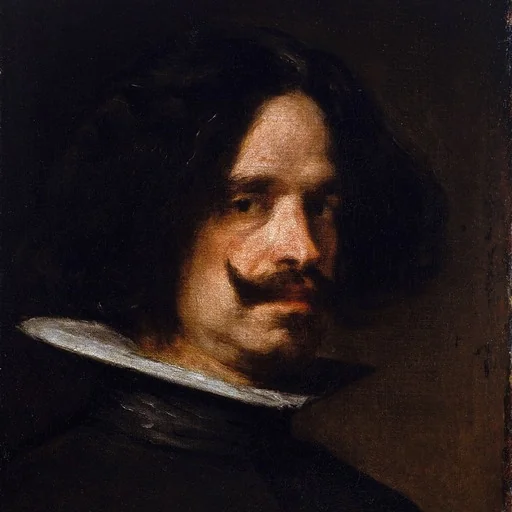
Diego Rodríguez de Silva y Velázquez was a Spanish Baroque painter, the leading artist in the court of King Philip IV of Spain and Portugal, and of the Spanish Golden Age.