Artwork
Las Hilanderas
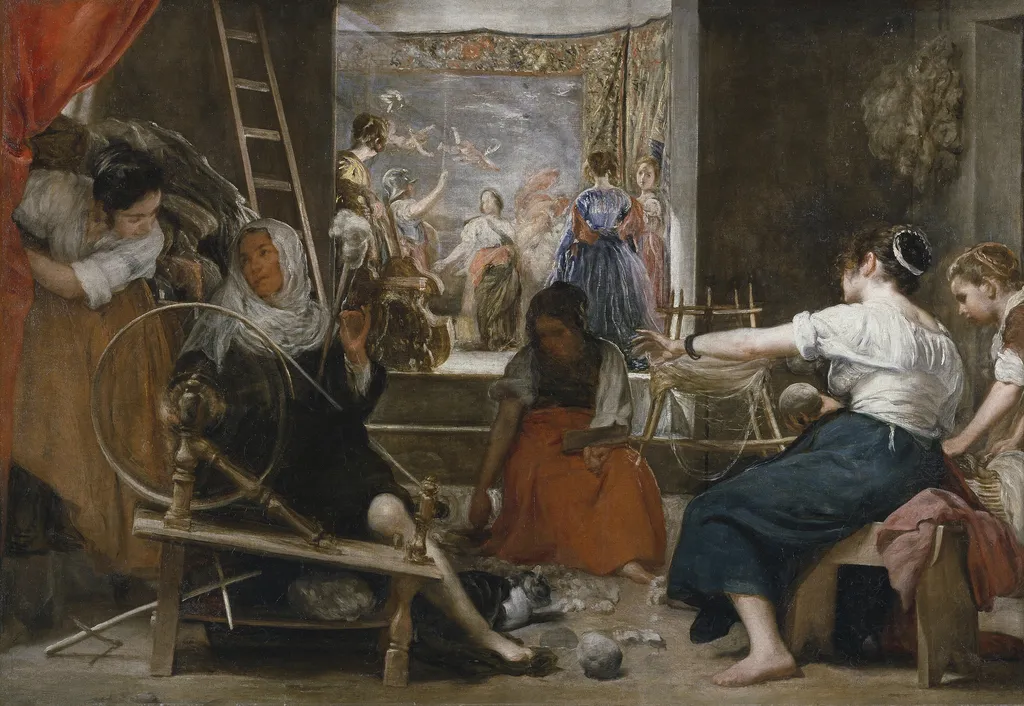
Las Hilanderas is an oil painting by the Early Baroque Italian artist Diego Velázquez. It dates from 1655 and is held in the collection of the Museo del Prado.
About this work
Las Hilanderas, also called The Fable of Arachne, is an oil painting by Diego Velázquez. Scholars disagree on its date, some placing it around 1644 to 1648 and others between 1657 and 1658.
Subject & Meaning
The inclusion of the mythological contest within a realistic workshop setting creates a complex layering of meaning regarding creativity and artistic status.
Although traditionally viewed as a genre scene of workers in the Santa Isabel tapestry workshop, the painting is now widely recognized as an illustration of Ovid's myth of Arachne. The foreground depicts the weaving contest between the goddess Athena, disguised as an old woman, and the mortal Arachne, who faces away from the viewer. In the background, a raised stage displays the finished tapestries, specifically showing Arachne's depiction of Titian's The Rape of Europa, a work held in the Spanish royal collection.
This narrative references Arachne's challenge to the goddess and her subsequent transformation into a spider. Scholars interpret the composition as an allegory of the arts, contrasting divine inspiration with technical craft, or as Velázquez's argument for elevating painting from a manual trade to a liberal art. The inclusion of the mythological contest within a realistic workshop setting creates a complex layering of meaning regarding creativity and artistic status.
Technique & Style
Las Hilanderas is executed in oil paint on canvas, measuring approximately 220 × 289 cm in its current extended state, though the original dimensions recorded in Pedro de Arce's 1664 inventory were about 167 × 250 cm. Velázquez employed an economical, light touch, with loose, almost invisible brushwork that contemporaries like Anton Raphael Mengs described as appearing to involve the will alone rather than the hand. The composition is built on a layered, two-stage structure inherited from his earlier bodegones, in which a foreground workshop scene gives way to a raised, tapestry-hung alcove behind. A celebrated technical feat is the stroboscopic rendering of the spinning wheel's spokes, dissolving into a blurred shimmer that captures motion faster than the eye can register.
The work was damaged in the 1734 Royal Alcázar fire; eighteenth-century restorers added strips at the top and sides, and subsequent relining caused the original canvas to shrink and the paint to crack. It was conserved at the Prado in 1984–85.
History & Provenance
Las Hilanderas was commissioned by Don Pedro de Arce, huntsman to King Philip IV, and first recorded in his 1664 inventory under the title La fábula de Arachne, measuring 167 × 250 cm. By 1711 it entered the Spanish royal collection after being confiscated from Luis de la Cerda, Duke of Medinaceli, and was listed in palace inventories from the Real Alcázar (1711) through the Prado (1814–1818). Damaged in the 1734 Royal Alcázar fire, the canvas was extended by about 37 cm at the sides and over 50 cm at the top, later concealed behind a screen to reveal its original dimensions. Stylistic analysis places its execution between 1657 and 1658, aligning with Velázquez’s late period alongside Las Meninas.
Las Hilanderas is held by the Museo del Prado in Madrid. The painting entered the Spanish royal collection in the eighteenth century; it is documented in the Real Alcázar by 1711, later recorded in the Palacio del Buen Retiro after 1716, and listed in the Palacio Real Nuevo in 1772 and 1794 before passing to the Prado. The work was probably damaged in the 1734 fire at the Royal Alcazar of Madrid, after which strips were added to all four sides in the eighteenth century, enlarging the canvas beyond its original dimensions of approximately 167 × 250 cm recorded in the 1664 inventory of Don Pedro de Arce.
It was restored at the Prado between 1984 and 1985. In 2007 the painting was shown at the Prado in a temporary exhibition that revealed its original dimensions through a special scenographic device.
Context
Las Hilanderas, also called The Fable of Arachne, is housed in the Museo del Prado and is generally dated to 1657–58, though some scholars propose an earlier date around 1644–48. Art historians regard it as one of Velázquez’s two greatest late works, alongside Las Meninas, and interpret it as an allegory of the arts that juxtaposes the goddess Athena with the mortal weaver Arachne to comment on the blend of creativity and technical skill. The painting’s layered composition derives from the artist’s earlier bodegones and reflects his courtly context as a royal painter.
Critical reception has shifted from 19th‑century genre interpretations to 20th‑century mythic readings and modern analyses that stress its political and aesthetic significance. Its influence on later artists, notably the impressionists, is documented, and technical study highlights Velázquez’s solution to depicting rapid wheel motion.
Legacy
Las Hilanderas is recognized alongside Las Meninas as one of Velázquez's final and most complex masterpieces, though it remained relatively obscure compared to the latter for centuries. Its reputation evolved significantly after the 1948 rediscovery of an inventory listing it as the 'Fable of Arachne,' which corrected the long-held nineteenth-century view that it merely depicted a tapestry workshop. The painting's loose brushwork and depiction of motion, particularly the spinning wheel, profoundly influenced later artists; Auguste Renoir famously praised its luminous quality upon viewing it.
Scholars note that the work's layered composition and ambiguous iconography have continuously challenged traditional methods of interpretation, cementing its status as an enigmatic cornerstone of art history that bridges genre scenes with high mythological allegory.
Overview
Diego Velázquez's oil painting, Las Hilanderas, resides in Madrid's Museo del Prado. Also referred to as The Fable of Arachne, this work is generally considered a late creation by the Spanish master, with most scholars placing its execution between 1657 and 1658. However, some art historians propose an earlier date, suggesting it was completed around 1644-1648. The painting is notable for its intricate composition and scale within Velázquez's oeuvre.
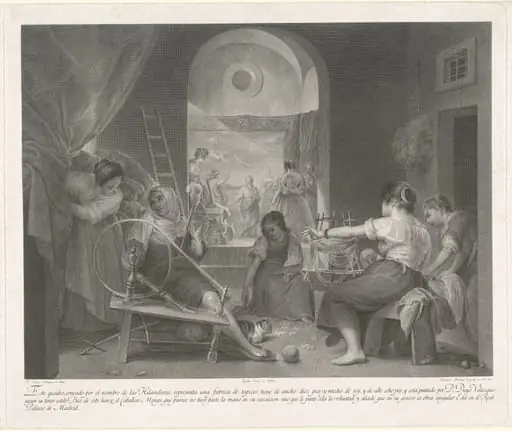
Own this work as a print
Artist & collection
Artist
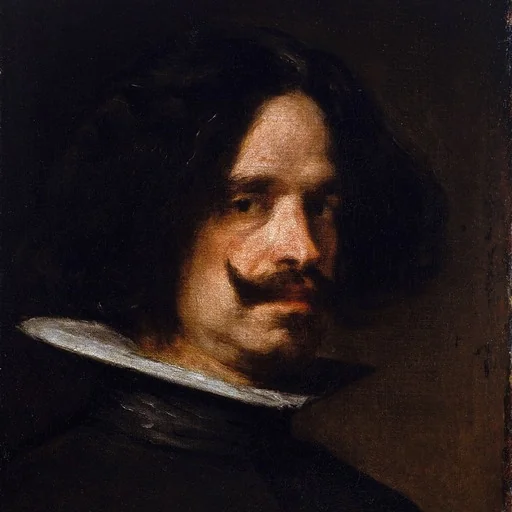
Diego Rodríguez de Silva y Velázquez was a Spanish Baroque painter, the leading artist in the court of King Philip IV of Spain and Portugal, and of the Spanish Golden Age.