Artwork
Adoration of the Magi
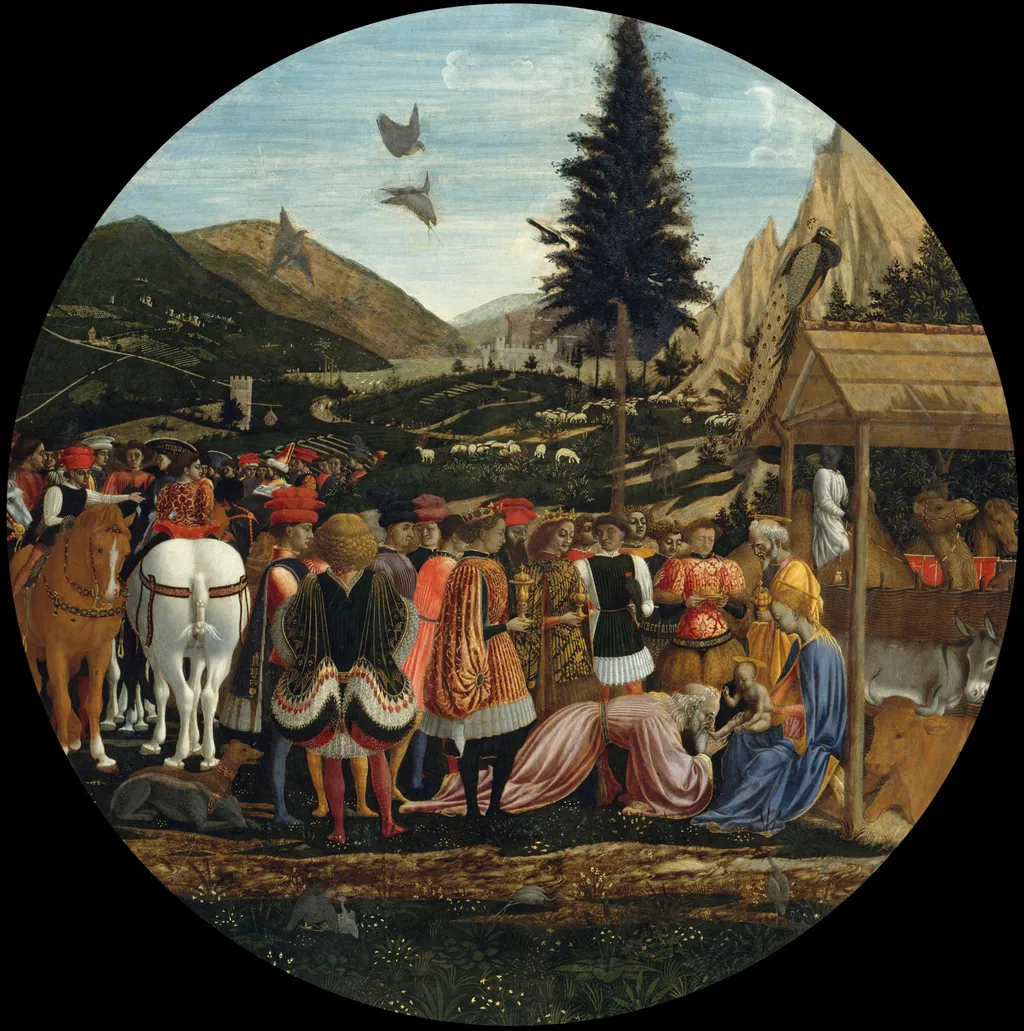
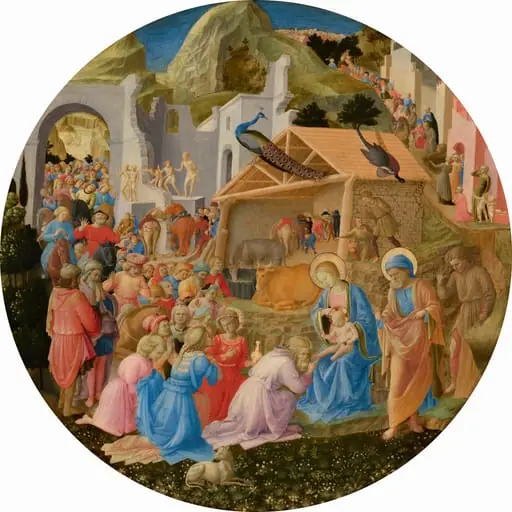
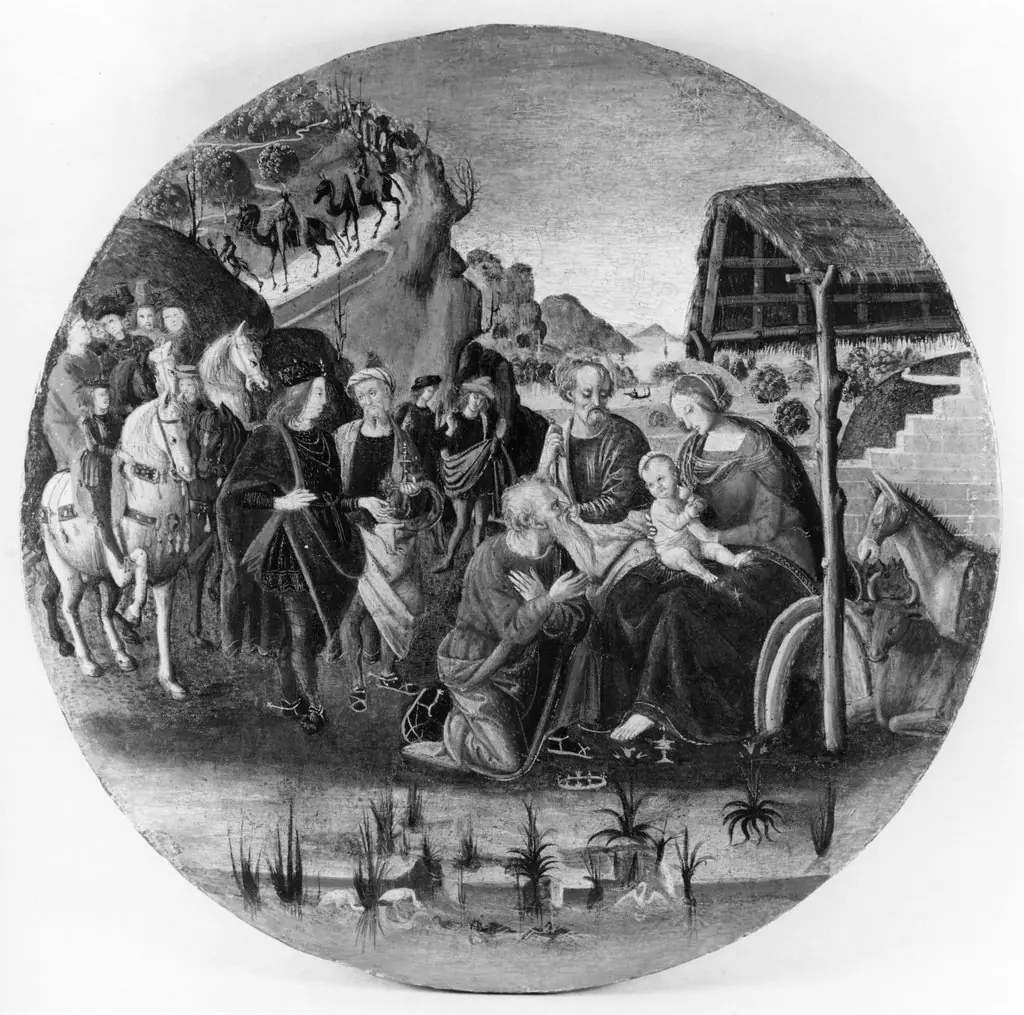
Adoration of the Magi is an oil painting by the Early Renaissance artist Domenico Veneziano. It dates from 1435 and is held in the collection of the Gemäldegalerie Berlin.
About this work
Technique & Style
The distant landscape features atmospheric perspective, with hills fading into a clear haze, revealing an early assimilation of Flemish painting techniques.
Executed as a tondo with a diameter of 84 cm, this work is painted in tempera on a poplar panel. The composition arranges the procession of the Magi horizontally toward a shelter on the right, balanced vertically by a central tree that serves as a slightly offset axis of symmetry. While the elegant figures, exotic costumes, and meticulously detailed flora in the foreground reflect a Late Gothic aesthetic reminiscent of Gentile da Fabriano, the painting simultaneously demonstrates Early Renaissance innovations.
These include a unified treatment of light, a convincing mastery of spatial volume, and the realistic physicality of the subjects. The distant landscape features atmospheric perspective, with hills fading into a clear haze, revealing an early assimilation of Flemish painting techniques.
History & Provenance
The Adoration of the Magi by Domenico Veneziano is a tondo of 84 cm diameter executed in tempera on poplar panel and dated to 1439–1441.
It was commissioned by Piero de’ Medici in 1438, at which time Veneziano wrote from Perugia offering his services in Florence. The work was completed in 1441. By the mid-twentieth century the painting entered the collection of the Gemäldegalerie, Berlin, where it remains.
The painting is held in the collection of the Gemäldegalerie in Berlin. Described as a tondo with a diameter of 84 cm, the work was executed in tempera on wood. Historical records indicate it was commissioned by Piero de' Medici in 1438 and completed around 1441.
While the piece is documented in major art historical bibliographies and linked to digital repositories such as Google Arts & Culture and the RKD, the provided sources do not list specific past exhibition titles, dates, or venues beyond its permanent location.
Legacy
The painting is recognized as one of the earliest surviving tondi created specifically as independent works of art, rather than serving a functional purpose such as a birth tray. Its completion led to further commissions for the artist, including work at the church of Sant'Egidio in Florence. The work's luminous style profoundly influenced Piero della Francesca, who collaborated with Domenico Veneziano on these frescoes.
Art historian Roberto Longhi later cited the panel as a definitive example of the artist's formation, praising its synthesis of Flemish detail, Masaccio's spatial command, and the coloristic warmth associated with Fra Angelico.
Overview
Domenico Veneziano’s Adoration of the Magi is an oil painting executed around 1435. The work presents a biblical scene in which the three Magi, accompanied by attendants and horses, gather before a kneeling woman cradling an infant. A rolling landscape with distant villages, trees and a river forms the backdrop, while birds animate the sky. The composition is now displayed in the Gemäldegalerie in Berlin.
Subject & Meaning
The central figures are the Virgin Mary and the Christ Child, receiving homage from the richly attired Magi, who symbolize the recognition of Christ by the wider world. The inclusion of both mounted and on‑foot travelers underscores the universal scope of the visitation, while the surrounding countryside suggests a bridge between the sacred event and everyday life.
Context
The Adoration reflects the growing interest in naturalistic landscapes and spatial coherence that marked the Florentine artistic milieu of the 1430s. Domenico’s approach aligns with contemporaries who explored perspective and atmospheric effects, contributing to the broader shift toward more lifelike representation in religious narrative paintings.
Own this work as a print
Artist & collection



- Adoration of the Magi
 The Legend of the King's Sons
 scene con storie degli argonauti
 The Adoration of the Magi
 The Story of Virginia
 Christ Carrying the Cross
 The Adoration of the Kings
 Adoration of the Magi
 The Betrayal of Christ
 The Adoration of the Shepherds
 The Adoration of the Magi
 The Beheading of St. Catherine of Alexandria