Artwork
Saint John in the Desert
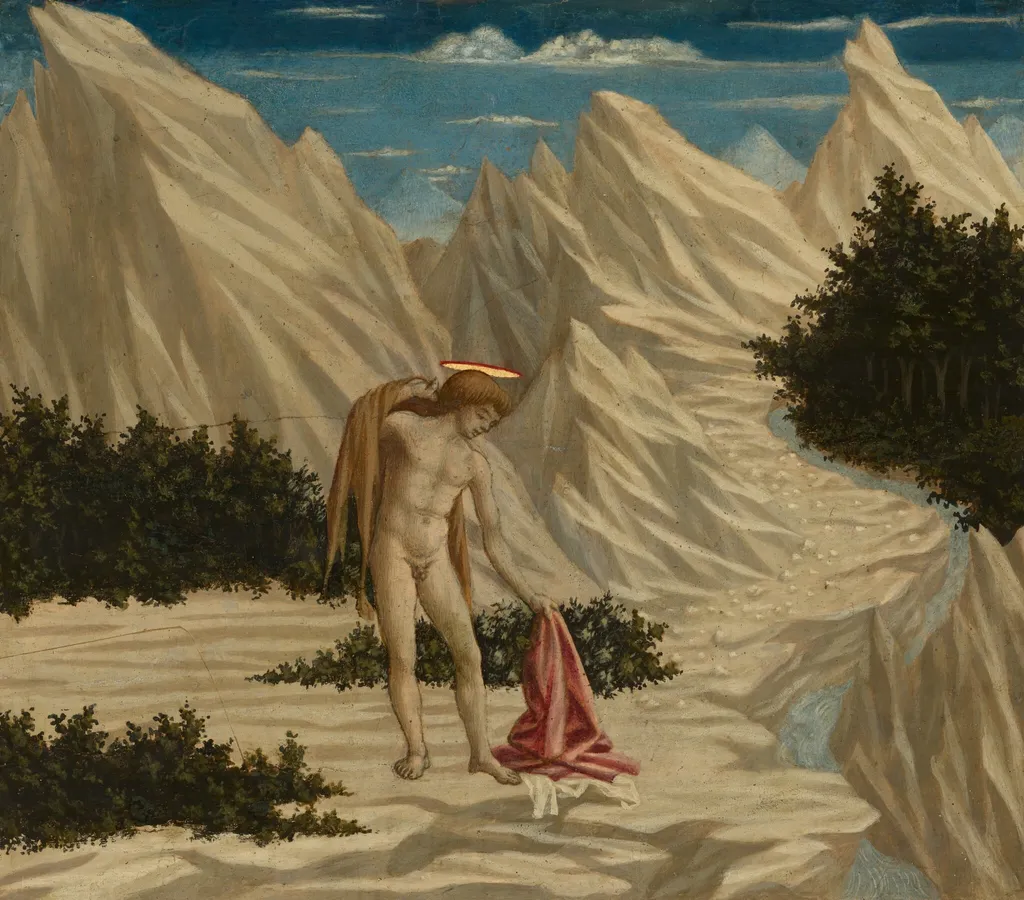
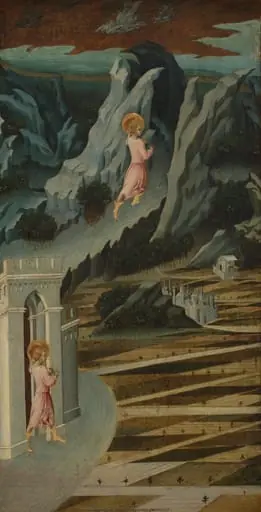
Saint John in the Desert is a tempera painting by the Early Renaissance artist Domenico Veneziano. It dates from 1448 and is held in the collection of the National Gallery of Art.
About this work
Subject & Meaning
The painting depicts John the Baptist at the pivotal moment he renounces his elegant civil attire to don the hair garment of a hermit, symbolizing his entry into an ascetic life. This specific iconography, described as unique within the saint's narrative cycle, likely draws inspiration from lost frescoes by Pisanello and Gentile da Fabriano. The composition reinterprets the classical myth of Hercules at the Crossroads through a Christian lens, presenting the saint's nude form as a figure of moral choice.
Visually, the work represents a transition between late Gothic and Renaissance aesthetics; the saint stands within an innovative mountainous landscape where rocks function as 'light prisms' and distant peaks demonstrate early atmospheric perspective. The naturalistic blue sky, streaked with clouds, replaces the traditional abstract gold backgrounds of earlier periods, grounding the spiritual subject in a tangible, evolving natural world.
Technique & Style
This approach updates traditional Byzantine and Gothic rock formations while incorporating spatial innovations seen in Masaccio's Brancacci Chapel frescoes.
Executed circa 1445, the work is a tempera painting on a wooden panel measuring 28.4 by 31.8 cm. Stylistically, it represents a transition between late Gothic and Renaissance aesthetics, characterized by a unique landscape where jagged rocks are rendered as luminous prisms of pale and vivid hues. This approach updates traditional Byzantine and Gothic rock formations while incorporating spatial innovations seen in Masaccio's Brancacci Chapel frescoes. The composition features a naturalistic blue sky veined with clouds that brightens toward the horizon, replacing the abstract gold backgrounds of earlier periods.
Notably, the distant mountains exhibit early examples of aerial perspective with a hazy softness. While the saint's figure lacks cast shadows, indicating some lingering spatial ambiguity, the nude form is modeled with classical precision, drawing inspiration from ancient statuary and the myth of Hercules at the Crossroads.
History & Provenance
The painting Saint John in the Desert was executed around 1445 as tempera on panel for the main altar of the Florentine church of Santa Lucia dei Magnoli, forming part of its predella. Its documented locations include the main altar until the early 18th century, the sacristy by 1728, and a side altar by 1762 until the early 1800s. In the early 20th century it entered the collection of Bernard Berenson, who acquired it perhaps in London by July 1913, and was presented to Carl W. Hamilton in 1919 by his wife Mary Berenson.
Hamilton sold the work in 1942 to the Samuel H. Kress Foundation, which gifted it to the National Gallery of Art in 1943. The composition depicts John the Baptist in the wilderness and measures 28.4 × 31.8 cm, a date confirmed by catalog records.
Since 1943 the panel has been held by the National Gallery of Art, Washington, D.C. as part of the Samuel H. Kress Collection (accession no. 1943.3.6). It formed the second of five predella scenes from the dismantled Santa Lucia de’ Magnoli altarpiece (c. 1445) originally installed on the church’s high altar in Florence. After mid-eighteenth-century rehangings in sacristy and on a lateral altar, the predella was dispersed by the early nineteenth century.
The present panel surfaced in Bernard Berenson’s collection at Villa I Tatti by the early 1900s, was given in 1919 to Carl W. Hamilton, sold in 1942 to the Samuel H. Kress Foundation, and entered the National Gallery in 1943.
Context
Critical scholarship on Domenico Veneziano’s Saint John in the Desert has traced its provenance from the main altar of Santa Lucia de’ Magnoli in Florence, through the sacristy and a side altar, to the collections of Bernard Berenson and Carl W. Hamilton before its acquisition by the Samuel H. Kress Foundation and donation to the National Gallery of Art‑3). Early inventories by Cinelli, Baldinucci, Richa and Lanzi recorded the work’s location and attribution history, while modern studies highlight its innovative landscape, employing aerial perspective and prism‑like rock formations that signal a transition from late‑Gothic to Renaissance visual language. The painting’s unique iconography of the Baptist’s ascetic conversion and its naturalistic treatment of light and terrain have been cited as exemplars of early quattrocento experimentation, situating it within the broader development of Florentine religious art.
Overview
Domenico Veneziano's Saint John in the Desert, painted around 1448, is a tempera on panel work depicting John the Baptist. The painting captures the saint as a young man in a desolate landscape, emphasizing a moment of solitude and reflection before his public ministry. The artist employs a restrained palette to evoke the starkness of the desert environment.
Own this work as a print
Artist & collection


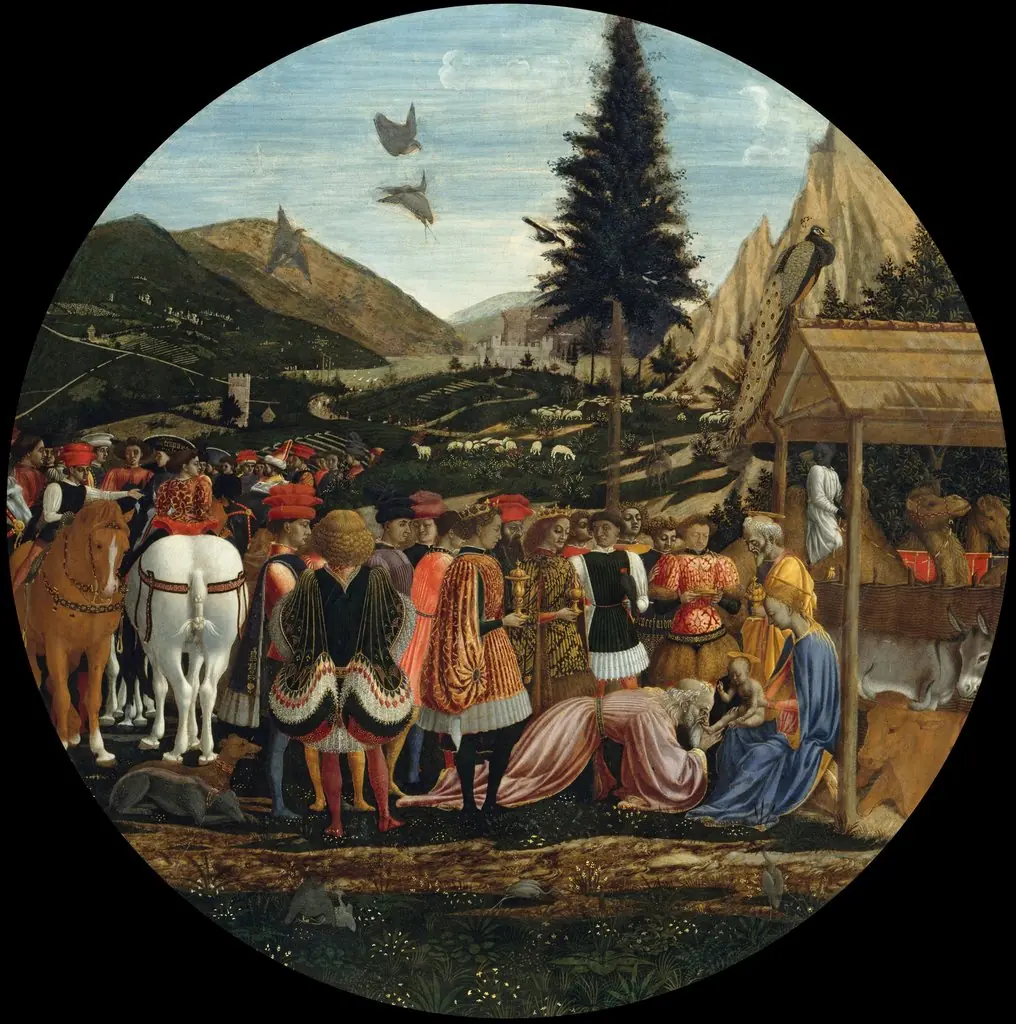
- St. John the Baptist in the Wilderness
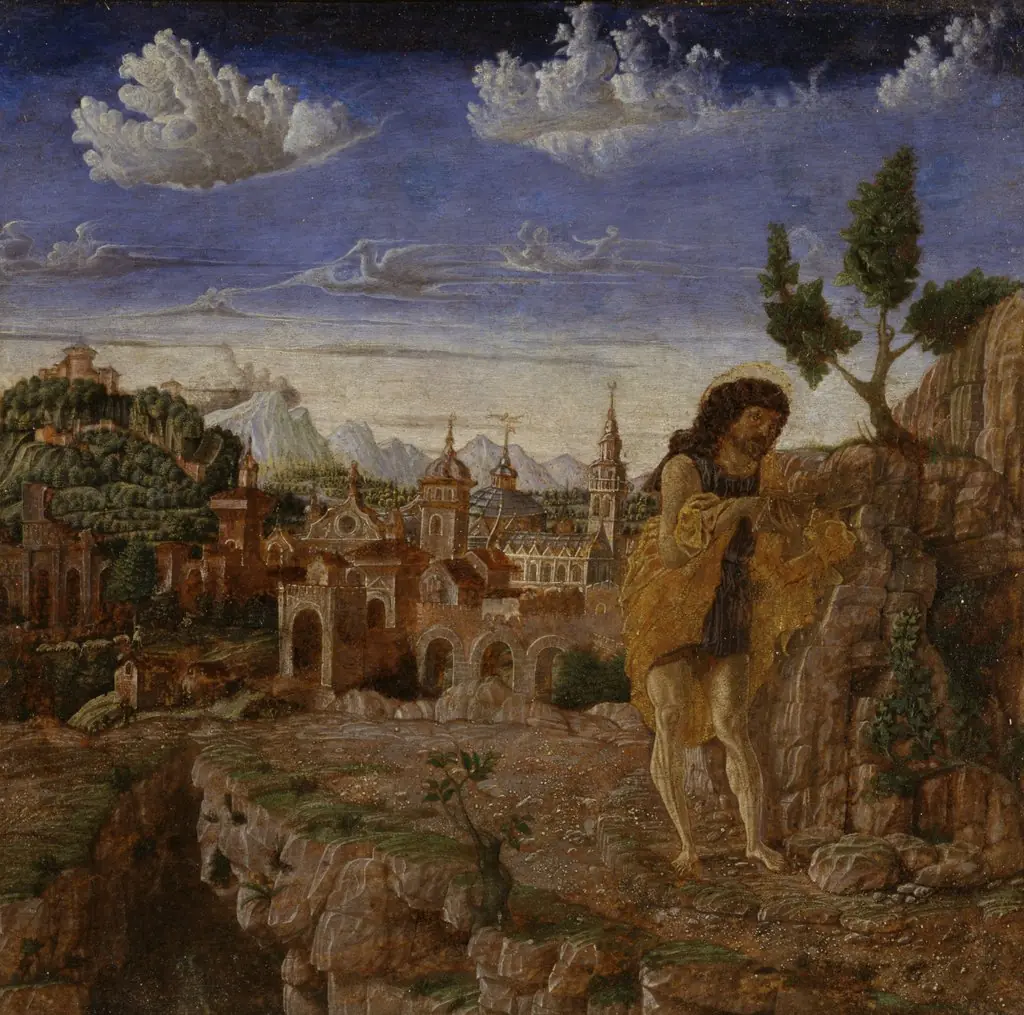 Saint John the Baptist in a Landscape
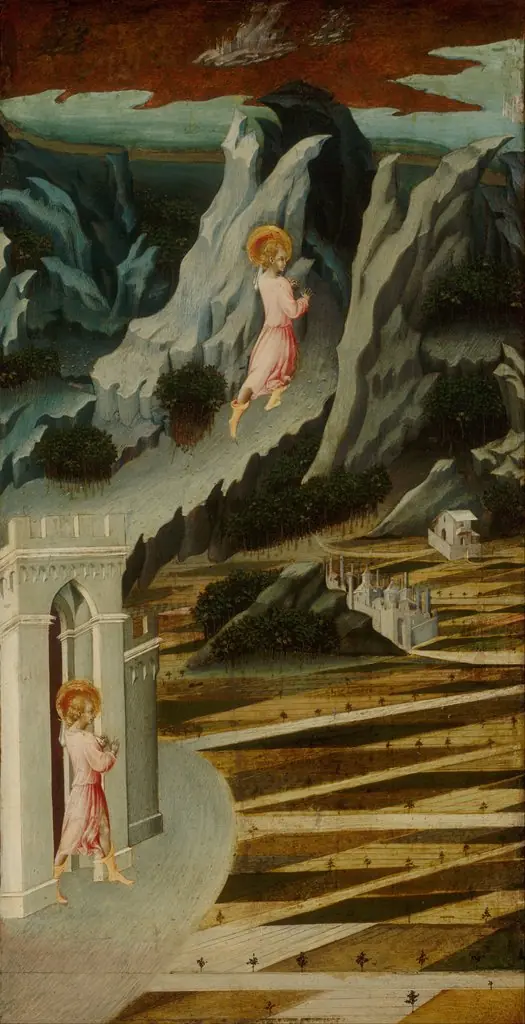 Saint John the Baptist Entering the Wilderness
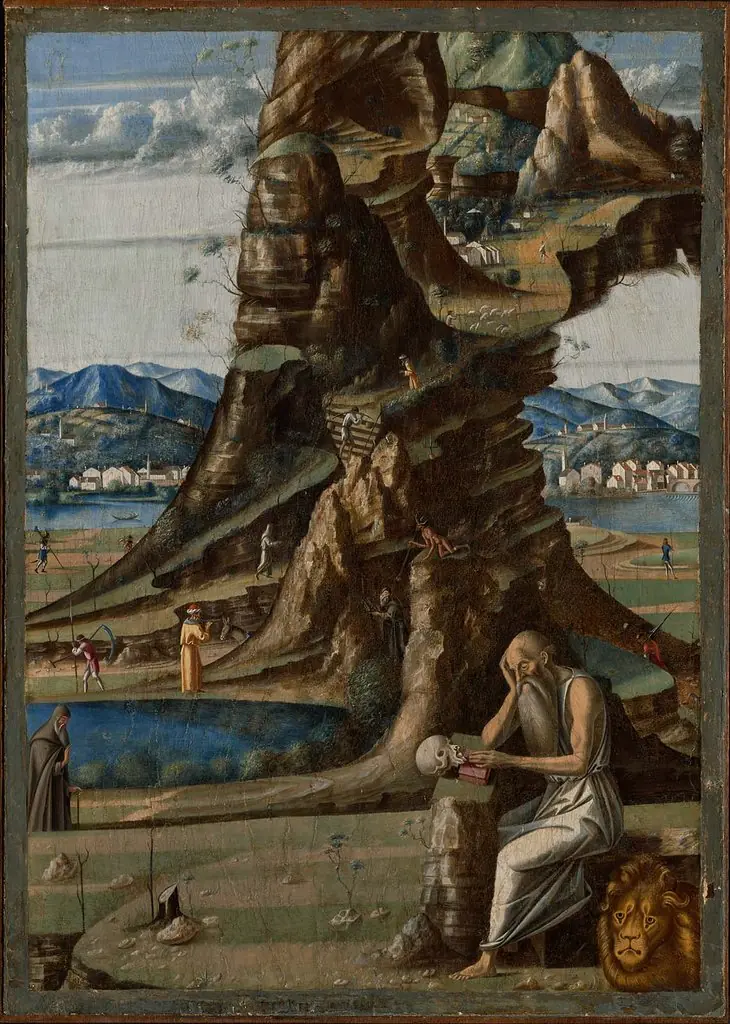 Saint Jerome in the Wilderness
 Saint John the Baptist Entering the Wilderness
 Landscape with Bathsheba
 Ariadne on Naxos
 The Meeting of the Young Christ and the Young St. John
 Landscape with biblical scenes and scenes from the legends of saints
 The Baptism of Christ
 Saint Jerome Reading
 Saint Jerome Reading in the Desert