Artwork
Saint Lucy
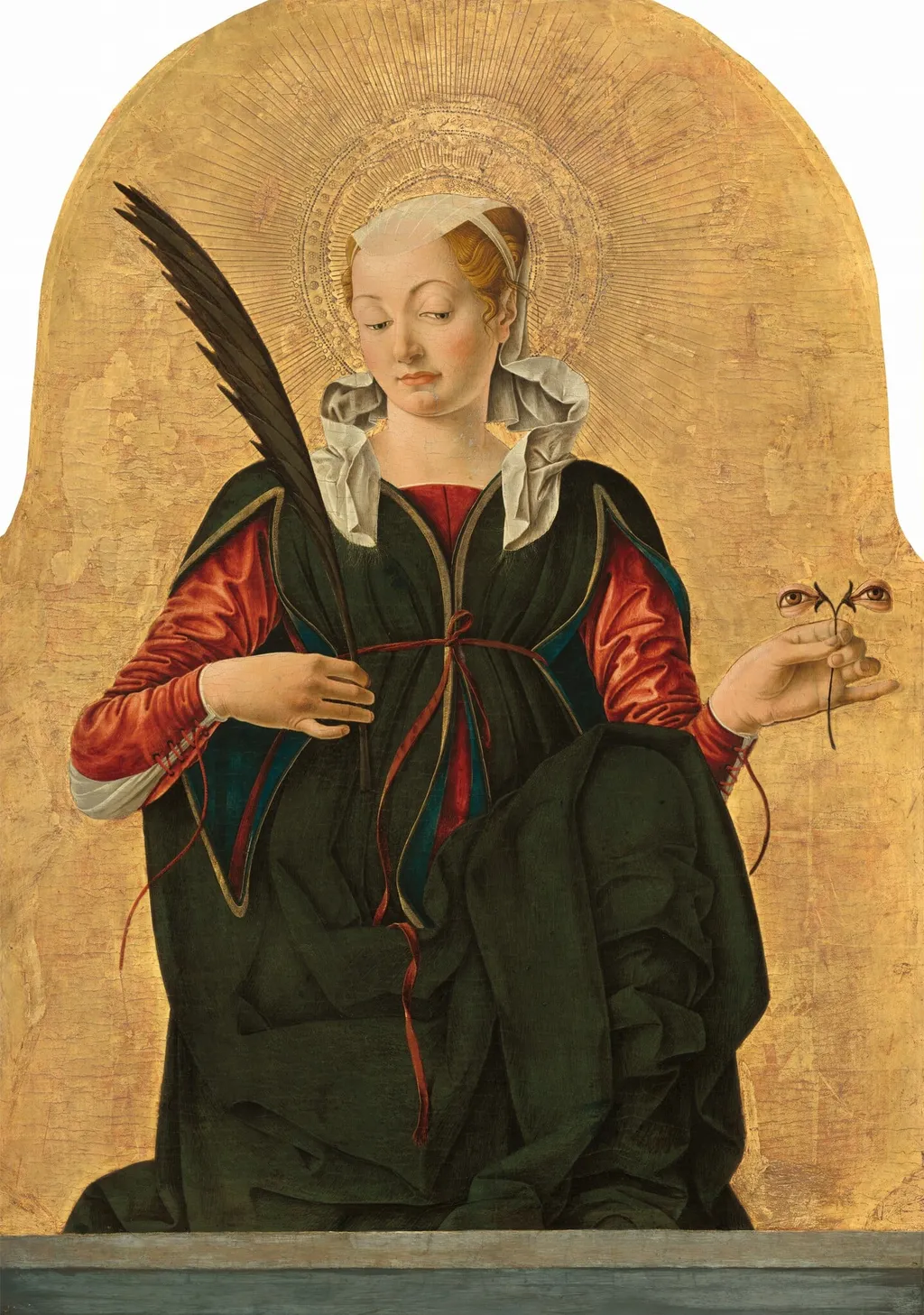
Saint Lucy is a tempera painting by the Early Renaissance artist Francesco del Cossa. It dates from 1474 and is held in the collection of the National Gallery of Art.
About this work
A slender stem sprouting two eyes rises from Saint Lucy's hand in Francesco del Cossa's panel, painted around 1473 for the Griffoni chapel in Bologna's San Petronio. Instead of the usual platter, her attribute becomes a flowering plant held beside a palm frond. The tempera panel once belonged to the Griffoni Polyptych, dismantled in the eighteenth century and scattered across Europe.
Subject & Meaning
As a panel of the Griffoni Altarpiece, Saint Lucy is placed in a paradisiacal loggia, gazing toward the central scene of the polyptych.
The painting depicts Saint Lucy, a virgin martyr, standing with one foot raised on a stone parapet. She holds a palm branch, symbolizing her martyrdom, and wears a coif and dress, with a gold aureola and halo signifying her sanctity. A notable iconographic detail is the metaphorical treatment of her eyes as two buds emerging from a stem, alluding to her legend of eye-gouging and subsequent restored sight.
As a panel of the Griffoni Altarpiece, Saint Lucy is placed in a paradisiacal loggia, gazing toward the central scene of the polyptych. This positioning underscores her role as an intercessor and witness to the sacred narrative, inviting contemplation of her sacrifice and place within the divine hierarchy.
Technique & Style
The painting is executed in egg tempera and gold on a poplar panel (approximately 79 × 56 cm). The saint stands on a stone parapet before a burnished gold ground, a device that places her in a celestial loggia overlooking the central panel of the polyptych. Del Cossa’s handling combines Piero della Francesca’s solemn, monumental figural style with the softer, naturalistic modeling typical of the Ferrarese school.
The saint’s right hand displays a delicate, raised little finger, while the fabric at her neck folds in crisp, animated patterns reminiscent of Cosmè Tura. The palm branch and direct gaze reinforce the figure’s serene dignity.
History & Provenance
Commissioned by Floriano Griffoni for a family chapel in the church of San Petronio, Bologna, the altarpiece was executed around 1472–1473 by Francesco del Cossa with contributions from Ercole de' Roberti. It remained in the chapel until approximately 1725–1731, when it was dismounted and entered the art market. By 1858 the panel was owned by Count Ugo Beni of Gubbio; it was purchased in 1881 or at the Beni sale in April 1882 by Joseph Spiridon of Paris.
Spiridon's collection was sold in Berlin in 1929, and the work passed to Duveen Brothers, who sold it in May 1936 to the Samuel H. Kress Foundation. The foundation gifted the painting to the National Gallery of Art, Washington, in 1939.
The painting is held by the National Gallery of Art, Washington, D.C., as part of the Samuel H. Kress Collection. It was a gift from the Kress Foundation to the museum in 1939. No inventory number is specified in the sources, and a detailed exhibition history beyond its documented provenance (e.g., Beni, Spiridon, Duveen) is not provided.
Context
The Saint Lucy panel formed part of the Griffoni Polyptych, commissioned by the Griffoni family for San Petronio in Bologna around 1472–73, a collaborative work by Francesco del Cossa and the younger Ercole de' Roberti. Its critical reception began with Giorgio Vasari, who in his Lives (1550, 1568) noted the altarpiece and praised the predella as of higher quality than the main panels. The polyptych was dismantled in the 18th century, and its panels were dispersed.
A watershed in modern scholarship was Roberto Longhi’s 1935 essay Officina ferrarese, which virtually reconstructed the polyptych. Longhi’s work re-established Cossa’s central role in the Ferrarese school and situated this painting within the broader Quattrocento context, highlighting influences from Piero della Francesca and Cosmè Tura.
Legacy
The work's legacy was solidified by Roberto Longhi's 1935 virtual reconstruction of the Griffoni Polyptych in his seminal essay Officina ferrarese, which re-established the original arrangement of the dispersed panels. After the altarpiece was dismantled in the early 18th century and the Saint Lucy panel passed through private collections, it was acquired by the Samuel H. Kress Foundation in 1936 and gifted to the National Gallery of Art in 1939. Its permanent home in Washington, D.C., as part of the Kress Collection, has ensured sustained scholarly attention and public visibility, cementing its importance within Ferrarese Renaissance painting.
Overview
Francesco del Cossa's painting, Saint Lucy, created around 1473-1474, is a tempera on poplar panel. This work was originally a component of the Griffoni Polyptych, an altarpiece commissioned by Floriano Griffoni for his family's chapel within the church of San Petronio in Bologna. Measuring 77.2 by 56 centimeters, the panel likely occupied an upper side section of the larger ensemble. Today, it resides in the National Gallery of Art in Washington, D.C.
Own this work as a print
Artist & collection
Artist
Francesco del Cossa (c. 1430 – c. 1477) was an Italian Renaissance painter of the School of Ferrara, who after 1470 worked in Bologna. Cossa is best known for his frescoes, especially his collaboration with Cosimo Tura…







 Compared in the Renaissance Florence course