Artwork
The Pentecost
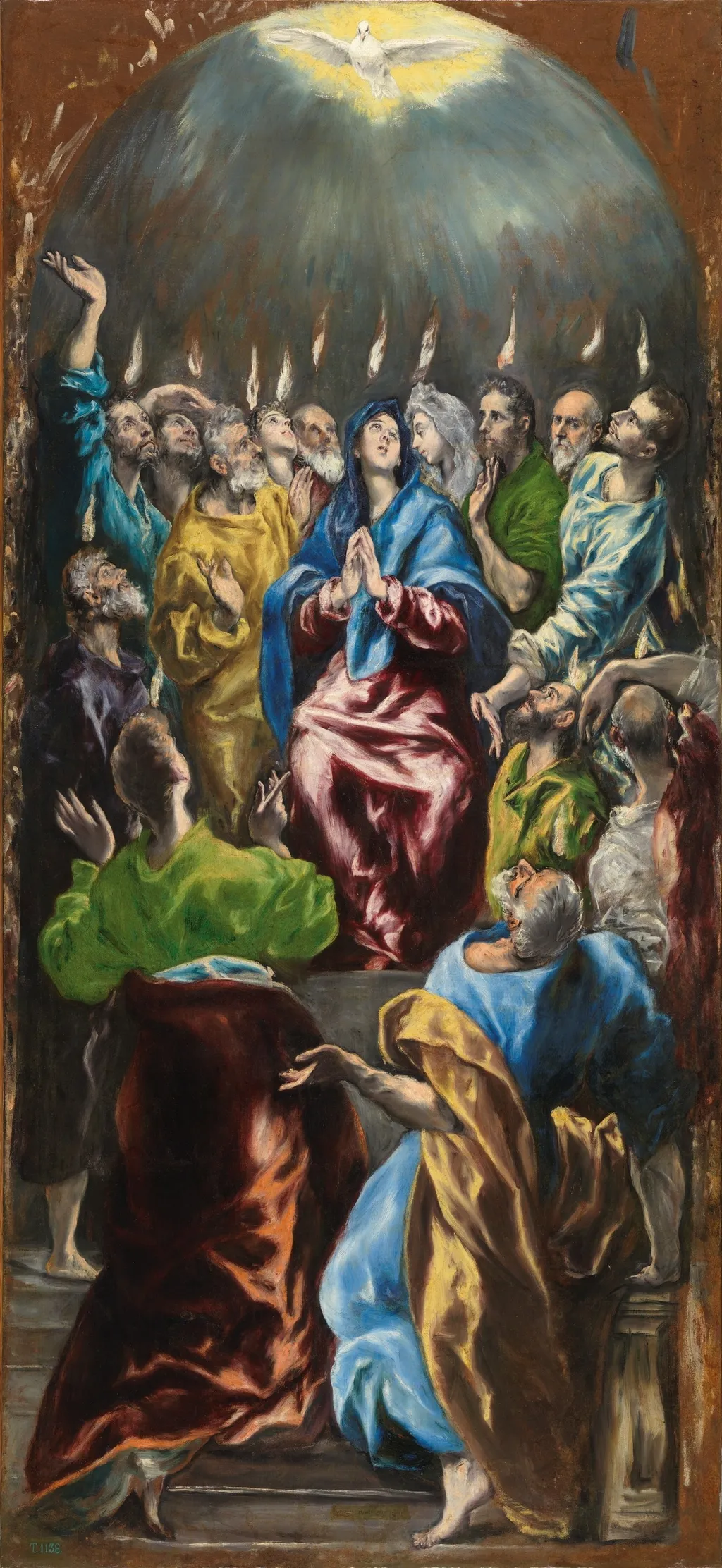
The Pentecost is an oil painting by the Mannerist artist El Greco. It dates from 1600 and is held in the collection of the Museo del Prado.
About this work
Subject & Meaning
The painting depicts the Pentecost, the biblical event described in the Acts of the Apostles in which the Holy Spirit descends upon the apostles.
The painting depicts the Pentecost, the biblical event described in the Acts of the Apostles in which the Holy Spirit descends upon the apostles. El Greco organizes the composition around an inverted triangle, centering the Virgin Mary, Mary Magdalene, and the apostles in a circular arrangement that compresses the pictorial space. The inclusion of Mary Magdalene alongside the Virgin reflects the tradition that the apostles were gathered in the house of the holy women at the time of the event.
At the upper edge of the scene, the dove of the Holy Spirit radiates a divine light that illuminates the figures and their garments below. In the foreground, two apostles shown from behind react convulsively to the appearance of tongues of fire, while others raise their arms or extend their hands in gestures of faith and astonishment. El Greco emphasizes psychological diversity through individualized gestures that carry both structural and symbolic weight, departing from classical canons of beauty with elongated figures and a flattened sense of perspective.
Technique & Style
The Pentecost is an oil painting on canvas measuring 275 by 127 centimeters, created by El Greco between 1597 and 1600 for the upper portion of the altarpiece commissioned by the Colegio de Doña María de Aragón in Toledo. The work depicts the moment of Pentecost, showing the Virgin Mary, Mary Magdalene, and the apostles gathered in a composition organized around an inverted triangle, with the Holy Spirit represented by a dove emitting light that illuminates the scene. El Greco arranges the figures in elongated forms that depart from classical ideals of beauty, lacking marked perspective but employing strong tonal contrasts influenced by Tintoretto and Michelangelo. The painting is housed in the Museo del Prado in Madrid, where it has been part of the collection since 1872 following a series of transfers from its original religious context.
History & Provenance
The Pentecost was commissioned in 1596 by the Council of Castile for the retable of the chapel of Doña María de Aragón, a seminary of Augustinian canons in Madrid. El Greco received the commission through the mediation of the council and was paid 63,000 reals, the highest sum ever paid for one of his works. The painting was executed between 1597 and 1600, likely in Toledo, and was intended for the upper part of the altarpiece. Contemporary documents indicate the work took three years to complete. After its creation the canvas remained in the Colegio de Doña María de Aragón until 1813, then passed to the church of San Felipe el Real and the Casa de la Inquisición, later to the Real Academia de Bellas Artes de San Fernando, and finally entered the Museo de la Trinidad in 1838 before being acquired by the Museo del Prado. The Pentecost is held at the Museo del Prado in Madrid, where it is displayed in one of the museum's galleries. The painting is catalogued as Wethey no. 100 and Tiziana Frati no. 146-a, and is recorded as an oil on canvas measuring 275 × 127 cm, dated by the Prado to circa 1600. Its documented provenance traces from the Colegio de doña María de Aragón in Madrid (1600-1813), to the Church of San Felipe el Real and the Casa de la Inquisición (1813-1835), then to the Real Academia de Bellas Artes de San Fernando (1835-1838), and finally to the Museo de la Trinidad (1838-1872), from which it entered the Prado's holdings. No temporary loan exhibitions are recorded in the available sources.
Context
Scholarship notes El Greco’s Pentecost as a late Mannerist work, executed between 1597 and 1600 for the upper tier of the retable in the Colegio de Doña María de Aragón, Toledo, commissioned by the Castilian Council and patronized by María de Aragón. The painting’s inverted-triangle composition and elongated, psychologically charged figures reflect El Greco’s assimilation of Tintoretto and Michelangelo, with a compressed, luminous space centered on the dove of the Holy Spirit. Critical discussions emphasize its expressive force over classical proportion, situating it within the artist’s mature Toledo period and linking it stylistically to contemporaneous works such as The Resurrection of Christ from the same retable project. Its later provenance, from the Colegio to the Museo de la Trinidad and finally the Museo del Prado, has framed its reception as a canonical example of Spanish Mannerism, anchoring El Greco’s place in art history beyond Venetian and Roman traditions.
Artist & collection
Artist
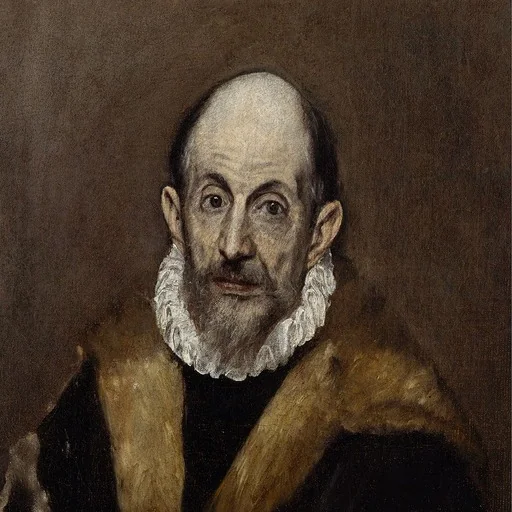
Doménikos Theotokópoulos was born in 1541 in Candia (modern Heraklion), the capital of Venetian-ruled Crete, where he was trained in the post-Byzantine tradition of icon painting.