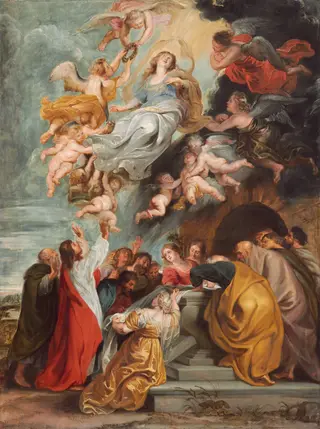
Artwork
The Assumption of the Virgin
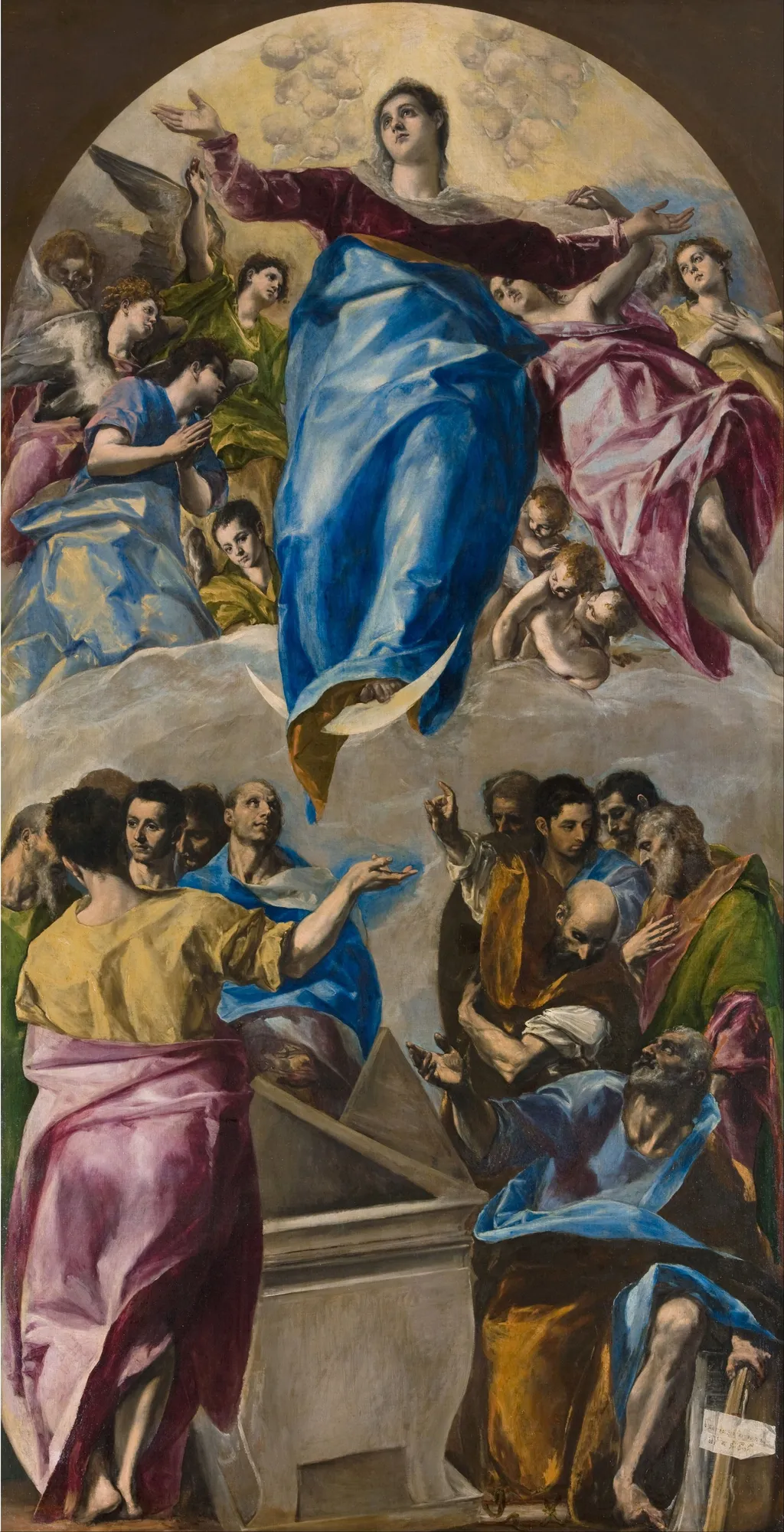
The Assumption of the Virgin is an oil painting by the Mannerist artist El Greco. It dates from 1589 and is held in the collection of the Art Institute of Chicago.
About this work
The Assumption of the Virgin is an oil painting by El Greco, made around 1577. It was the first of nine works he did for the church of Santo Domingo el Antiguo in Toledo.
The piece shows the Virgin rising with angels, echoing a similar scene by Titian. El Greco was influenced by Michelangelo, using a naturalistic style and a Roman palette.
You can see more at the Art Institute of Chicago.
Overview
The Assumption of the Virgin is an oil on canvas painting by Doménikos Theotokópoulos, known as El Greco, executed in 1577.
The Assumption of the Virgin is an oil on canvas painting by Doménikos Theotokópoulos, known as El Greco, executed in 1577. Measuring 403.2 by 211.8 centimeters, it is the first work the artist produced in Toledo, Spain, where he would remain for the next 37 years. The painting is currently held by the Art Institute of Chicago, having been acquired in 1906. It is the only known work from El Greco's Spanish period that is both signed and dated, with the artist's signature and the date 1577 inscribed in Greek cursive on a small paper visible in the lower right corner. As the central panel of the altarpiece for the church of Santo Domingo el Antiguo in Toledo, it inaugurated the most significant phase of El Greco's career and established the visual language that would define his mature work.
Subject & Meaning
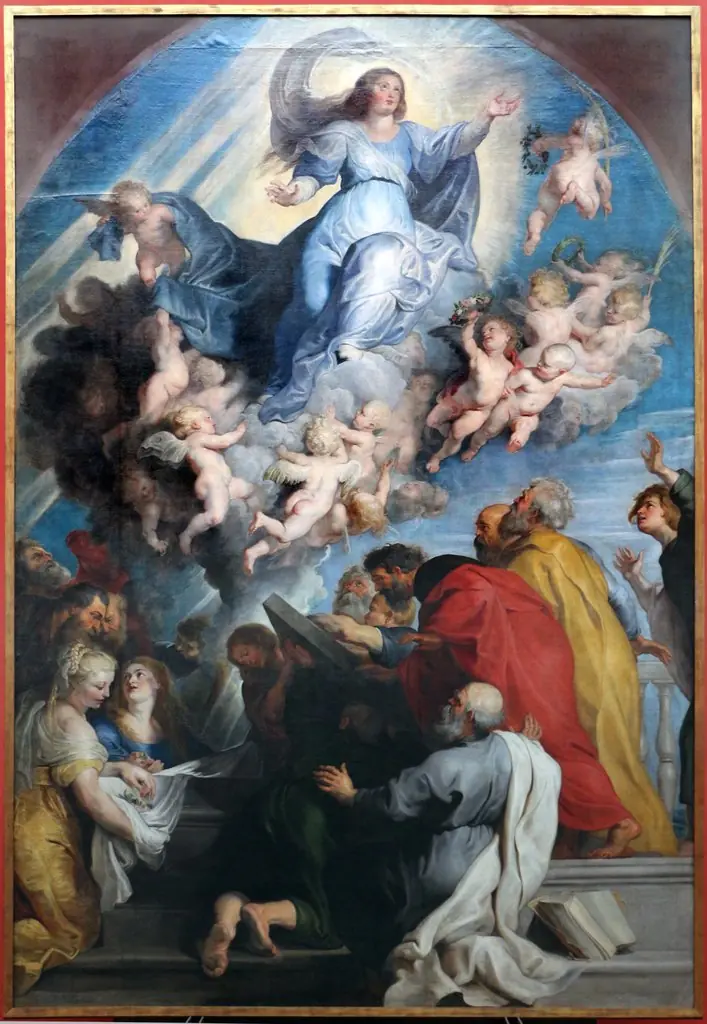
The painting depicts the Assumption of the Virgin Mary, a subject drawn from apocryphal literature of the 3rd and 4th centuries rather than the New Testament. By the 12th century it had become a popular theme in Western Christian art, promoted especially by the Cistercian Order and Saint Bernard of Clairvaux. El Greco divides the composition into two zones: above, the Virgin ascends with arms outstretched, supported by a crescent moon and surrounded by angels amid luminous clouds; below, the apostles gather around her empty stone sarcophagus, their bodies twisted in gestures of amazement and concern. The Virgin's grave expression and open arms indicate her role as co-redemptrix of humanity, while her upward float symbolizes purity. Specific figures include Saint James the Greater kneeling at right, Saint Paul with raised right arm in dark golden-brown robes, Saint Peter in blue-gray and yellow, and the young Saint John the Evangelist at left with his characteristic open-handed gesture toward heaven, a motif El Greco would reuse to signify divine presence. The scene's emotional range and the apostles' lack of direct interaction, linked instead through aesthetic rather than human connection, reflect the artist's distinctive approach to sacred narrative.
Technique & Style
The Assumption of the Virgin is painted in oil on canvas, with a technical investigation revealing that strips of canvas approximately 15 centimeters wide were added to each side. The composition features a rounded arch at top with dark spandrels, and the surface exhibits a polished finish alongside areas of thin, sketch-like application. The palette is dominated by saturated blues, crimsons, and golden yellows against pale gray clouds, with the terrestrial zone displaying intense greens and the celestial zone employing more delicate colors. El Greco's brushwork is loose and expressive, with visible energetic strokes, elongated proportions, and dramatic foreshortening that emphasize movement and spiritual ecstasy over naturalistic detail. The technique and generous use of white highlights derive from Titian and the Venetian school, while the agitated figures and compressed spatial depth show Mannerist tendencies. Scholars have noted the horror vacui in the composition, with maximum figures and minimal empty space, and the use of live models for both angels and apostles, rendered with a rich variety of attitudes, foreshortenings, and inflections. The lower figures are larger than life-size, perhaps reflecting a desire for typological vividness rather than natural scale.
History & Provenance
The painting was commissioned in 1577 by Don Diego de Castilla for the church of the convent of Santo Domingo el Antiguo in Toledo, where it served as the central element of the main altarpiece. It remained in the church for over two centuries until around 1830, when it was sold to Infante Don Sebastián Gabriel de Borbón y Braganza in Madrid and replaced by a copy executed by the neoclassical painter José Aparicio. In 1835 the Spanish government confiscated the work and installed it in the Museo Nacional de Trinidad in Madrid, but it was returned to Don Sebastián in 1861. Following his death in 1875, his heirs began dispersing the collection; the painting passed to his widow, Infanta María Cristina de Borbón, until her death in 1902. It was then lent to the Museo del Prado from 1902 to 1904. In 1904 the American painter Mary Cassatt persuaded the Parisian dealer Paul Durand-Ruel to purchase the work, with financing from H. O. Havemeyer. The Art Institute of Chicago acquired it in 1906. The painting has been exhibited at the Salons of the former Asile de Pau in September 1876; at the Museo Nacional de Pintura y Escultura in Madrid in 1902; at the Art Institute of Chicago for A Century of Progress in 1933 and 1934; at the Grand Palais in Paris for the Greco exhibition of 2019-2020; and at the Art Institute again for El Greco: Ambition and Defiance in 2020.
Context
The Assumption of the Virgin marks El Greco's arrival in Toledo and the beginning of his 37-year career in Spain. At this early stage, he remained deeply influenced by his Italian training, particularly under Michelangelo, and the work has been described as essentially Italian in character, with naturalistic style, monumental figures, and a Roman school palette. The composition most closely resembles Titian's Assumption in the Basilica dei Frari in Venice, sharing its helical movement of the Virgin and the bipartite division between celestial and terrestrial realms. However, scholars caution that Titian's work functions more as antecedent than direct model, with the relationship limited primarily to these structural elements. The painting was the first of nine commissions El Greco executed for Santo Domingo el Antiguo, establishing the pattern of major altarpiece commissions that would sustain his career. Harold Wethey, the specialist in El Greco's oeuvre, catalogued it as number 1 in his raisonné. The work occupies a pivotal position in art history as the bridge between the artist's Italian formation and his distinctive Spanish manner, demonstrating how El Greco synthesized Venetian color, Michelangelesque monumentality, and his own emerging spiritual intensity into a coherent and influential visual language.
Legacy
The Assumption of the Virgin holds foundational importance in El Greco's legacy as the inaugural work of his Spanish period and the catalyst for his enduring association with Toledo. Its acquisition by the Art Institute of Chicago in 1906 represents a significant moment in the international recognition of Spanish painting, facilitated by the convergence of American collecting ambition, dealer expertise, and artist advocacy through Mary Cassatt's intervention. The painting's presence in Chicago has made it a cornerstone of the museum's Old Master holdings and a regular feature in major exhibitions, including the 2020 El Greco: Ambition and Defiance. Within El Greco's own development, the work established compositional and iconographic solutions, such as the open-handed gesture of Saint John and the expressive treatment of apostles' faces, that the artist would revisit and refine throughout his career. The painting also exemplifies the broader cultural function of the Assumption subject in post-Reformation Catholic art, serving as an assertion of doctrinal positions rejected by Protestantism. Its survival and prominence in an American museum collection underscore the global redistribution of European artistic patrimony in the late 19th and early 20th centuries.
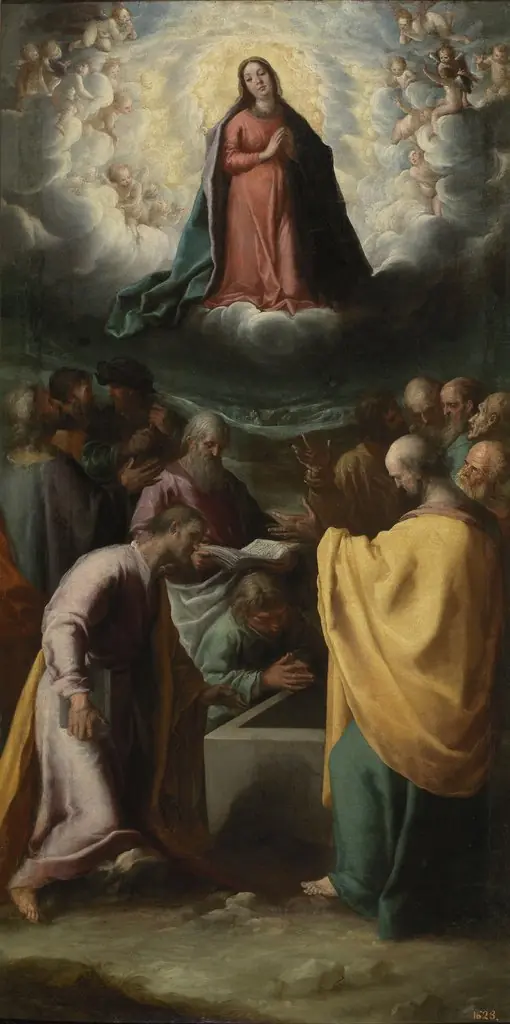
Artist & collection
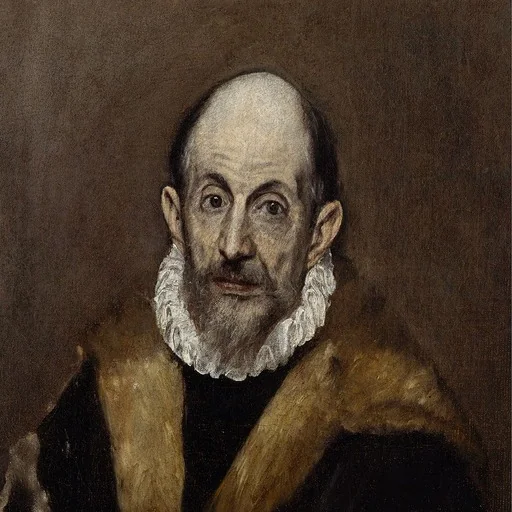
Artist
Doménikos Theotokópoulos was born in 1541 in Candia (modern Heraklion), the capital of Venetian-ruled Crete, where he was trained in the post-Byzantine tradition of icon painting.